Showing posts with label camps. Show all posts

Wednesday, April 6, 2011

Review - Terezin: Voices from the Holocaust

Terezin: Voices from the Holocaust
by Ruth Thomson
Candlewick Press 2011
Rating: Recommend* grades 5 and up

Review by Marie-Anne Harkness

Middle School and high school students studying the Holocaust will find this book enlightening to understand daily life in the Nazi’s showcase transit camp using diary entries, photographs, drawings and paintings throughout. Terezin was a fortified city in northern Czech Republic, transformed into the Theresienstadt Transit Camp in Oct. 1941 by the Nazis during World War II..

The privileged Jews deported from all over Europe were told they were going to a spa-like Ghetto for artists, intellectuals and the wealthy. It was to be a holding camp where none would be harmed. Allowed to pack only 2 suitcases, they were forced to sign away their homes and furniture to be redistributed to Germans. They packed their suitcases with their nicest clothes, and belongings only to have them confiscated immediately upon arrival.

The reality was that the people were on their way on regular transports to the gas chambers of Auschwitz, if they had not died from starvation and disease at Theresienstadt.
Through documentation secretly recorded by artists, writers and diaries of children and adults, the reader experiences the true heartbreak of the camp.

When Jews from Denmark were deported to the “Spa” at Terezin in April 1943, the King of Denmark sent a delegation from the Danish Red Cross to inspect the living conditions of the Danish Jews. A sham “family camp” was erected on a carefully laid out route just before the delegation arrived. They did not see the real camp for what it was, only cafĂ©’s, schools, theatre, neatly planted gardens and freshly painted houses as they were escorted by SS officers. The deception worked because the delegation reported back to the King that the Danish Jews were being well treated.

The layout of the book is attractive, including sidebars that expand on the text, index, glossary and a very interesting timeline. The material is well documented with source notes. A useful primary source website is listed: http://www.azrielifoundation.org/memoirs/.

Tuesday, February 22, 2011

Trial Continues for Demjanjuk, Accused Sobibor Guard

Accused Sobibor guard still on trial. Thomas Blatt, long-time Seattle resident and one of only 53 survivors of Sobibor, testified earlier in the trial against Demjanjuk.

Demjanjuk threatens hunger strike in Holocaust trial

Monday, January 31, 2011

Magda S., Holocaust Survivor, at Meridian Middle School


Meridian Middle School Honors International Holocaust Remembrance Day

In education, studying primary source documents is often a valuable tool. Meridian’s eighth-graders had an opportunity to hear from the ultimate primary source, a living witness to the Holocaust, as part of their language arts literature study. Mrs. Magda Schaloum, an eighty-eight year old Hungarian survivor of the Holocaust spoke to students sharing her story of deportation from her Hungarian village, life in Auschwitz and the Plaszow work camp in Poland, a weapons factory in Germany, and finally liberation from Muhldorf, another concentration camp in Germany at the end of World War II.


January 27th marks the anniversary of the liberation of Auschwitz-Birkenau, the largest Nazi death camp, in 1945. Listening to Mrs. Schaloum share her survival story was a powerful way for the students to honor the memories of the more than 6,000,000 Jewish people, Gypsies, Jehovah’s Witnesses, the mentally and physically handicapped, and homosexuals who lost their lives under the Nazi regime from 1933-1945.

Students honored Mrs. Schaloum with flowers and their undivided attention as she told of her moving experiences losing her father, mother, and brother. She told of her personal humiliation, brutal beatings, starvation diet, deprivation, and fear under the horrors of the Nazis. On the tender and sweet side, she shared about the meeting of her husband, a Greek Holocaust survivor, in a displaced persons camp shortly after the end of the war. Mrs. Schaloum began telling her survival story about twenty years ago when many were denying the Holocaust altogether. She knew she had to speak out and make sure the world never forgets.

At the closing of her visit to Meridian Middle School, Mrs. Schaloum was in tears as she said good-bye to the students and shared how much she had been blessed by them as an audience with their gifts of flowers and honor of her. She told the students she had never been treated so well and felt so loved in all of her years of visiting schools. She closed telling them she loved them all and challenged them to never let anyone put them down or allow them to believe they were not valuable and important.

Meridian eighth-graders in Miss Do’s and Mrs. Carlson’s classes have been doing a literature study of the Holocaust in preparation for reading The Diary of Anne Frank, a piece of literature commonly read by eighth-graders nationally. They have been reading about the survivors, rescuers, and resistors involved in life in the Jewish ghettos, concentration camps, and how many were hidden and protected from the Nazi atrocities. Both teachers share a passion for encouraging students to become contributing citizens of the world, honoring and valuing all human life. Studying the Holocaust is a way to learn from the past, honor those whose lives were stolen from them, and look to the future with eyes of tolerance and acceptance. Students are challenged to consider and make personal commitments to change patterns of bullying, harassment, and hatred of other human beings.

The Washington State Holocaust Education Resource Center provides teaching trunks, with many primary source materials, literature units, posters, and other resources for teaching the Holocaust and making the link to the present with anti-bullying campaigns and the prevention of future genocides. Meridian Middle School has adopted their theme of “Change Begins with Me” with a huge, beautiful new wall hanging in the eighth grade pod, created by Mr. Bogle. The WSHERC also maintains a list of local Holocaust survivors who are willing to visit schools and other groups to share their own personal stories. Magda Schaloum is part of this local speakers bureau.

Wednesday, January 5, 2011

"Every year is a great year" says local survivor


While many this time of year recall personal ups and downs in 2010, and hold renewed hopes for 2011, West Seattle's Hermine Berner, 91, believes her life is a miracle and, in recent history, each of her years has passed with much optimism.


"People ask me, 'What's your secret?' " said Berner, referring to her sharp and active mind and body. "Why do they ask? You think I look young? You think that's a secret?" she said with a sample of her sarcastic wit.


Berner, who lives near Alki, does have secret of another sort, one she speaks about when gently persuaded. She is a Holocaust survivor who was shipped to Auschwitz, the notorious concentration camp in German-occupied Poland, while visiting Budapest, Hungary with her father. Their home was in Prague, Czechoslovakia. Read full article...


Wednesday, December 22, 2010

From the news

US urged to extradite ex-Nazi suspect to Serbia
Dec. 22 - Associated Press. Forbes.com.
Former Nazi in Seattle area. He and his unit are accused of murdering over 17,000 Jews in Serbia.

Yad Vashem has compiled list of over 4 million names of Holocaust victims
Dec. 22 - By Nir Hasson. Haaretz.com.
Authority in Jerusalem says more than 1.5 million names were added to the archives in the last decade.

Controversial genocide resolution may hit floor of House in final days
Dec. 19 - By Bridget Johnson. The Hill's Blog Briefing Room
Schools across the country recognize the Armenian genocide and teach about it as such - when will Congress finally address it appropriately?

Center will tell Cambodian story
Dec. 17 - Greg Mellan, Press-Telegram
New Khmer Genocide Study and Resource Center in California

Thursday, November 11, 2010

Veterans' Day - Holocaust Survivor & US Soldier on KIRO


Holocaust survivor and US soldier remember liberation

To commemorate Veteran's Day, KIRO radio interviewed Holocaust survivor and speaker Magda Schaloum and WWII Veteran and liberator Ralph Dicecco:

"It's Veteran's Day, a day we remember what members of our armed services have done to make us free. Two Seattle area residents can never forget..."

Click here to listen to or read this short, moving interview, which aired this morning.

Wednesday, November 3, 2010

Working in a Trap: Drawings from the Theresienstadt Ghetto 1941-1942


Paraphrased from a discussion with Susie S., local Holocaust survivor and member of the Holocaust Center's Speaker's Bureau:


My cousin, Ruth Perry, is about my age and lives in Ramat Gan, Israel. Other than my sister and I, she is the only remaining direct relative of our generation. Ruth comes to visit us now and then ... recently she spoke of some very special pictures that her family and others in Israel were trying to put together for a limited printing. She said that these paintings were to honor an important Jewish "Elder" of Terezin. My own dear family, on my mother and father's side, was dragged to Terezin in 1942. I thought that I knew the names of the "Elders of the Jews" in Terezin, but the name she used was not familiar to me and I became curious. As it turns out, I did not understand the Hebrew version of Jacob Edelstein's name. Edelstein was an influential leader chosen and used by the Germans to aid in carrying out their horrible plans.

There has been much written about the "Jewish Elders," those people who had to pass down the edicts of the Germans. The Nazis tried to turn the inmates against the Elders and were successful in some instances. While many writings are critical of some of the elders, this album shows that Edelstein had a good, courageous heart and did the best he could.

My cousin, Ruth, was a friend of "Dittle." As it turns out, "Dittle" was Dr. Edith Ornstein, one of the creators and signatories of the album. Ruth told me of a time when Dittle had to sit on the paintings when Adolf Eichmann came into her living area. The paintings, by Leo Haas, were presented to Jacob Edelstein on the occasion of the first anniversary of the Nazi-established ghetto.

The timetable of Theresienstadt and the Final Solution is so organized and easy to read that one can get a clear understanding of the timetable behind the horrific main events from 1933 to 1945. The pictures and writings in the album record the efforts of the labor center and serve as an empowering and sensitive text, giving a new and deeper understanding of the Holocaust. In particular, it gives me a newer understanding and feeling of the horror that was Terezin. The album also gives information on the German use of propaganda using the "Jewish Town."


This album shows the positive relationship that Edelstein had with his staff, who recognized his efforts as leader towards helping those inmates of Terezin as much as he could. I am honored on behalf of my family to loan this very special and poignant album to the Center for one year.

Monday, November 1, 2010

An American's Diary of the Concentration Camp Experience


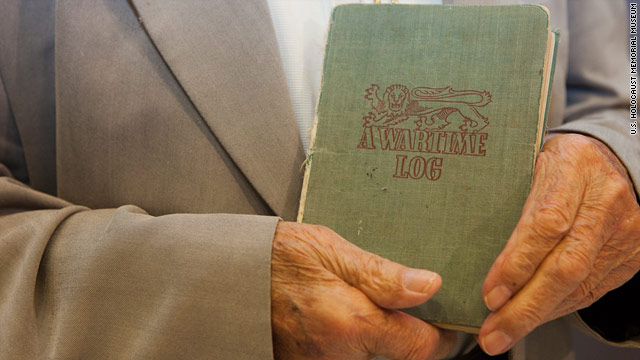
350 American soldiers were captured by the Nazis and sent to the concentration camp Berga in Feb. 1945. They endured terrible conditions, starvation, abuse and finally a death march in April 1945. One of the survivors donated his diary to the USHMM this past month.


'You don't forget': Medic's Holocaust diary tells story of hell
By Wayne Drash, CNN
October 28, 2010

Washington (CNN) -- The tattered journal, its pages yellow with age, contains the painful memories of a U.S. medic, a man who recorded the deaths of soldiers who survived one of World War II's bloodiest battles yet met their end as slaves in Nazi Germany.

32. Hamilton 4-5-45
33. Young 4-5-45
34. Smith 4-9-45
35. Vogel 4-9-45
36. Wagner 4-9-45

"Some were dying," said its author, Tony Acevedo, now 86. "Some died, and I made a notation of that."

Flipping through the pages, you encounter a horrific part of world history through the eyes of a 20-year-old inside a slave labor camp. Amid the horror, the journal captures extraordinary human moments of war. Acevedo sketched beautiful women in the back pages, pinups whose eyes provided comfort amid hell.

Acevedo kept the diary hidden in his pants. He feared death if the commanders saw it. Yet he believed it was his duty as an Army medic to catalog the deaths and the atrocities against the 350 U.S. soldiers at the camp known as Berga, a subcamp of the notorious Buchenwald compound. Read full article...

Monday, October 4, 2010

The Man Who Sneaked Into Auschwitz

An unbelievable story. Pilecki voluntarily went to Auschwitz in order to reveal the truth about the camp. Story is also available in audio on NPR.


September 18, 2010
NPR Staff

This weekend marks the 70th anniversary of a World War II milestone few people have heard before. It's the story of a Polish army captain named Witold Pilecki.

In September 1940, Pilecki didn't know exactly what was going on in Auschwitz, but he knew someone had to find out. He would spend two and a half years in the prison camp, smuggling out word of the methods of execution and interrogation. He would eventually escape and author the first intelligence report on the camp.... Read more.

Monday, September 20, 2010

Kent Teacher, Debbie Carlson, Puts Emphasis on Social Justice

The Holocaust Center is so proud to be working with teachers like Debbie Carlson.

Spurred by Holocaust studies, Kent teacher puts emphasis on social justice in the classroom: Slide show of Holocaust sites

By LAURA PIERCE
Kent Reporter Editor
Sep 14 2010

It was the shoes on a riverbank that brought Debbie Carlson close to tears.

The Meridian Middle School teacher was on a trip to Eastern Europe this summer, and her tour group passed by a bronze sculpture of shoes, lined up on a riverbank. There were work shoes, children’s shoes, ladies’ shoes: a mixture of jobs, genders and ages.

The significance of the sculpture wasn’t lost on Carlson, who happened by this spot in the soft light of a summer day in Budapest, along the banks of Danube River with her tour group, while visiting sites of the Holocaust.

The shoes were the wordless reminder of the men, women and children whom the Nazis or their Hungarian counterparts lined up and shot along the riverbank. The bodies fell into the river, to be swept away by the current, their identities lost to their families and the world.

“When they were exterminating the Jews, they would line them up, and shoot them into the river,” Carlson says, of what she learned happened on that riverbank.

For Carlson, the sculpture was a consciousness-raising moment – one of many she experienced on the three-week trip... Read full article and see the slide show

Thursday, July 15, 2010

Terezin Reflections - Chapter 4

Terezin Reflections - Chapter 4
By Rachel Nathanson

From June 24 - July 4, 2010 the Holocaust Center, in partnership with Museum Without Walls, organized a Holocaust study trip to Budapest and Prague. Frieda S., a survivor from Terezin, and her daughter Dee (also the Co-Executive Director of the Holocaust Center) participated in the trip and shared the group invaluable first hand experiences. Eva, a survivor of Terezin who had been in the barracks with Frieda, met up with us. Below Rachel Nathanson, one of the Holocaust Center's board members and a participant on the trip, describes some of sites and shares her thoughts on the experience of visiting Terezin.


Although much has been recorded of the Terezin history, the flood of 2002 that ravaged much of Central Europe, gave rise to new discoveries. Due to the flood, a storage room within a private home’s yard was damaged by the almost five-foot high waters. All of the stored goods were then removed, leading to the discovery of what was clearly a hidden synagogue. This small room (about 15’ by 15’), with no windows, lost the inscriptions along the walls due to the floodwaters, but the ceiling painting remains. The prayers, written high along the walls, beg God to return from his anger. The remaining words of one damaged prayer now say, “If I forget thee…”


The Red Cross Visit
The Red Cross was allowed to visit Terezin to see what Hitler called “a city for the Jews”, a city he created to supposedly protect them from the horrors of war. The village area was spruced up and an illusion that this was a working, lovely town was made complete. Stores were filled with goods, bakeries overflowed with food, and the inmates carefully instructed on how to “play act” for these visiting outsiders. Children were given candy to hold but told not to eat it and upon a successful ruse for the Red Cross, the candy was cruelly stripped from their fingers by the guards.

A film, made by Jewish filmmakers within Terezin, shows the theatrically happy lives being lived by all the inmates. Playacting included a soccer game with cheering crowds, young women sharing their knitting projects, and other manufactured scenes. With the film complete, the filmmakers and many of those participating in the film were promptly sent to Auschwitz to eliminate their knowing complicity.

Survival
Frieda and Eva were blessed to have lived. Their survival was helped by so many small factors: the fact that as “mischlings” they were transported later and treated slightly better; that they were given the job of working the fields for the officers which allowed them to sneak a little food while in the fields and bring a few items back to the other girls; that they were strong and young – and determined.

Frieda tells the chilling story of so many girls getting shipped out on the trains and she wanted desperately to get out of Terezin. She managed to trade some things to get one of the “transport cards” for a train, not realizing she would be sealing her fate to leave for Auschwitz. The guard at the train saw her and noted that she reminded him of his own daughter. She begged to get on the train and he told her he would “break her legs” if she ever tried to get on the train again, and sent her back. What amount of guilt did this man have that he could choose just one girl, save just one soul?

Three months before the war was over, Frieda’s father, who was Jewish, and brother were also transported to Terezin. As the Soviet fighting came closer to Terezin in 1945, the Germans fled, destroying bridges and roads behind them. Frieda’s father did not hesitate. He stole a horse and cart and filled it with as many children as could fit and took them out of Terezin to Prague. What would normally take 12 hours, took 5 days.

When the Soviets reached Terezin, they had to quarantine the area due to the rampant outbreak of Typhus. Adding to the tragedy of this chapter of history, many of the remaining inmates died of typhoid fever, even though “liberated” from the camp.

I started this long account by saying I have a 15-year old daughter. I could not help but think of my own daughter when learning about Frieda and Eva’s experience (as only 2 of so many). How could I have handled her being taken from me at such a young age for several years? We learned that Frieda’s mother travelled many days to stand outside the fortress walls in hopes of catching a glimpse of her daughter, just to know that she was still alive. I stood with chills, thinking about her mother. I could be her mother.

In the end, the only thing I can do is bear witness to the story. Let this horrendous time in our history never be forgotten. I am ever so grateful for what I have.

Terezin Reflections - Chapter 3

Terezin Reflections - Chapter 3
By Rachel Nathanson


From June 24 - July 4, 2010 the Holocaust Center, in partnership with Museum Without Walls, organized a Holocaust study trip to Budapest and Prague. Frieda S., a survivor from Terezin, and her daughter Dee (also the Co-Executive Director of the Holocaust Center) participated in the trip and shared the group invaluable first hand experiences. Eva, a survivor of Terezin who had been in the barracks with Frieda, met up with us. Below Rachel Nathanson, one of the Holocaust Center's board members and a participant on the trip, describes some of sites and shares her thoughts on the experience of visiting Terezin.

Chapter 1
Chapter 2

Chapter 4


We stood before the building where Frieda and Eva’s teenage years were stolen, and their lives forever marked by this horrendous historical time. They pointed to the window of their once jail-like home, where they shared their small room with 30 or so others. Most of those “roommates” were shipped out over time, continually replaced with new faces, only to be shipped out again and again. So many of the teens they lived with were tragically transported to a place even darker in history: Auschwitz-Birkenau.

This photo (above) shows Frieda and Eva in front of their “barracks” during their internment.

A recreated room in the women’s living quarters:


Terezin is now freshly painted and beautifully planted with flowers. The newly spruced up town sadly belies its tragic history, from a visual perspective. Approximately 1,000 people returned to live in Terezin, but one wonders how they can bear to do so. Our guide, a young man trained in the vocation of being a Terezin tour guide admitted he could not imagine living within the walls of a town where such history took place.

Wednesday, July 14, 2010

Terezin Reflections - Chapter 2

Terezin Reflections - Chapter 2
By Rachel Nathanson


From June 24 - July 4, 2010 the Holocaust Center, in partnership with Museum Without Walls, organized a Holocaust study trip to Budapest and Prague. Frieda S., a survivor from Terezin, and her daughter Dee (also the Co-Executive Director of the Holocaust Center) participated in the trip and shared the group invaluable first hand experiences. Eva, a survivor of Terezin who had been in the barracks with Frieda, met up with us. Below Rachel Nathanson, one of the Holocaust Center's board members and a participant on the trip, describes some of sites and shares her thoughts on the experience of visiting Terezin.


The Ghetto
While Terezin was not a death camp, it was not without its own atrocities and death. The numbers vary throughout accounts, but around 140,000 people were deported to Terezin between 1941 and 1945, with an additional 15,000 arriving in the last days of the war. Of these, about 35,000 died in the ghetto itself, and about 88,000 were sent to Auschwitz and other extermination camps.

The town’s original inhabitants of about 5,000 people were forced to relocate by the Nazi party and were replaced over time by about 55,000 Jews. These overcrowding conditions lead to many deaths and unspeakable living conditions for all.

It is one thing to read accounts of the Holocaust, and quite another to stand on the hallowed ground of these historic sites. And to do so with two valiant survivors, two amazingly strong women, was a unique experience for me, one I am truly grateful for. Frieda and Eva, both from mixed-religion families, noted that they grew up in a time when religion was not critical to family structure. Many families of mixed-religion raised one child as a Jew and the next as a Catholic. All holidays were observed and national pride was more important than religion.

As mixed-religion children, “mischlings” as labeled by the Germans, Frieda and Eva were told to be on the transport to Terezin upon or near their 14th birthday. Frieda was the 175th person on her transport of 175, from Prague (Praha) on June 9, 1943 as documented on the wall of the Ghetto Museum today:


Terezin Reflections - Chapter 1. By Rachel Nathanson

Terezin Reflections - Chapter 1
July 2010
By Rachel Nathanson
From June 24 - July 4, 2010 the Holocaust Center, in partnership with Museum Without Walls, organized a Holocaust study trip to Budapest and Prague. Frieda S., a survivor from Terezin, and her daughter Dee (also the Co-Executive Director of the Holocaust Center) participated in the trip and shared the group invaluable first hand experiences. Eva, a survivor of Terezin who had been in the barracks with Frieda, met up with us. Below Rachel Nathanson, one of the Holocaust Center's board members and a participant on the trip, describes some of sites and shares her thoughts on the experience of visiting Terezin.
I have a 15-year old daughter. She is the age that Frieda and Eva were after spending the first of two years in a concentration work camp in Terezin, Czech Republic. But for a mere 50 years or so (a blink of an eye in the annals of historic time) and the serendipity of being born in America, this could have been my daughter’s experience.

Having been home now for a week, I am still processing all that I saw and learned while participating in a Holocaust educational trip to Hungary and the Czech Republic. It was a transformative experience, and an honor, to learn more about this tragic history from these two women who survived it. Here, I want to share what we saw in Terezin, on an all-too-brief visit on July 2, 2010.


The Fortress
Originally built by the Hapsburg Monarchy (in 1780) as a fortress to protect Prague from invaders, it is a walled city surrounded by a moat. Broken into 2 sections, the “small fortress” was used by the Prague Gestapo as a prison in WWII. The larger “town” portion was used as a ghetto to “concentrate” the Jews, hence the term “concentration camp”.

The entry yard to the small fortress still has the German labels above the doors for the various offices, where the initial processing of prisoners took place. How eerie to stand on the same worn down, wooden floors where efficient Nazi command sent nearly 32,000 prisoners through the gates to hell. On through the archway with the insidious Nazi mockery, “Work Makes One Free”.


Most prisoners were Czech and most were part of the resistance. Many were jailed for having made a joke in the streets about Nazis, for being gay, with the harshest treatment meted out to the Jews.

The largest barracks were first on our tour, used to house the upper level of prisoners. Here there were about 90 men per room, with large bunk beds to be shared, one sink, one latrine, windows, but no heat. From here the rooms got smaller, the crowding greater and the conditions heartbreakingly worse.


The cells holding Jews were smaller. In a room of about 144 square feet, there typically were 55 prisoners. Can you imagine being in a cell with only 2 feet of space to stand in, taking turns to sit or lie down? These cells had one small window high in the wall, no beds, no toilet, no heat, and most importantly, no ventilation. Without adequate oxygen, many perished of suffocation. The solitary cells further along were yet smaller. These cells held only 3-5 prisoners at a time, but the space was frightening. Only about 10 square feet, they had no windows, no light whatsoever, and those held herein would have been plunged into a world of total darkness once the hefty wooden door slammed shut on them. How many lost their sanity in these conditions?

We moved on to the adjacent building where the showers were shown to us. Chilling to us as we all contemplated the more deathly use of showers at the Nazi death camps, but these showers were innocent enough. Prisoners were given a delousing shower once per week. Since they were done in groups of 100 or so, it was an important gathering place for prisoners to see friends and learn who was still alive.

Leaving the walls of the small fortress, we viewed the home of the camp commander and ranking guard housing. The swimming pool dug by hand by prisoners (without the benefit of any tools!), was the sense that housing conditions had improved for someone. Gestapo families raised their children here, showed them the atrocities taking place inside the walls, and were able to sleep at night. It was more than I could mentally grasp. The commander’s home was a huge palace-like structure with a flower-lined drive.


Thursday, April 29, 2010

Holocaust Survivor, Magda S., Speaks at Seattle University


Holocaust survivor recounts her life during WWII
Magda Shaloum endured Auschwitz and Muhldorf, meeting her husband shortly after

Seattle University Spectator By Richard Kaiser
Published: Wednesday, April 28, 2010
Photo: Candace Shankel The Spectator

Magda Shaloum was joined by her son Jack to speak in Pigott auditorium. Shaloum is a member of the Speaker’s Bureau of the Washington State Holocaust Resource Center.

With support from her son and cane, Magda Shaloum makes her way up the stage and the spotlight settles on her. She settles into her seat, she adjusts her sleeve buttons and pulls her skirt closer to her feet. She looks down, then forward to an eager au- dience as she begins to tell her story.

Shaloum is a Holocaust survivor who came to Seattle University on behalf of the university’s Jewish Student Union (JSU) April 21 in honor of Holocaust Remembrance Day earlier this month. Magda shared her experiences from life in the Nazi concentration camps of Auschwitz and Muhldorf, a slave labor camp in Bavaria, Germany... Read full article

Tuesday, April 27, 2010

Soldier who liberates Buchenwald concentration camp speaks at Madigan Army Medical Center

World War II Soldier reflects on liberating concentration camp during Holocaust remembrance ceremony

By Julie Calohan, Madigan Healthcare System Strategic Communication Office
Photo by Bryan Kopp.

MADIGAN ARMY MEDICAL CENTER, Wash. -- For 65 years, Leo Hymas has been haunted by what he witnessed just outside of the German town of Weimar during World War II.

In his short military career of 11 months, Hymas had already lost his best friend in combat and disobeyed orders to kill two German prisoners of war, but discovering the Buchenwald concentration camp was something Hymas wasn't prepared to find.

Engaging in a firefight with German soldiers guarding the camp, Hymas and three other machine-gunners blew through the razor-wire fence with explosives, and captured or killed all of the guards.

Buchenwald became the first concentration camp discovered by American Soldiers, and Hymas, then 19 years old, was dubbed "Leo the Liberator."

But there are images and memories from that day which will never fade from his mind. "Buchenwald concentration camp was a place where people were literally worked to death," Hymas said.

"I've seen the ovens where the bodies were burned and I've seen the thousands of people who were treated so inhumanely." Hymas, now 84, shared his story as part of Madigan Army Medical Center's observance of the Holocaust Days of Remembrance, which takes place from April 11 to 18.

The program also included a traditional folktale by Dr. Julie Kinn, a research psychologist with the National Center for Telehealth and Technology located on Joint Base Lewis-McChord, and a Prayer for Peace by Dr. Karen Fitzgerald, chief of Madigan's Developmental and Behavioral Pediatrics department.

Hymas spoke at Madigan on the 65th anniversary of finding Buchenwald, and brought along mementos of his experience fighting in the European Theater, including an original Nazi party flag, which he seized from Gestapo Headquarters in Dusseldorf, Germany.

During the observance's opening remarks, Madigan Commander Col. Jerry Penner III shared his thoughts about the liberation of the concentration camps.

"During World War II, the United States put 10 million men under arms," Penner said. "I can only imagine what it must have felt like to be one of those very select few Soldiers walking into one of these camps in Buchenwald, Dachau and others. It boggles the mind."

The day after Buchenwald was liberated, the war ended.

In the following days, the camp was visited by Gen. Omar Bradley, Gen. Dwight D. Eisenhower and Gen. George S. Patton, who, according to Hymas, became physically ill at the sight of the emaciated prisoners and hundreds of dead bodies.

"General Eisenhower issued a statement to the world about what we had found there," Hymas said. "And I got to go home, where there was no one shooting at me."

Hymas, a resident of Whidbey Island, Wash., and a member of the speaker's bureau for the Washington State Holocaust Education Resource Center, shares his wartime experience as a way to come to peace with his memories.

"I was blessed to help free many oppressed people," Hymas said. "What tiny little bit I did to help overcome that terrible, awful wickedness, as difficult as it was, was the best thing I have ever done in my life.

Watch a short documentary biography of Leo Hymas on YouTube - http://www.youtube.com/watch?v=N2oNoT0MPlk


Monday, April 19, 2010

List of Buchenwald Victims Now Online

By Jennifer Rosenberg,
About.com Guide to 20th Century History

List of Buchenwald Victims Now Online
Tuesday April 13, 2010

Just in time for the 65th anniversary of the liberation of the Buchenwald Concentration Camp, the Buchenwald Memorial Foundation created a website to list the confirmed victims of Buchenwald. The website, Die Toten, 1937-1945 ("The Dead, 1937-1945"), contains 38,000 names.

Although, the website is currently only in German, you can still easily find and read the names. In addition to each name, the Memorial has attached a separate page for each person that lists information such as the person's birth and death dates along with their birthplaces. If you are a relative of someone who died at Buchenwald or know someone who is a relative, please contact the the Buchenwald Memorial if you have any additional personal information that they could be added to the website.

Monday, April 12, 2010

Stories of Local Survivors: Frieda S.


In honor of Holocaust Remembrance Week, we will be posting a links to stories of local (Washington State) Holocaust survivors.


Frieda S.


Frieda is standing just to the left of the instructor in the middle of the photo. She is wearing a white shirt.

Why are corners of this photo cut out? Click here to find out about this photo.

~ ~ ~

In 1933, the Nazi party was elected in Germany and Adolf Hitler was appointed Chancellor. Hitler and the Nazi party quickly put into practice their belief that Germans were “racially superior.” Jewish people were not only defined as “inferior,” but became the primary target for Nazi hatred.


On September 1, 1939, Germany invaded Poland and World War II began. By the end of that same year, Nazi forces occupied Czechoslovakia. For the next 5 years, Nazi forces occupied country after country in Europe.

In 1943, at the age of 14, Frieda was deported to Theresienstadt, a concentration camp in her native country of Czechoslovakia, because she was a “mischling” – half Jewish. Frieda’s mother was not Jewish, but her father was. Against the odds, Frieda survived the Holocaust in Theresienstadt.


"After the war people told me I was lucky to have been sent to Theresienstadt. It was the model camp. Intellectuals, artists and individuals who might someday provide something to the Reich were sent to Theresienstadt. I was sent to Theresienstadt because I was a “Mischling” (half Jewish). I didn’t feel lucky..." Read more of Frieda's story.


Frieda is a member of the Holocaust Center's speakers bureau.

Tuesday, March 16, 2010

Thomas Blatt, Holocaust Survivor, Speaks to Students in Coeur d'Alene


Holocaust Survivor Shares His Story
By David Cole/Coeur d'Alene Press


COEUR d'ALENE -An 82-year-old Holocaust survivor who escaped the grip of a Nazi German extermination camp in 1943 told students Friday at Coeur d'Alene Charter Academy he speaks out about his experiences to tell the world what happened.

"When you come face to face with a survivor, history comes alive," Thomas "Toivi" Blatt told students. The school has 550 students in grades six through 12.

"Having been born into the wrong religion was a deadly sin," Blatt said.

Blatt participated in the revolt at the extermination camp Sobibor, which was located near the present-day eastern border of Poland. The camp had gas chambers and was sited near a railway line in a wooded, and thinly populated area, he said.

He broke out of Sobibor during the prisoner revolt in October 1943, when there were about 600 prisoners in the camp. Approximately 300 prisoners escaped during the revolt, as they killed guards, cut through barbed wire, and ran through the minefield surrounding the camp, he said.

Many were killed by guards, gunmen perched in towers on the compound, and land mines.
Blatt, as he sought freedom, was betrayed by a farmer who had hid him for a time, shooting the boy in the face. The bullet remains lodged in Blatt's jaw to this day, he said.

Blatt was 15 years old when he arrived at the camp, and was there for six months, he said. Today, Blatt lives in Santa Barbara, Calif.

He told the students to "accept, understand other groups," regardless of their religion, race or other differences.

In difficult times, he said, "Don't look on someone else to blame." ...Read complete article


From the Ashes of Sobibor - Thomas Blatt's Memoir
(available to borrow from the Holocaust Center's library and included in the High School Teaching Trunks)

Wednesday, January 27, 2010

Today is International Holocaust Remembrance Day

International Holocaust Remembrance Day

The United Nations General Assembly Designated January 27th an annual international day of commemoration to honor Holocaust victims. January 27th is the day associated with the liberation of Auschwitz.

To the thousands of survivors who were on the death march out of Auschwitz, this is a controversial day.

Israel and the United States continue to observe Holocaust Remembrance Day on the date assigned on the Hebrew calendar, the 27th of Nissan. (This year, that is April 11, 2010.) Nonetheless, the UN's move is momentous as it urges Member States to develop educational programs to instill the memory of the tragedy in future generations to prevent genocide from occurring again...read UN document.

What about Holocaust Remembrance Day (Yom Hashoah) in April?

After the horrors of the Holocaust, Jews wanted a day to memorialize this tragedy. But what day? For two years, the date was debated. Finally, in 1950, compromises and bargaining began. The 27th of Nisan on the Hebrew calendar,* was chosen. This date falls beyond Passover but within the time span of the Warsaw Ghetto uprising.

On April 12, 1951, the Knesset (Israel's parliament) proclaimed Yom Hashoah U'Mered HaGetaot (Holocaust and Ghetto Revolt Remembrance Day) to be the 27th of Nisan. The name was later simplified to Yom Hashoah. This year Holocaust Remembrance Day is on April 11, 2010.

Each year the Holocaust Center organizes the Yom Hashoah: Holocaust Remembrance Day Community Program. This year the program will be on April 11, 2010 at the Stroum Jewish Community Center, Mercer Island. This year's program will include: musical and theatrical performances, a display of student artwork, a memorial service, and a panel of children of Holocaust survivors sharing thoughts and experiences. More information available soon at www.wsherc.org/programs. Free and open to the public.

*The Hebrew calendar is based on the lunar cycle. The months are shorter than those on the solar calendar (the calendar we commonly use), so a date on the Hebrew calendar does not consistently match up with a day on the solar calendar. For example, the 27th of Nisan is not always April 11. In 2011, Yom Hashoah (the 27th of Nisan) fall on May 1.

What does the word Holocaust mean?

The term Holocaust originally meant a sacrifice that was totally burned by fire. The Hebrew word Shoah, which means "catastrophe" or "destruction," is also used to refer to the Holocaust.

More information and teaching materials for Holocaust Remembrance: http://www.wsherc.org/teaching/commemoration/intro.aspx


Stories of local Holocaust survivors:
http://www.wsherc.org/center/survivorstories/survivorstories.aspx


Holocaust Writing and Art Contest:
http://www.wsherc.org/writingcontest/contest.aspx

Photo by Nicole Kahn. Holocaust Memorial on Mercer Island.