Showing posts with label Prague. Show all posts

Wednesday, January 5, 2011

"Every year is a great year" says local survivor


While many this time of year recall personal ups and downs in 2010, and hold renewed hopes for 2011, West Seattle's Hermine Berner, 91, believes her life is a miracle and, in recent history, each of her years has passed with much optimism.


"People ask me, 'What's your secret?' " said Berner, referring to her sharp and active mind and body. "Why do they ask? You think I look young? You think that's a secret?" she said with a sample of her sarcastic wit.


Berner, who lives near Alki, does have secret of another sort, one she speaks about when gently persuaded. She is a Holocaust survivor who was shipped to Auschwitz, the notorious concentration camp in German-occupied Poland, while visiting Budapest, Hungary with her father. Their home was in Prague, Czechoslovakia. Read full article...


Tuesday, November 9, 2010

72 Years After Kristallnacht


Kristallnacht -- literally, "Night of Crystal," is often referred to as the "Night of Broken Glass." The name refers to the wave of violent anti-Jewish pogroms which took place on November 9 and 10, 1938 throughout Germany, annexed Austria, and in areas of the Sudetenland in Czechoslovakia recently occupied by German troops.


Instigated primarily by Nazi Party officials and members of the SA (Sturmabteilungen: literally Assault Detachments, but commonly known as Storm Troopers) and Hitler Youth, Kristallnacht owes its name to the shards of shattered glass that lined German streets in the wake of the pogrom-broken glass from the windows of synagogues, homes, and Jewish-owned businesses plundered and destroyed during the violence. (USHMM - read more)
How did religious leaders in the US respond?
The events of November 9, 1938 pogrom sparked a wave of outrage among U.S. religious leaders. In the weeks following November 9, 1938, there were numerous editorials, radio broadcasts, and sermons. In a few cases – like the historic Church of the Pilgrimage in Plymouth, Massachusetts – local Christian clergy invited their Jewish colleagues to address their congregations for the first time. (USHMM - read more)

Photos:
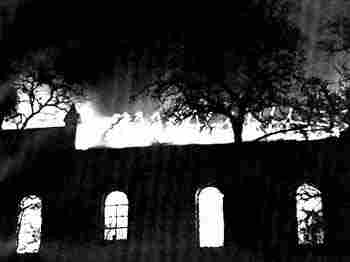
Top: Photographer unknown. Synagogue Burning in Siegen, Germany. 1938. Photograph. The Pictorial History of the Holocaust, New York.
Middle: Photographer unknown. Bystanders view the smashed windows of a Jewish shop. 1938. Holocaust Education & Archive Research Team, Germany. Kristallnacht. Web. 9 Nov. 2010.
Bottom: Photographer unknown. Destruction of the Synagogue in Memel . 1938. Holocaust Education & Archive Research Team, Memel. Kristallnacht. Web. 9 Nov. 2010.

Monday, September 20, 2010

Kent Teacher, Debbie Carlson, Puts Emphasis on Social Justice

The Holocaust Center is so proud to be working with teachers like Debbie Carlson.

Spurred by Holocaust studies, Kent teacher puts emphasis on social justice in the classroom: Slide show of Holocaust sites

By LAURA PIERCE
Kent Reporter Editor
Sep 14 2010

It was the shoes on a riverbank that brought Debbie Carlson close to tears.

The Meridian Middle School teacher was on a trip to Eastern Europe this summer, and her tour group passed by a bronze sculpture of shoes, lined up on a riverbank. There were work shoes, children’s shoes, ladies’ shoes: a mixture of jobs, genders and ages.

The significance of the sculpture wasn’t lost on Carlson, who happened by this spot in the soft light of a summer day in Budapest, along the banks of Danube River with her tour group, while visiting sites of the Holocaust.

The shoes were the wordless reminder of the men, women and children whom the Nazis or their Hungarian counterparts lined up and shot along the riverbank. The bodies fell into the river, to be swept away by the current, their identities lost to their families and the world.

“When they were exterminating the Jews, they would line them up, and shoot them into the river,” Carlson says, of what she learned happened on that riverbank.

For Carlson, the sculpture was a consciousness-raising moment – one of many she experienced on the three-week trip... Read full article and see the slide show

Wednesday, September 8, 2010

Teachers in the News

A Summer of Learning
“The whole point is to activate kids,” to get them past the horror and “to understand that they are global citizens and can make a difference.” Jo Cripps is a Seattle Public Schools teacher who was a Memorial Library summer fellow at New York’s Holocaust Education Network in July.

http://www.jtnews.net/index.php?/columnists/item/7860/C7


Teaching the Teachers
Teachers Tammy Grubb and Debbie Carlson describe their experiences and impressions from the Holocaust Center's trip to Budapest and Prague in the JT News.

http://www.jtnews.net/index.php?/news/item/teaching_the_teachers/

Monday, July 26, 2010

A life-long learner's education continues in Budapest and Prague

By Larry Kolano

Larry Kolano is a retired middle school social studies/U.S. History teacher from Longview's Cascade Middle School. For over 40 years he has read and studied books and viewed films covering different aspects of the Holocaust. His formal Holocaust education training includes classes and seminars sponsored by the Washington State Holocaust Education Resource Center, B'nai Brith, Facing History, and the Jewish Foundation for the Righteous. In 2005 JFR awarded him an Alfred Lerner Fellowship. In addition to attending presentations in classroom settings, he participated in the JFR's summer Holocaust trip to Germany and Poland in 2008. For three years he served on the Holocaust Center's education advisory committee. Even in retirement, he conducts Holocaust presentations to civic groups and elementary/secondary classes. Larry currently resides in California.

[Photo by Larry Kolano: Memorial on the Danube. Cast iron shoes.]


For most of my 30 year teaching career I taught my students the basics of the Holocaust. Both teenaged and adult students were amazed by the inhumanity displayed by Nazi Germany and its allies between 1933 and 1945. As a life-long learner, I continue to explore different aspects of the Holocaust.
In 2008 I journeyed to Dachau, Buchenwald, and Auschwitz with other Holocaust scholars. In 2010 I travelled to Budapest and Prague to learn about the treatment of Jews in Hungary and the Czech Republic. Experiences of the Jewish people differed from those who lived in the German Reich, Poland, the Ukraine, and other occupied territories. Until 1944 Hungary's leaders allied themselves with Germany and successfully refused to comply with Nazi requests for Jewish "special actions" and "relocation." When faced with Hungary's defection, after the Red Army crossed its border, German troops invaded and Nazi racial laws implemented. With the assistance of Hungary's anti-semitic Arrow Cross, hundreds of thousands of Jews were rounded up and sent off to Auschwitz or they were simply killed where they were housed awaiting transport. Others were herded to the banks of the Danube, shot, and their bodies thrown into the river. A memorial comprised of bronzed shoes now exists at one of the execution spots along the Danube.

The Holocaust in Hungary was new to me. I had heard of Raoul Wallenberg's efforts to save Jewish lives, but I had never read about or heard about the collection of horrors inflicted on the Jewish population living in and around Budapest. After preparing for the trip by reading The Siege of Budapest, Kasztner's Train, and Hunting Eichmann and experiencing the European tour associated with the Washington State Holocaust Education Resource Center and Museum Without Walls, I have a much greater understanding of the Holocaust as it developed in another occupied country.

Thursday, July 15, 2010

Terezin Reflections - Chapter 4

Terezin Reflections - Chapter 4
By Rachel Nathanson

From June 24 - July 4, 2010 the Holocaust Center, in partnership with Museum Without Walls, organized a Holocaust study trip to Budapest and Prague. Frieda S., a survivor from Terezin, and her daughter Dee (also the Co-Executive Director of the Holocaust Center) participated in the trip and shared the group invaluable first hand experiences. Eva, a survivor of Terezin who had been in the barracks with Frieda, met up with us. Below Rachel Nathanson, one of the Holocaust Center's board members and a participant on the trip, describes some of sites and shares her thoughts on the experience of visiting Terezin.


Although much has been recorded of the Terezin history, the flood of 2002 that ravaged much of Central Europe, gave rise to new discoveries. Due to the flood, a storage room within a private home’s yard was damaged by the almost five-foot high waters. All of the stored goods were then removed, leading to the discovery of what was clearly a hidden synagogue. This small room (about 15’ by 15’), with no windows, lost the inscriptions along the walls due to the floodwaters, but the ceiling painting remains. The prayers, written high along the walls, beg God to return from his anger. The remaining words of one damaged prayer now say, “If I forget thee…”


The Red Cross Visit
The Red Cross was allowed to visit Terezin to see what Hitler called “a city for the Jews”, a city he created to supposedly protect them from the horrors of war. The village area was spruced up and an illusion that this was a working, lovely town was made complete. Stores were filled with goods, bakeries overflowed with food, and the inmates carefully instructed on how to “play act” for these visiting outsiders. Children were given candy to hold but told not to eat it and upon a successful ruse for the Red Cross, the candy was cruelly stripped from their fingers by the guards.

A film, made by Jewish filmmakers within Terezin, shows the theatrically happy lives being lived by all the inmates. Playacting included a soccer game with cheering crowds, young women sharing their knitting projects, and other manufactured scenes. With the film complete, the filmmakers and many of those participating in the film were promptly sent to Auschwitz to eliminate their knowing complicity.

Survival
Frieda and Eva were blessed to have lived. Their survival was helped by so many small factors: the fact that as “mischlings” they were transported later and treated slightly better; that they were given the job of working the fields for the officers which allowed them to sneak a little food while in the fields and bring a few items back to the other girls; that they were strong and young – and determined.

Frieda tells the chilling story of so many girls getting shipped out on the trains and she wanted desperately to get out of Terezin. She managed to trade some things to get one of the “transport cards” for a train, not realizing she would be sealing her fate to leave for Auschwitz. The guard at the train saw her and noted that she reminded him of his own daughter. She begged to get on the train and he told her he would “break her legs” if she ever tried to get on the train again, and sent her back. What amount of guilt did this man have that he could choose just one girl, save just one soul?

Three months before the war was over, Frieda’s father, who was Jewish, and brother were also transported to Terezin. As the Soviet fighting came closer to Terezin in 1945, the Germans fled, destroying bridges and roads behind them. Frieda’s father did not hesitate. He stole a horse and cart and filled it with as many children as could fit and took them out of Terezin to Prague. What would normally take 12 hours, took 5 days.

When the Soviets reached Terezin, they had to quarantine the area due to the rampant outbreak of Typhus. Adding to the tragedy of this chapter of history, many of the remaining inmates died of typhoid fever, even though “liberated” from the camp.

I started this long account by saying I have a 15-year old daughter. I could not help but think of my own daughter when learning about Frieda and Eva’s experience (as only 2 of so many). How could I have handled her being taken from me at such a young age for several years? We learned that Frieda’s mother travelled many days to stand outside the fortress walls in hopes of catching a glimpse of her daughter, just to know that she was still alive. I stood with chills, thinking about her mother. I could be her mother.

In the end, the only thing I can do is bear witness to the story. Let this horrendous time in our history never be forgotten. I am ever so grateful for what I have.

Terezin Reflections - Chapter 3

Terezin Reflections - Chapter 3
By Rachel Nathanson


From June 24 - July 4, 2010 the Holocaust Center, in partnership with Museum Without Walls, organized a Holocaust study trip to Budapest and Prague. Frieda S., a survivor from Terezin, and her daughter Dee (also the Co-Executive Director of the Holocaust Center) participated in the trip and shared the group invaluable first hand experiences. Eva, a survivor of Terezin who had been in the barracks with Frieda, met up with us. Below Rachel Nathanson, one of the Holocaust Center's board members and a participant on the trip, describes some of sites and shares her thoughts on the experience of visiting Terezin.

Chapter 1
Chapter 2

Chapter 4


We stood before the building where Frieda and Eva’s teenage years were stolen, and their lives forever marked by this horrendous historical time. They pointed to the window of their once jail-like home, where they shared their small room with 30 or so others. Most of those “roommates” were shipped out over time, continually replaced with new faces, only to be shipped out again and again. So many of the teens they lived with were tragically transported to a place even darker in history: Auschwitz-Birkenau.

This photo (above) shows Frieda and Eva in front of their “barracks” during their internment.

A recreated room in the women’s living quarters:


Terezin is now freshly painted and beautifully planted with flowers. The newly spruced up town sadly belies its tragic history, from a visual perspective. Approximately 1,000 people returned to live in Terezin, but one wonders how they can bear to do so. Our guide, a young man trained in the vocation of being a Terezin tour guide admitted he could not imagine living within the walls of a town where such history took place.

Wednesday, July 14, 2010

Terezin Reflections - Chapter 2

Terezin Reflections - Chapter 2
By Rachel Nathanson


From June 24 - July 4, 2010 the Holocaust Center, in partnership with Museum Without Walls, organized a Holocaust study trip to Budapest and Prague. Frieda S., a survivor from Terezin, and her daughter Dee (also the Co-Executive Director of the Holocaust Center) participated in the trip and shared the group invaluable first hand experiences. Eva, a survivor of Terezin who had been in the barracks with Frieda, met up with us. Below Rachel Nathanson, one of the Holocaust Center's board members and a participant on the trip, describes some of sites and shares her thoughts on the experience of visiting Terezin.


The Ghetto
While Terezin was not a death camp, it was not without its own atrocities and death. The numbers vary throughout accounts, but around 140,000 people were deported to Terezin between 1941 and 1945, with an additional 15,000 arriving in the last days of the war. Of these, about 35,000 died in the ghetto itself, and about 88,000 were sent to Auschwitz and other extermination camps.

The town’s original inhabitants of about 5,000 people were forced to relocate by the Nazi party and were replaced over time by about 55,000 Jews. These overcrowding conditions lead to many deaths and unspeakable living conditions for all.

It is one thing to read accounts of the Holocaust, and quite another to stand on the hallowed ground of these historic sites. And to do so with two valiant survivors, two amazingly strong women, was a unique experience for me, one I am truly grateful for. Frieda and Eva, both from mixed-religion families, noted that they grew up in a time when religion was not critical to family structure. Many families of mixed-religion raised one child as a Jew and the next as a Catholic. All holidays were observed and national pride was more important than religion.

As mixed-religion children, “mischlings” as labeled by the Germans, Frieda and Eva were told to be on the transport to Terezin upon or near their 14th birthday. Frieda was the 175th person on her transport of 175, from Prague (Praha) on June 9, 1943 as documented on the wall of the Ghetto Museum today:


Terezin Reflections - Chapter 1. By Rachel Nathanson

Terezin Reflections - Chapter 1
July 2010
By Rachel Nathanson
From June 24 - July 4, 2010 the Holocaust Center, in partnership with Museum Without Walls, organized a Holocaust study trip to Budapest and Prague. Frieda S., a survivor from Terezin, and her daughter Dee (also the Co-Executive Director of the Holocaust Center) participated in the trip and shared the group invaluable first hand experiences. Eva, a survivor of Terezin who had been in the barracks with Frieda, met up with us. Below Rachel Nathanson, one of the Holocaust Center's board members and a participant on the trip, describes some of sites and shares her thoughts on the experience of visiting Terezin.
I have a 15-year old daughter. She is the age that Frieda and Eva were after spending the first of two years in a concentration work camp in Terezin, Czech Republic. But for a mere 50 years or so (a blink of an eye in the annals of historic time) and the serendipity of being born in America, this could have been my daughter’s experience.

Having been home now for a week, I am still processing all that I saw and learned while participating in a Holocaust educational trip to Hungary and the Czech Republic. It was a transformative experience, and an honor, to learn more about this tragic history from these two women who survived it. Here, I want to share what we saw in Terezin, on an all-too-brief visit on July 2, 2010.


The Fortress
Originally built by the Hapsburg Monarchy (in 1780) as a fortress to protect Prague from invaders, it is a walled city surrounded by a moat. Broken into 2 sections, the “small fortress” was used by the Prague Gestapo as a prison in WWII. The larger “town” portion was used as a ghetto to “concentrate” the Jews, hence the term “concentration camp”.

The entry yard to the small fortress still has the German labels above the doors for the various offices, where the initial processing of prisoners took place. How eerie to stand on the same worn down, wooden floors where efficient Nazi command sent nearly 32,000 prisoners through the gates to hell. On through the archway with the insidious Nazi mockery, “Work Makes One Free”.


Most prisoners were Czech and most were part of the resistance. Many were jailed for having made a joke in the streets about Nazis, for being gay, with the harshest treatment meted out to the Jews.

The largest barracks were first on our tour, used to house the upper level of prisoners. Here there were about 90 men per room, with large bunk beds to be shared, one sink, one latrine, windows, but no heat. From here the rooms got smaller, the crowding greater and the conditions heartbreakingly worse.


The cells holding Jews were smaller. In a room of about 144 square feet, there typically were 55 prisoners. Can you imagine being in a cell with only 2 feet of space to stand in, taking turns to sit or lie down? These cells had one small window high in the wall, no beds, no toilet, no heat, and most importantly, no ventilation. Without adequate oxygen, many perished of suffocation. The solitary cells further along were yet smaller. These cells held only 3-5 prisoners at a time, but the space was frightening. Only about 10 square feet, they had no windows, no light whatsoever, and those held herein would have been plunged into a world of total darkness once the hefty wooden door slammed shut on them. How many lost their sanity in these conditions?

We moved on to the adjacent building where the showers were shown to us. Chilling to us as we all contemplated the more deathly use of showers at the Nazi death camps, but these showers were innocent enough. Prisoners were given a delousing shower once per week. Since they were done in groups of 100 or so, it was an important gathering place for prisoners to see friends and learn who was still alive.

Leaving the walls of the small fortress, we viewed the home of the camp commander and ranking guard housing. The swimming pool dug by hand by prisoners (without the benefit of any tools!), was the sense that housing conditions had improved for someone. Gestapo families raised their children here, showed them the atrocities taking place inside the walls, and were able to sleep at night. It was more than I could mentally grasp. The commander’s home was a huge palace-like structure with a flower-lined drive.


Tuesday, June 29, 2010

Hearing a survivor in Budapest

After so many years of studying and learning about the Holocaust, on Sunday we learned some interesting perspectives about the Holocaust in Hungary from scholar, Laszlo Csosz. As it turns out, each country was so different in what happened to Jewish populations. The Hungarian deportations of 1944 started in the countryside--but did not continue with total deportation of the Jews of Budapest. About 70,000 of them remained in two different ghettos in the city and were liberated by the Russians. The tradgedy of the 1/2 million Hungarian Jews who were being deported to Auschwitz as the Allies were driving west always makes the losses of the Holocaust seem even more tragic and appalling. Add to this that we learned that students today are not required to learn about the Holocaust and do not hear the many survivors who do live here in Budapest. It made out presentation by a local survivor very poignant as she travels to Germany to speak to schools but does not speak in Hungary. Even so, the sun was shining and we were priviledged to hear Eva's story.

Laurie Warshal Cohen

See a photo of Eva of with the group at the Holocaust Center in Budapest on our facebook page.

Saturday, June 26, 2010

Photos from Budapest - day 1

New photos on facebook today from our visit to Castle Hill in Budapest, the labyrinth of caves under the hill, archictecture in Pest, and more...

http://www.facebook.com/album.php?aid=184847&id=140140310737&saved#!/album.php?aid=184847&id=140140310737

Friday, June 25, 2010

Arrived in Budapest!

Check out our photos on the Holocaust Center's Facebook Page -

http://www.facebook.com/album.php?aid=184847&id=140140310737&saved#!/album.php?aid=184847&id=140140310737

You don't have to be signed into facebook to see them. Or better yet, sign into facebook and become a fan of the Holocaust Center's page so that you can follow our trip!

Arrived in Budapest on Friday evening and ate dinner at the delicious Cyrano restaurant in walking distance from our hotel.

Dinner consisted of Gulash soup or Indian carrot and corn soup, paprika chicken with egg gnocchi (or lentils for the vegetarian), and a wonderful fruit/ginger yogurt.

Our hotel, Budapest Panorama Central Hotel, is really a floor of an apartment-like building. Each floor of the building looks at the Center courtyard. The rooms are small but lovely. The owner of the hotel even provided a bottle of wine for each room.