Showing posts with label Alcohol consumption. Show all posts
Showing posts with label Alcohol consumption. Show all posts
Wednesday, January 12, 2011
Homer Simpson-When I Was 17
Apropos Martin's post below, further evidence on under-age drinking amongst top American students.

Sunday, October 31, 2010
Smoking and drinking while pregnant
Smoking and drinking while pregnant is generally acknowledged to be a bad for the child's health depending, of course, on the extent of it. So how common is it and what are some of the predictors?
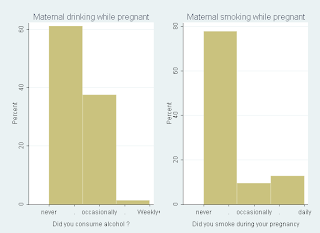 Using Growing Up in Ireland data I graph the mothers response to a question which asked about this. About 60% never drank and less than 40% said occasionally. For smoking about 75% never smoked though about 13% smoked daily.
These questions were asked 9 years after the child was born and are probably under-estimates. One is less likely, I think, to overstate one's drinking or smoking.
If one does some simple multivariate (ordered probit) analysis it is striking that there are some very different patterns:
Older mothers are more likely to have consumed alcohol than younger mothers while pregnant but young mothers are more likely to smoke than the older ones. Income also has opposite effects being positively associated with drinking and negatively associated with smoking. The same is true for mothers education. Likewise medical card holders are more (less) likely to smoke (drink). So there seems to be a clear class divide. These effects are simultaneous, remember.
The one factor I found which had a consistent effect (& there are many other possible factors which I didn't look at) was a question that asked the respondent "Would you describe yourself as religious/spiritual?". Those that answered in the higher categories ("very much so" or "extremely") were significantly less likely to have smoked or drank alcohol while pregnant.
It is interesting to speculate whether this has something to do with an association between religiousity and discount rates. It seems there may be positive externalities from religion/spirituality.
 Using Growing Up in Ireland data I graph the mothers response to a question which asked about this. About 60% never drank and less than 40% said occasionally. For smoking about 75% never smoked though about 13% smoked daily.
These questions were asked 9 years after the child was born and are probably under-estimates. One is less likely, I think, to overstate one's drinking or smoking.
If one does some simple multivariate (ordered probit) analysis it is striking that there are some very different patterns:
Older mothers are more likely to have consumed alcohol than younger mothers while pregnant but young mothers are more likely to smoke than the older ones. Income also has opposite effects being positively associated with drinking and negatively associated with smoking. The same is true for mothers education. Likewise medical card holders are more (less) likely to smoke (drink). So there seems to be a clear class divide. These effects are simultaneous, remember.
The one factor I found which had a consistent effect (& there are many other possible factors which I didn't look at) was a question that asked the respondent "Would you describe yourself as religious/spiritual?". Those that answered in the higher categories ("very much so" or "extremely") were significantly less likely to have smoked or drank alcohol while pregnant.
It is interesting to speculate whether this has something to do with an association between religiousity and discount rates. It seems there may be positive externalities from religion/spirituality.
Tuesday, October 19, 2010
Suicide in Ireland: The Influence of Alcohol and Unemployment
Brendan Walsh, Dermot Walsh
In this paper we model the behaviour of the Irish suicide rate over the period 1968‐2009 using the unemployment rate and the level of alcohol consumption as explanatory variables. It is found that these variables have significant positive effects on suicide mortality in several demographic groups. Alcohol consumption is a significant influence on the male suicide rate up to age 64. Its influence on the female suicide rate is not as well‐established, although there is evidence that it is important in the 15‐24 and 25‐34 age groups. The unemployment rate is also a significant influence on the male suicide rate in the younger age groups. The behaviour of suicide rates among males aged 55 and over and females aged 25 and over is largely unaccounted for by our model. These broad conclusions hold when account is taken of a structural break in the 1980s, with the response to unemployment being greater in the earlier period and that to alcohol greater in the later period. The findings suggest that higher alcohol consumption played a major role in the increase in suicide mortality among young Irish males between the late 1960s and the end of the century. In the early twenty first century a combination of falling alcohol consumption and low unemployment led to a marked reduction in suicide rates, although there is some evidence that the suicide rate is being increasingly under‐reported in recent years. The recent rise in the suicide rate may be attributed to the sharp increase in unemployment, especially among males, but it has been moderated by the continuing fall in alcohol consumption. Some policy implications of the findings are discussed.
In this paper we model the behaviour of the Irish suicide rate over the period 1968‐2009 using the unemployment rate and the level of alcohol consumption as explanatory variables. It is found that these variables have significant positive effects on suicide mortality in several demographic groups. Alcohol consumption is a significant influence on the male suicide rate up to age 64. Its influence on the female suicide rate is not as well‐established, although there is evidence that it is important in the 15‐24 and 25‐34 age groups. The unemployment rate is also a significant influence on the male suicide rate in the younger age groups. The behaviour of suicide rates among males aged 55 and over and females aged 25 and over is largely unaccounted for by our model. These broad conclusions hold when account is taken of a structural break in the 1980s, with the response to unemployment being greater in the earlier period and that to alcohol greater in the later period. The findings suggest that higher alcohol consumption played a major role in the increase in suicide mortality among young Irish males between the late 1960s and the end of the century. In the early twenty first century a combination of falling alcohol consumption and low unemployment led to a marked reduction in suicide rates, although there is some evidence that the suicide rate is being increasingly under‐reported in recent years. The recent rise in the suicide rate may be attributed to the sharp increase in unemployment, especially among males, but it has been moderated by the continuing fall in alcohol consumption. Some policy implications of the findings are discussed.
Friday, September 10, 2010
Do good colleges lead to good health?
Quality and Young Adult Health Behaviors
Jason Fletcher, David Frisvold
Jason Fletcher, David Frisvold
| Large literatures have shown important links between the quantity of completed education and health outcomes on one hand and the quality of schooling on a host of adult outcomes, such as wages, on the other hand. However, little research has been targeted to producing evidence of the link between school quality and health. The paper presents the first evidence in the literature on the potential short and intermediate term effects of attending a selective college on health behaviors during and following college attendance. Using a variety of empirical methods, this paper shows strong evidence that college quality reduces tobacco and marijuana use but has small and possibly positive effects on binge drinking. The effects on weight behaviors are suggestive of reduced weight, potentially through diet but not exercise change. |
Subscribe to:
Posts (Atom)