Showing posts with label history. Show all posts

Wednesday, March 30, 2011

NY Times - Why Palestinians should learn about the Holocaust

Why Palestinians Should Learn About the Holocaust

Should Palestinian and other Arab schools teach their students about the Holocaust?

This is not an academic question. Many Palestinian and Arab political organizations recently pounced on reports that a new human rights curriculum being prepared for use in Gaza schools operated by Unrwa, the United Nations aid agency for Palestinian refugees, might include historical references to the Holocaust. Their reaction underscores the urgency of answering this fundamental question: Should Palestinians (and other Arabs) learn about the Holocaust? Should this historical tragedy be included in the Arab curriculum?

We — a Muslim-Palestinian social scientist, and a Jewish-American historian — believe the answer is yes. Indeed, there are many reasons why it’s important, even essential, that Arabs learn about the Holocaust. And much of this has nothing to do with Jews at all.

One of the sad realities of many modern Arab societies is that Arab students have been denied history, their own and the world’s. For decades, millions of Arabs have lived under autocrats resentful of the legacy of the leader they replaced and fearful of the leader-to-come. Although Arabs revere the study, writing and teaching of history, and have produced many famous historians, their rulers often tend to view history as a threat. The result is that many historians in Arab countries are more like the court chroniclers of long-dead dynasties, and entire chapters of history have been expunged from the curricula that Arab governments teach their students.

Read full article in the New York Times

Thursday, March 10, 2011

Student Project on the Bosnian Genocide


Emily B, an 8th grade student, created an extensive project related to the Bosnian war for the Manatee County History fair.

"One of the major tings I learned was that even though tragic events happen and pass, they are never fogotten. Someone will always be affected by it, no matter how far in the past it occurred."

Emily contacted the Holocaust Center, and we were able to connect her with Selena, a survivor of the Bosnian war, living in the Seattle area. (Selena also contributed to the Holocaust Center's "Stories Among Us: Personal Accounts of Genocide" series published in the Seattle Times.)

"I chose my topic, the Bosnian genocide, for many reasons. My mom introduced the topic to me at first. As I researched more in depth, I learned how recent this event had occurred. Also, not a lot of people knew about it and I wanted to raise awareness. My last reason was it affected thousands of people only a few years before I was born."

Tuesday, March 1, 2011

Seattle Times calls Nuremberg film a "must-see"

NUREMBERG - THE FILM

Show dates extended dut to popular demand.

Seattle Times calls it a must-see!

Varsity Theater, 4329 University Way NE, Seattle. Running Time - 78 minutes. Showing until March 10.

One of the greatest courtroom dramas in history, Nurmeberg shows how the international prosecutors built their case against the top Nazi war criminals using the Nazis' own films and records. presented by the Holocaust Center in conjunction with Schulberg Productions and Metropolis Productions. For more info about the film, visit http://www.nurembergfilm.org/. For show times and location, call the Varsity Theater at 206-781-5755.

Monday, February 7, 2011

Accused Nazi Living in Bellevue Dies

Peter Egner, accused Nazi living in Bellevue, dies before his trial which was scheduled for February 22, 2011.

Egner, 88, was accused of assisting in the murder of thousands of Jews in Serbia in 1940 - 1943. The government was considering deporting Egner, who lied about his involvement when he immigrated to the United States in 1960 and applied for citizenship.

Egner had denied all claims of involvement.


Thursday, December 2, 2010

Pictures of Resistance - Exhibit & Teacher Workshop


Opening Reception - January 13
Teacher Workshop - January 14
Exhibit - January 13 -February 17, 2011
Programs and display at Hillel, University of Washington, Seattle
Sponsored by the Holocaust Center in partnership with Hillel.


Special Guest - Sharon Rennert, granddaughter of Jewish partisan commander Tuvia Bielski. January 13 & 14.

OPENING RECEPTION - January 13, 2011. 6:30pm - 8:30pm.
Keynote speakers: Sharon Rennert,
granddaughter of Tuvia Bielski, the commander of the Bielski Partisan group (made famous by the recent movie, "Defiance"), and a documentary filmmaker shares her family's compelling story of courage and resistance; and Mitch Braff, Executive Director and Founder, Jewish Partisans Educational Foundation.
RSVP - admin@wsherc.org

TEACHER WORKSHOP - January 14, 2011. 8:30am - 3:00pm.
Presentations by Mitch Braff, "Women in the Partisans," and Sharon Rennert, "In Our Hands: A Personal Story of the Bielski Partisans." Clock hours available. $10 registration fee. Space is limited - register now!

Special thanks to the Shemanksi Foundation, Jewish Federation of Greater Seattle, King Country 4Culture, the Conference on Jewish Material Claims against Germany, for supporting this exhibit and programming. Exhibit is produced by the Jewish Partisans Educational Foundation.

Tuesday, November 30, 2010

How many Jewish partisans were there?

What is a Jewish partisan and how many were there?

A partisan is a member of an organized body of fighters who attack or harass an enemy, especially within occupied territory; a guerrilla.


Approximately 20,000 to 30,000 Jews, many of whom were teenagers, managed to escape to form or join organized resistance groups. They are known as the Jewish partisans, who, along with hundreds of thousands of non-Jewish partisans, fought against their common enemy across much of Europe.


Faye with her Camera
Photographer: Moishe Lazebnik, Toronto, Canada, 1999

“I want people to know that there was resistance. Jewish people didn’t go like sheep to the slaughter. If they had the slightest opportunity to fight back, they did and took revenge. Many lost their lives heroically.


“I was a photographer. I have pictures. I have proof.”


See Faye Schulman's photos in the exhibit "Pictures of Resistance" coming to Hillel in January. For information on the exhibit and programming, click here.

Monday, November 29, 2010

Questions on Genocide

A college student writing a paper on genocide and governmental policies for prevention and response emailed us with a few questions.

We turned to Marie Berry, a PhD candidate in Sociology with a focus on genocide in UCLA's prestigious program. Marie, a graduate of the University of Washington, spent several years working at the Holocaust Center.


Do you think any changes should be made to the UN structure to try and help responses to genocides?

Most debates about the UN’s treatment genocide are concerned with altering the definition of genocide, rather than changing the mandated responses to genocide. In general, this is because the UN’s responses to genocide have yet to successfully materialize. Thus, scholars and policy makers debate the definition in an attempt to pressure the signatories of the convention to refine the definition and thus make it more feasible for action to stop genocides that are underway.

The process of drafting the 1948 Genocide Convention was extremely political; in particular, the involvement of the Soviet Union complicated the process, given that they (and affiliated countries like Belarus) wouldn’t sign a document that criminalized something Stalin had been doing for years. What resulted was a definition that includes “national, ethnic, racial, or religious” groups, but excludes political or economic ones. And, as a result, the historical episodes of violence that are commonly accepted as genocides exclude mass murders in Ethiopia, and often Guatemala. The problem with this is that in most analyses of genocide, the real causes are obscured—instead, it is easier to explain away genocide in terms of ethnic, racial, or religious groups that “hate” each other. Of course, in every case of genocide in history, the “ethnic” or “racial” groups that end up being targeted for extermination have been integrated in the societies that they live in for centuries (or more). Jews in Europe, Tutsis in Rwanda, and Bosniaks in Bosnia weren’t simply targeted one day because of their ethno-religious identify, but rather because of a series of political power struggles that escalated and were ultimately framed as ethno-religious.

The UN’s definition of genocide, therefore, is problematic in several ways. First, it serves to reify the ethno/racial/religious aspects of a brewing conflict while obscuring the political and economic ones. In the case of Rwanda, this allowed the international media and foreign governments to dismiss the violence as “tribal” and neglect acknowledging the power struggle at play in Kigali that was in part facilitated by the international community’s attempts to negotiate a peace process between the current Hutu regime and the Tutsi-dominated Rwandan Patriotic Front invading from Uganda. Moreover, it obscured the significance of the colonial era, recent crop shortages and resulting famines, and intra-ethnic conflicts between a powerful family from the North and other powerful families from the South.

Second, the definition revolves around the idea of “intent”; a group must have the intent to destroy a group for mass violence to be considered genocide. This eliminates some of the most massive deaths in human history, such as Mao’s “Great Leap Forward,” where it is difficult to argue that Mao intended to kill 20 million+ of his countrymen (but easy to argue that his policies had that effect). The very concept of “intent” is almost always subjectively determined; barring the leak of some sort of internal government memo explicitly stating the goal of eliminating a group within its population, intent is usually agreed upon after amassing mounds of evidence that point that direction. This is much easier in retrospect, after genocide is over, when the true intent of a perpetrating group is revealed. Intent is much more difficult to determine during the actual genocide itself—especially in cases like Rwanda, where the genocide happened rapidly over merely 100 days.

Last, the narrowness of this definition and the exclusion of political or economic (i.e. class) groups, is conducive to disagreement and debate over whether violence counts as a genocide or not. This leads, ultimately, to inaction, as we’ve seen in basically every case that ultimately resulted in genocide (with the possible exception of East Timor: See Geoffrey Robinson’s book If You Leave Us Here We Will Die, 2009). For the UN’s definition of genocide to be more effective at invoking action from the international community, I believe it needs to be centered on the degree of devastation being caused to civilians, rather than on the subject concept of intent and restrictive classifications like race and religion.


How much does politics complicate responses to genocide?

I think that politics complicates responses to genocide a lot, but self-interest complicates responses even more. Military interventions generally carry tremendous costs in terms of human lives and financial resources. If a given country has little strategic or economic relevance to an intervening state, the risks of intervening are high while the potential gains are low. Politics also factors in, particularly when strategic alliances are strained over an ally engaging in genocide. We’ve seen this most recently with US involvement in Darfur, where at the initial stages of the conflict the US was hesitant to shame Sudanese President Bashir publicly given his cooperation about eliminating al-Qaeda training cells in his country. The US-led 1995 Dayton Accords after the wars in the Balkans were also influenced by politics, and as a result we watched as the Serbian aggressors (and perpetrators of egregious crimes against humanity) were given control over 49% of Bosnian territory – a higher percentage than before the war. So we see that politics can not only influence decisions to intervene in genocides, but also the peace-process afterward.


What are some of the best tactics in stopping/preventing genocide? What is your feeling on military interference versus peaceful interventions?


The best tactics for stopping and preventing genocide are unique in each situation and at each stage in the conflict. In my opinion, however, the first and most important things to consider are the real roots of the conflict. Dismissing violence in Rwanda as merely tribal warfare between Hutus and Tutsis gives policy makers little leverage to negotiate a cessation of violence or to design a plan to physically intervene. Instead, understanding the historical processes that led to the evening of April 6, 1994, when the genocide began, are absolutely essential if we are going to be able to conceive of bringing the violence to a halt. Furthermore, understanding the “repertoires of violence” that people in a given region draw from based on historical experiences of violence can give us a better knowledge of where the violence might be heading and thus how we could potentially confront it. The brutal treatment of Serbs in UstaĊĦa concentration campus in former Yugoslavia during WWII provided a historical memory that was adopted by Serbs several decades later against Bosniaks—had the “west” understood many of the historical roots of the types of violence being used in the war in the Balkans, intervention might have been more carefully designed and carried out. Once the history of a conflict is understood from all perspectives, the best tactics of intervention can be more successfully determined. And, in my opinion, sometimes peaceful interventions are the best option, while at other times the situation has gotten so out of control that the only possible options are military. In the case of Rwanda, for example, a military intervention really was the only option. However, I tend to believe in the cyclical nature of violence, and thus would only endorse an armed intervention as a very last resort.

Tuesday, November 9, 2010

72 Years After Kristallnacht


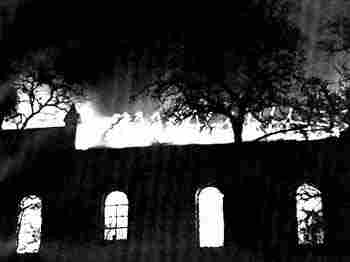
Kristallnacht -- literally, "Night of Crystal," is often referred to as the "Night of Broken Glass." The name refers to the wave of violent anti-Jewish pogroms which took place on November 9 and 10, 1938 throughout Germany, annexed Austria, and in areas of the Sudetenland in Czechoslovakia recently occupied by German troops.


Instigated primarily by Nazi Party officials and members of the SA (Sturmabteilungen: literally Assault Detachments, but commonly known as Storm Troopers) and Hitler Youth, Kristallnacht owes its name to the shards of shattered glass that lined German streets in the wake of the pogrom-broken glass from the windows of synagogues, homes, and Jewish-owned businesses plundered and destroyed during the violence. (USHMM - read more)
How did religious leaders in the US respond?
The events of November 9, 1938 pogrom sparked a wave of outrage among U.S. religious leaders. In the weeks following November 9, 1938, there were numerous editorials, radio broadcasts, and sermons. In a few cases – like the historic Church of the Pilgrimage in Plymouth, Massachusetts – local Christian clergy invited their Jewish colleagues to address their congregations for the first time. (USHMM - read more)

Photos:
Top: Photographer unknown. Synagogue Burning in Siegen, Germany. 1938. Photograph. The Pictorial History of the Holocaust, New York.
Middle: Photographer unknown. Bystanders view the smashed windows of a Jewish shop. 1938. Holocaust Education & Archive Research Team, Germany. Kristallnacht. Web. 9 Nov. 2010.
Bottom: Photographer unknown. Destruction of the Synagogue in Memel . 1938. Holocaust Education & Archive Research Team, Memel. Kristallnacht. Web. 9 Nov. 2010.

Wednesday, November 3, 2010

Working in a Trap: Drawings from the Theresienstadt Ghetto 1941-1942


Paraphrased from a discussion with Susie S., local Holocaust survivor and member of the Holocaust Center's Speaker's Bureau:


My cousin, Ruth Perry, is about my age and lives in Ramat Gan, Israel. Other than my sister and I, she is the only remaining direct relative of our generation. Ruth comes to visit us now and then ... recently she spoke of some very special pictures that her family and others in Israel were trying to put together for a limited printing. She said that these paintings were to honor an important Jewish "Elder" of Terezin. My own dear family, on my mother and father's side, was dragged to Terezin in 1942. I thought that I knew the names of the "Elders of the Jews" in Terezin, but the name she used was not familiar to me and I became curious. As it turns out, I did not understand the Hebrew version of Jacob Edelstein's name. Edelstein was an influential leader chosen and used by the Germans to aid in carrying out their horrible plans.

There has been much written about the "Jewish Elders," those people who had to pass down the edicts of the Germans. The Nazis tried to turn the inmates against the Elders and were successful in some instances. While many writings are critical of some of the elders, this album shows that Edelstein had a good, courageous heart and did the best he could.

My cousin, Ruth, was a friend of "Dittle." As it turns out, "Dittle" was Dr. Edith Ornstein, one of the creators and signatories of the album. Ruth told me of a time when Dittle had to sit on the paintings when Adolf Eichmann came into her living area. The paintings, by Leo Haas, were presented to Jacob Edelstein on the occasion of the first anniversary of the Nazi-established ghetto.

The timetable of Theresienstadt and the Final Solution is so organized and easy to read that one can get a clear understanding of the timetable behind the horrific main events from 1933 to 1945. The pictures and writings in the album record the efforts of the labor center and serve as an empowering and sensitive text, giving a new and deeper understanding of the Holocaust. In particular, it gives me a newer understanding and feeling of the horror that was Terezin. The album also gives information on the German use of propaganda using the "Jewish Town."


This album shows the positive relationship that Edelstein had with his staff, who recognized his efforts as leader towards helping those inmates of Terezin as much as he could. I am honored on behalf of my family to loan this very special and poignant album to the Center for one year.

Monday, November 1, 2010

An American's Diary of the Concentration Camp Experience


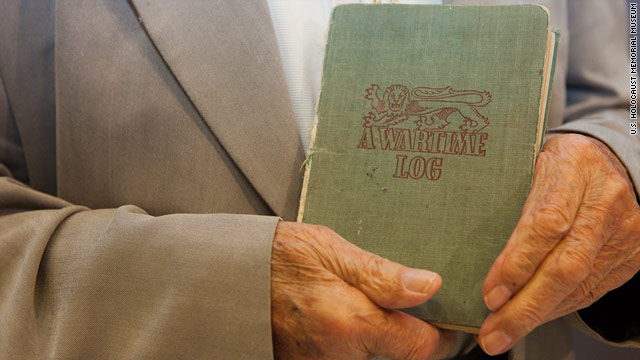
350 American soldiers were captured by the Nazis and sent to the concentration camp Berga in Feb. 1945. They endured terrible conditions, starvation, abuse and finally a death march in April 1945. One of the survivors donated his diary to the USHMM this past month.


'You don't forget': Medic's Holocaust diary tells story of hell
By Wayne Drash, CNN
October 28, 2010

Washington (CNN) -- The tattered journal, its pages yellow with age, contains the painful memories of a U.S. medic, a man who recorded the deaths of soldiers who survived one of World War II's bloodiest battles yet met their end as slaves in Nazi Germany.

32. Hamilton 4-5-45
33. Young 4-5-45
34. Smith 4-9-45
35. Vogel 4-9-45
36. Wagner 4-9-45

"Some were dying," said its author, Tony Acevedo, now 86. "Some died, and I made a notation of that."

Flipping through the pages, you encounter a horrific part of world history through the eyes of a 20-year-old inside a slave labor camp. Amid the horror, the journal captures extraordinary human moments of war. Acevedo sketched beautiful women in the back pages, pinups whose eyes provided comfort amid hell.

Acevedo kept the diary hidden in his pants. He feared death if the commanders saw it. Yet he believed it was his duty as an Army medic to catalog the deaths and the atrocities against the 350 U.S. soldiers at the camp known as Berga, a subcamp of the notorious Buchenwald compound. Read full article...

Monday, October 18, 2010

"Flight from the Reich"

On Wednesday, October 13, Robert Jan van Pelt spoke to a room full of educators, students, and members of the community interested in the topics of the Holocaust, genocide, and refugees.

Van Pelt is a world renowned Holocaust scholar and author. He is a professor at the University of Waterloo in Ontario. Robert Jan van Pelt spoke on this evening about his most recent book, Flight from the Reich: Refugee Jews, 1933-1946.


We asked those educators wanting clock hours to write up something from the evening's presentation that stood out to them. Below are a few of these reflections. We will continue to add to this post as we receive submissions.


------------------

By Helena B.

Robert Jan van Pelt’s talk revealed the way Holocaust studies has broadened its parameters to encompass the plight of refugees and weave the stories of those who “escaped” into the broader narrative of suffering and endurance. Using passports, visas, and documents as a unifying trope, van Pelt examines the plight of over one million Jews who fled the Reich, were deported from nation to nation, or rebuilt their lives in places as foreign as Shanghai. I appreciated how van Pelt exposed the contradiction of terms that inevitably emerges in a discussion of statelessness, border crossing, and transnational existence. Take, for example, the case of Anne Frank, who holds place in popular thought as a Dutch citizen, when in reality, her family had fled Nazi Germany and sought temporary refuge in Amsterdam. Or the conundrum that if a passport serves as a kind of legal guarantee—as assurance that the issuing country will unconditionally welcome back the holder into its jurisdiction—then a refugee with a passport, by definition, cannot exist. I found van Pelt’s analysis of contradictory terms and paper documents to be a provocative and useful means of grappling with his central question: “Who belongs to this history?”


I was also particularly struck by van Pelt’s analysis of the demographics of the exodus. French and British sponsored kindertransports, for example, were the result of political negotiation more than an acute and abiding sense of moral obligation. According to van Pelt, “We’ll take the children, if it will appease the public and excuse us from dealing with their parents” was the general consensus in British parliament. Moreover, although the Nazis requested that the Slovaks ship only young and able Jews for slave labor in concentration camps, the Slovak “all or nothing, old and young” response was, at least in part, responsible for the Final Solution in the sense that it prompted the Nazis to conduct their first systematic extermination based on age. Finally, young refugees (and young female refugees in particular) had a higher chance of survival and success post-exodus, for it was much easier for them to both secure proper documentation and rebuild their lives in a new place. Van Pelt’s decision to place lesser-examined topics like demographics and family dynamics in the context of diaspora and flight was a fresh approach to Holocaust scholarship. Refugees did not exist as an isolated group with wholly disparate experiences from those who stayed behind and found themselves trapped inside death camps. Indeed, theirs was a trauma with its own particular horrors, but with the same basic and ineffable suffering—the experience of living out terror, suddenly losing everything one knows and everything one holds dear.
------
By Erika M.

The lecture given by Dr. Robert Jan van Pelt on October 13th was engaging and informative on the topic of Jewish refugees in the Holocaust.


I studied the history of the Holocaust at university and found my knowledge of the plight of refugees to be very limited. I was totally unaware of the numbers of Jews who escaped through Shanghai and the ease of attaining visas from the Japanese consulate. It was interesting to hear of the bureaucrats who offered escape to Jews in Europe regardless of the mandates from their government.

I often find myself focusing on the larger facts of the Holocaust and the chronological progression of events instead of the stories behind the story. For example, I have read The Diary of Anne Frank and am familiar with Frank’s story of hiding but wasn’t aware of the reasoning behind Otto Frank’s timely decision to escape to Holland before there was the sense of urgency found after 1939. It was with personal stories that van Pelt reiterated the truth that the refugee experience was different for everyone. This truth was echoed by comments from attendees who were the children of refugees.


I also appreciated the stories van Pelt shared including the tale of the Swiss spinster who copied letters between separated parents and children. To me it revealed the goodness of humanity in a time of such darkness with which parents tried to offer as much support and guidance to their children. I now look forward to increasing my knowledge on the topic as I read Flight from the Reich.

--------------


By Keith M.


Dr. Van Pelt’s presentation allowed me to delve deeper into my own understanding of the mass removal and escape of Jews during the Holocaust. We often hear about the many stories of success in leaving Nazi Germany or Nazi occupation, but, as we discovered from Dr. Van Pelt, the plight of German Jews and Jews in German-occupied lands continued with the lack of interest of many countries, the United States included, in providing safeguard for many because immigration guidelines that limited widespread passage for many Jews, ultimately leading to capture and death within concentration camps. At the heart of Dr. Van Pelt’s stories and experiences is one important fact – we can never let our borders to safety be closed to those in need because of our own fears. Yet, we still see these experiences in the Sudan, in the former Yugoslavia, and in China. These must stop, and Dr. Van Pelt’s book is our own journal into the mistakes that were made by all, even those aiming to help.
------
Stephanie N.
Last night I had the opportunity to attend Dr. Robert Jan Van Pelt’s lecture on Flight from The Reich: Refugee Jews 1933-1946. The experience in attending Dr. Van Pelt brought to light the refugee experience for Jews over a 13 year period. I think this was an area I had not really studied or been taught before. It was great to have a chance to hear an expert in the topic share his knowledge as well as having the opportunity to purchase his book on the subject.

Learning how a passport was essential to life and how if you did not have one you were in a very bad place without the possibility for gaining freedom in another country. I enjoyed the resources he shared from his book and that the book had elements I had not been taught before. I appreciate having the opportunity to learn more about the Holocaust by attending Dr. Van Pelt’s book talk.

Monday, October 4, 2010

The Man Who Sneaked Into Auschwitz

An unbelievable story. Pilecki voluntarily went to Auschwitz in order to reveal the truth about the camp. Story is also available in audio on NPR.


September 18, 2010
NPR Staff

This weekend marks the 70th anniversary of a World War II milestone few people have heard before. It's the story of a Polish army captain named Witold Pilecki.

In September 1940, Pilecki didn't know exactly what was going on in Auschwitz, but he knew someone had to find out. He would spend two and a half years in the prison camp, smuggling out word of the methods of execution and interrogation. He would eventually escape and author the first intelligence report on the camp.... Read more.

Wednesday, September 29, 2010

Carrots and....the Holocaust?

Eating carrots will improve your vision. True or false?

False.

Carrots are a great source of vitamin A, and it’s true that severe A deficiency causes night-blindness. But there is no proof that eating extra vitamin A, in carrots or other forms, can help eyesight.

This myth has a great backstory, though: During World War II, the British Air Ministry didn’t want the Germans to know about their new radar system so they spread the rumor that the fighter pilots who shot down Nazi planes ate a lot of carrots. The Germans bought it...as did generations of parents.

Talk about propaganda!

You can read more about the story here:
http://www.snopes.com/food/ingredient/carrots.asp.

Thursday, July 15, 2010

Rafle du Vel d'Hiv

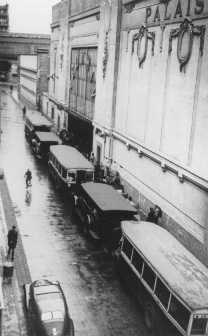
Buses waiting at the entrance to the Velodrome d'Hiver, where almost 13,000 Jews were assembled before being transported to Drancy and other French transit camps. Paris, France, July 16 and 17, 1942.
— Bibliotheque Historique de la Ville de Paris. Photo from USHMM.


July 16th and 17th mark the anniversary of the Rafle du Vel d'Hiv - the massive roundup of Jews in Paris, France in 1942.

Yad Vashem describes:

On July 16-17, 1942, in one of the most brutal and overt deportation operations, thousands of French police gathered up 12,884 Parisian Jews-including families with children, and irrespective of sex, age, and physical condition-and placed them in the Velodrome d’Hiver stadium without any provisions whatsoever. In several locations, children were separated from their parents. The victims were loaded aboard cattle cars and sent to Drancy en route to Auschwitz.


This deportation evoked the first substantial manifestations of opposition to the Vichy regime among several segments of the French population. It was impossible to keep the arrests of the Jews secret, and the brutality invoked in separating families was fiercely protested. The fact that most of the arrests were made by French police prompted charges against the force concerning collaboration with the Nazi regime on the part of France and its institutions, particularly with respect to the murder of Jews in this country.

During 1942, nearly 30,000 Jews were deported from Paris. (USHMM)
Susan Redd, a long-time French Teacher, scholar of the Holocaust in France, and member of the Holocaust Center's Education Advisory Committee comments:
"Thank you for posting this sad anniversary of the round-up of Jews by the French 'milice,' who gave more than demanded. The Nazis only requested 12,000 male Jews, but the enthusiastic antisemitic militia gave families of Jews, besides confiscating things of value from them."


Roundup of Jews. Paris, France, ca. 1942.
— YIVO Institute for Jewish Research, New York. Photo from USHMM.

A recent novel, Sarah's Key, has highlighted this experience and has become a popular read among book groups.

Sunday, May 9, 2010

The Alhambra


In their early period of rapid expansion the Arabs took over the Middle East, acquiring and preserving much of the ancient learning. They also developed it, picking up in many ways the intellectual torch of the Greeks. There was a brief shining moment some centuries later when Europe was able peacefully to absorb the knowledge of the then vastly superior Islamic civilization, through translations made in Toledo and the efforts of adventurers like Adelard of Bath. This transmission, as much or more than the redicovery of ancient learning in Italy, lay the foundations of the Renaissance and the rise of modern science. The story is told by historian Bettany Hughes in her accessible TV history documentary about the Moors in Spain - part of a larger series of excellent history programmes. Readers may like to see this clip about the Alhambra Palace in Granada, one of the wonders of the world, in the second half of which she talks about the legacy of Pythagoras and the geometrical principles that made possible this stunning architectural achievement.

The Alhambra


In their early period of rapid expansion the Arabs took over the Middle East, acquiring and preserving much of the ancient learning. They also developed it, picking up in many ways the intellectual torch of the Greeks. There was a brief shining moment some centuries later when Europe was able peacefully to absorb the knowledge of the then vastly superior Islamic civilization, through translations made in Toledo and the efforts of adventurers like Adelard of Bath. This transmission, as much or more than the redicovery of ancient learning in Italy, lay the foundations of the Renaissance and the rise of modern science. The story is told by historian Bettany Hughes in her accessible TV history documentary about the Moors in Spain - part of a larger series of excellent history programmes. Readers may like to see this clip about the Alhambra Palace in Granada, one of the wonders of the world, in the second half of which she talks about the legacy of Pythagoras and the geometrical principles that made possible this stunning architectural achievement.

Friday, January 8, 2010

Using history as a goal

Uffe Thomas Jankvist has written an article called An empirical study of using history as a ‘goal’. The article was published online in Educational Studies in Mathematics two days ago. Here is the abstract of his article:
This article discusses an empirical study on the use of history as a goal. A historical module is designed and implemented in a Danish upper secondary class in order to study the students’ capabilities at engaging in meta-issue discussions and reflections on mathematics and its history. Based on videos of the implementation, students’ hand-in essay assignments, questionnaires, and follow-up interviews, the conditions, sense, and extent to which the students are able to perform such discussions and reflections are analyzed using a described theoretical framework.

Using history as a goal

Uffe Thomas Jankvist has written an article called An empirical study of using history as a ‘goal’. The article was published online in Educational Studies in Mathematics two days ago. Here is the abstract of his article:
This article discusses an empirical study on the use of history as a goal. A historical module is designed and implemented in a Danish upper secondary class in order to study the students’ capabilities at engaging in meta-issue discussions and reflections on mathematics and its history. Based on videos of the implementation, students’ hand-in essay assignments, questionnaires, and follow-up interviews, the conditions, sense, and extent to which the students are able to perform such discussions and reflections are analyzed using a described theoretical framework.

Monday, January 4, 2010

January issue of Science & Education

The January issue of Science & Education has been published. One of the articles contained in the issue is of relevance to mathematics education: A Pilot Study of a Cultural-Historical Approach to Teaching Geometry. The article is written by Stuart Rowlands from the University of Plymouth. Here is the abstract of his article:
There appears to be a widespread assumption that deductive geometry is inappropriate for most learners and that they are incapable of engaging with the abstract and rule-governed intellectual processes that became the world’s first fully developed and comprehensive formalised system of thought. This article discusses a curriculum initiative that aims to ‘bring to life’ the major transformative (primary) events in the history of Greek geometry, aims to encourage a meta-discourse that can develop a reflective consciousness and aims to provide an opportunity for the induction into the formalities of proof and to engage with the abstract. The results of a pilot study to see whether 14–15 year old ‘mixed ability’ and 15–16 year old ‘gifted and talented’ students can be meaningfully engaged with two such transformative events are discussed.

January issue of Science & Education

The January issue of Science & Education has been published. One of the articles contained in the issue is of relevance to mathematics education: A Pilot Study of a Cultural-Historical Approach to Teaching Geometry. The article is written by Stuart Rowlands from the University of Plymouth. Here is the abstract of his article:
There appears to be a widespread assumption that deductive geometry is inappropriate for most learners and that they are incapable of engaging with the abstract and rule-governed intellectual processes that became the world’s first fully developed and comprehensive formalised system of thought. This article discusses a curriculum initiative that aims to ‘bring to life’ the major transformative (primary) events in the history of Greek geometry, aims to encourage a meta-discourse that can develop a reflective consciousness and aims to provide an opportunity for the induction into the formalities of proof and to engage with the abstract. The results of a pilot study to see whether 14–15 year old ‘mixed ability’ and 15–16 year old ‘gifted and talented’ students can be meaningfully engaged with two such transformative events are discussed.