Showing posts with label Artifacts. Show all posts

Tuesday, April 12, 2011

German Hagaddah from 1926 - Artifact


"Hagaddah Shel Pesach"

This Hagaddah shel Pesach, with commentary by Dr. M. Lehmann, was published and printed by Oscar Lehmann in Frankfurt am Main in 1926. It is printed in old German typeface and Hebrew.

The 12 illustrations are black and white reproductions of hand-painted manuscript pages from Hagaddot [the plural form of "Hagaddah"] from the 13th and 15th Century now housed in museums. The service and commentary fill 211 pages.

The signature of the owner and the date of 1926 are handwritten on the flyleaf. It is a timely reminder of life before World War II.

We gratefully accept artifacts to our growing collection. We especially value and record the stories told to us by the donors. Please contact Dee Simon, the Holocaust Center's Co-Executive Director at delilas@wsherc.org if you have any items that you think would be a good addition to our collection. On view to visitors and used by the Speakers Bureau, these items are used in educational presentations.

Thursday, March 24, 2011

Swastika Pin Worn by Jewish Couple - New Artifact


This tiny silver pin is a new addition to our display in the Holocaust Center's artifact collection. Approximately 3/4" square, its history is compelling.

The donor writes:

"This little swastika pin was made by a Jewish couple in Berlin after Kristallnacht. It allowed them for a while to blend in and not wear the yellow stars that the law required. They filed down a base metal brooch until they got the shape - however they got the direction of the bent arms reversed, but no one noticed for a long time. They were able to live in the spare rooms of a German Christian couple and survive long enough that they could still have strength to come through the camps after the War ended."

The Holocaust Center has a collection of artifacts donated by survivors and friends.

Currently on display in our four showcases are a broad range of items, including a bowl and spoon used in a camp, armbands worn by a nurse in Terezin, bread cards from the Lodz ghetto, "Signal" a Nazi propaganda magazine written in French, and the typewriter used by a member of the Leica Freedom train. Our collection includes photographs, letters, documents, passports, musical instruments, flags, armbands, cloth yellow stars, books, albums and many other items.

We gratefully accept artifacts to our growing collection. We especially value and record the stories told to us by the donors. Please contact Dee Simon, the Holocaust Center's Co-Executive Director at delilas@wsherc.org if you have any items that you think would be a good addition to our collection. On view to visitors and used by the Speakers Bureau, these items are used in educational presentations.

Wednesday, November 3, 2010

Working in a Trap: Drawings from the Theresienstadt Ghetto 1941-1942


Paraphrased from a discussion with Susie S., local Holocaust survivor and member of the Holocaust Center's Speaker's Bureau:


My cousin, Ruth Perry, is about my age and lives in Ramat Gan, Israel. Other than my sister and I, she is the only remaining direct relative of our generation. Ruth comes to visit us now and then ... recently she spoke of some very special pictures that her family and others in Israel were trying to put together for a limited printing. She said that these paintings were to honor an important Jewish "Elder" of Terezin. My own dear family, on my mother and father's side, was dragged to Terezin in 1942. I thought that I knew the names of the "Elders of the Jews" in Terezin, but the name she used was not familiar to me and I became curious. As it turns out, I did not understand the Hebrew version of Jacob Edelstein's name. Edelstein was an influential leader chosen and used by the Germans to aid in carrying out their horrible plans.

There has been much written about the "Jewish Elders," those people who had to pass down the edicts of the Germans. The Nazis tried to turn the inmates against the Elders and were successful in some instances. While many writings are critical of some of the elders, this album shows that Edelstein had a good, courageous heart and did the best he could.

My cousin, Ruth, was a friend of "Dittle." As it turns out, "Dittle" was Dr. Edith Ornstein, one of the creators and signatories of the album. Ruth told me of a time when Dittle had to sit on the paintings when Adolf Eichmann came into her living area. The paintings, by Leo Haas, were presented to Jacob Edelstein on the occasion of the first anniversary of the Nazi-established ghetto.

The timetable of Theresienstadt and the Final Solution is so organized and easy to read that one can get a clear understanding of the timetable behind the horrific main events from 1933 to 1945. The pictures and writings in the album record the efforts of the labor center and serve as an empowering and sensitive text, giving a new and deeper understanding of the Holocaust. In particular, it gives me a newer understanding and feeling of the horror that was Terezin. The album also gives information on the German use of propaganda using the "Jewish Town."


This album shows the positive relationship that Edelstein had with his staff, who recognized his efforts as leader towards helping those inmates of Terezin as much as he could. I am honored on behalf of my family to loan this very special and poignant album to the Center for one year.

Monday, November 1, 2010

An American's Diary of the Concentration Camp Experience


350 American soldiers were captured by the Nazis and sent to the concentration camp Berga in Feb. 1945. They endured terrible conditions, starvation, abuse and finally a death march in April 1945. One of the survivors donated his diary to the USHMM this past month.


'You don't forget': Medic's Holocaust diary tells story of hell
By Wayne Drash, CNN
October 28, 2010

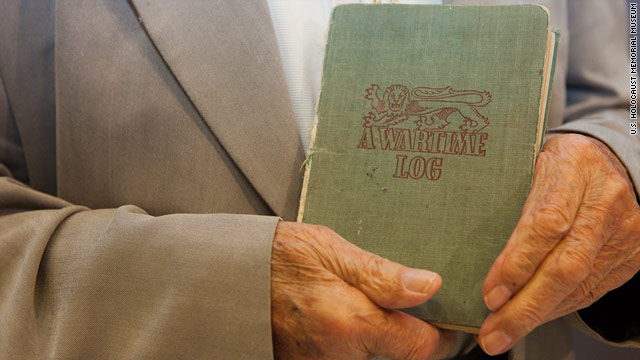
Washington (CNN) -- The tattered journal, its pages yellow with age, contains the painful memories of a U.S. medic, a man who recorded the deaths of soldiers who survived one of World War II's bloodiest battles yet met their end as slaves in Nazi Germany.

32. Hamilton 4-5-45
33. Young 4-5-45
34. Smith 4-9-45
35. Vogel 4-9-45
36. Wagner 4-9-45

"Some were dying," said its author, Tony Acevedo, now 86. "Some died, and I made a notation of that."

Flipping through the pages, you encounter a horrific part of world history through the eyes of a 20-year-old inside a slave labor camp. Amid the horror, the journal captures extraordinary human moments of war. Acevedo sketched beautiful women in the back pages, pinups whose eyes provided comfort amid hell.

Acevedo kept the diary hidden in his pants. He feared death if the commanders saw it. Yet he believed it was his duty as an Army medic to catalog the deaths and the atrocities against the 350 U.S. soldiers at the camp known as Berga, a subcamp of the notorious Buchenwald compound. Read full article...

Tuesday, January 19, 2010

Thomas Blatt, Survivor of Sobibor, Testifies Today

Thomas Blatt, one of only 53 survivors of the death camp Sobibor, lived for many years in Seattle and participated in the Holocaust Center's Speakers Bureau. He is testifying today against a former guard at Sobibor.


More on Thomas Blatt:
Blatt, Thomas Toivi. From the Ashes of Sobibor: A Story of Survival. Illinois: Northwestern University Press, 1997.
This book is a glimpse of Jewish life through the eyes of a twelve year old boy. The events of his separation from his family, six months in the Sobibor death camp, taking part in a successful uprising and finally the five years eluding Nazis and anti-Semitic nationalists.


Blatt, Thomas. Sobibor: The Forgotten Revolt - A Survivor's Report. H.E.P.; 1 edition, 1997.


"Escape from Sobibor" (DVD)
1999. Starring Rutger Hauer and Alan Arkin. Based in part on Thomas Blatt's story.


The above items are available to borrow from the Holocaust Center's library. Copies of From the Ashes of Sobibor can also be found in the Holocaust Center's high school teaching trunks.

Thomas Blatt's story and artifacts have been included in several of the Holocaust Center's materials, including the "Everyday Objects: Artifacts from Washington State Holocaust Survivors" poster series and the "Studying the Holocaust: Resistance, Rescue & Survival" Seattle Times Newspapers In Education series.

Wednesday, September 30, 2009

National Archives and Footnote.com Announce New Digital Holocaust Collection

Collection includes Holocaust-related photos and records available online for first time

Washington DC and Lindon, UT –September 29, 2009

The National Archives and Records Administration and Footnote.com today announced the release of the internet’s largest Interactive Holocaust Collection. For the first time ever, over one million Holocaust-related records – including millions of names and 26,000 photos from the National Archives– will be available online. The collection can be viewed at: http://www.footnote.com/holocaust/ .

“We cannot afford to forget this period in our history,” said Dr. Michael Kurtz, Assistant Archivist of the United States and author of America and the Return of Nazi Contraband: The Recovery of Europe's Cultural Treasures. “Working with Footnote, these records will become more widely accessible, and will help people now and in the future learn more about the events and impact of the Holocaust.”

Included among the National Archives records available online at Footnote.com are:

  • Concentration camp registers and documents from Dachau, Mauthausen, Auschwitz, and Flossenburg

  • The “Ardelia Hall Collection” of records relating to the Nazi looting of Jewish possessions, including looted art

  • Captured German records including deportation and death lists from concentration camps
    Nuremberg War Crimes Trial proceedings

Access to the collection will be available for free on Footnote.com through the month of October.

Read full article