As many of our readers already know, the Educational Institute for Democratic Renewal at the Woodring College of Education at Western Washington University, that houses the Journal of Educational Controversy, also partners with a creative, innovative and progressive school, the Whatcom Day Academy, to promote a democratic vision on what schools can be. Our work together is also associated with the League of Democratic Schools, a project initiated by educator, John Goodlad. On our institute’s page, readers can read about the philosophy of the school and view some of the videos featuring actual practices in the school along with a slide show of student art in which Susan Donnelly, the head of the school, guides the viewer into seeing more deeply into the artistic creations and evolution of young children’s drawings. On that page, the viewer can also view a section of a public forum that the Institute sponsored, in which teacher, Vale Hartley, describes her use of Socratic questioning with her young students along with short video clips that illustrate her technique. Readers can also read Vale’s article in our journal’s issue on Schooling as if Democracy Matters and Susan’s articles in our issue on Art, Social Imagination and Democratic Education.
One of the goals of both the Institute and the Whatcom Day Academy is to provide leadership to the community. I am so pleased to announce that Susan Donnelly in conjunction with Professor Matthew Miller of Western Washington University has received a $30000 grant that will enable them to both develop new ideas for childhood literacy practices but also to share their ideas with the community.
Congratulations to Susan and Matt. We hope to share more about this in future blogs.
But our readers will not have to wait too long to learn more about Susan’s school. Susan Donnelly is the co-editor for the upcoming summer issue of the Journal of Educational Controversy. In addition to our printed articles, readers can anticipate a lot of video footage highlighting innovative practices in schools. The theme for the issue is, “The Education and Schools Our Children Deserve.” For a look at another school in the League, see our post below on Schools that Make a Difference: A Look at the League of Democratic Schools.
Showing posts with label democratic education. Show all posts
Showing posts with label democratic education. Show all posts
Sunday, March 13, 2011

Friday, February 18, 2011
John Dewey: America's philosopher of democracy and his importance to education
Our journal's consulting editor, A.G. Rud, Dean of the College of Education at Washington State University, has produced a short YouTube video on "John Dewey: America's philosopher of democracy and his importance to education." As one commentary on YouTube put it, "Well done. Not an easy task to give an overview of JD and his more than 700 articles in 140 journals, and approximately 40 books." We agree.
Thursday, November 25, 2010
New Curriculum on Democracy and Jazz

Many of our readers will be interested in a new curriculum produced at Teachers College, Columbia University called, “Let Freedom Swing: Conversations on Democracy and Jazz.” On the eve of President Obama’s inauguration on January 20, 2009, a concert at the Kennedy Center in Washington, DC brought together Justice Sandra Day O’Connor and jazz musician, Wynton Marsalis. It was from this event that the idea of a curriculum based on two American traditions – jazz and democracy – was conceived. Readers can access the DVDs and study guide at: http://letfreedomswing.org//
From the website: “Three key themes structure the videos and study guide: “We the People,” “E Pluribus Unum” (From Many, One), and “A More Perfect Union.” Each video is about six minutes in length. The study guide contains questions for discussion, teaching activities, and additional resources. The website contains the three videos, the study guide, information about the project, and additional print, digital, and video resources.”
The journal has published an earlier article on another curriculum produced at Teachers College called, “Teaching the Levees: An Exercise in Democratic Dialogue.” We are planning on publishing an article on this latest curriculum in our upcoming issue next summer.
From the website: “Three key themes structure the videos and study guide: “We the People,” “E Pluribus Unum” (From Many, One), and “A More Perfect Union.” Each video is about six minutes in length. The study guide contains questions for discussion, teaching activities, and additional resources. The website contains the three videos, the study guide, information about the project, and additional print, digital, and video resources.”
The journal has published an earlier article on another curriculum produced at Teachers College called, “Teaching the Levees: An Exercise in Democratic Dialogue.” We are planning on publishing an article on this latest curriculum in our upcoming issue next summer.
Monday, October 4, 2010
Time for a Serious National Conversation on the Public Purposes of our Schools: An Interview with Bill Ayers

Readers will find the interview with Bill Ayers from Truthout.org an interesting departure from the mainsteam media's superficial coverage of our national debate on school reform. We reprint it in its entirety with permission from Truthout.org. In his interview, Ayers talks about the public purposes of schooling -- something often left out of the economic and privatized goals that have dominated the national debate -- and the real social and human conditions that need to be addressed. For readers who would like to read the article we published by Bill Ayers in our special issue on "Schooling as if Democracy Matters," go to: "Singing in Dark Times."
Back to School: An Interview With Bill Ayers
Friday 01 October 2010
by: Maya Schenwar, Executive Director, t r u t h o u t Interview
Reprinted by permission from Truthout.org
As the 2010-2011 school year grumbled to a start - and millions of public school students settled into overcrowded, underfunded, under-resourced classrooms - I sat down in Chicago with education theorist and activist Bill Ayers to discuss true democracy, false reform and his latest book (co-authored with cartoonist Ryan Alexander-Tanner), "To Teach: The Journey in Comics." In an educational culture increasingly permeated by top-down marketplace values, Ayers, who taught primary school for years, still believes in the possibility of a schooliverse where every teacher is respected and every student is valued as a full human being, where collaborative learning and growth trump the school-eat-school "Race to the Top." And by the end of our conversation, I did, too.
Maya Schenwar: In "To Teach," you talk about how a good school is defined by good teachers. What do you think of this practice that's been circling the country, of "reconstituting" schools and firing all the teachers? Does that logic work?
Bill Ayers: Not at all - not even close.
We're living in the darkest times for teachers that I've ever seen in my life. It's hard to fully understand how the conversation about what makes a robust, vital education for citizens in a democracy has degraded to the point where the frame of the whole discussion is that teachers are the problem. It's true that good schools are places where good teachers gather, but there's another piece to that: Good teachers need to be protected to teach, supported to teach, put into relationships with one another - and with the families of the kids - so that they can teach.
The attack on teachers is a classic example of what [cognitive linguist George] Lakoff calls "framing." We're hearing from every politician and editorial board in the land - including The New York Times and The Washington Post and The New Yorker - that we need to get the lazy, incompetent teachers out of the classroom. And everyone, including you and me, nods stupidly. Because what am I going to say? "My granddaughter deserves that lazy, incompetent teacher!" They're getting the conclusion that they want by framing the question as a statement. So there's only one answer; no one can take the other side of that proposition. But what if I got to the podium first and said, "Every kid in America deserves an intellectually grounded, morally committed, compassionate, caring, intelligent, thoughtful, well-rested and well-paid teacher in the classroom"? We'd agree with that, too! So, who gets to say what we're talking about?
There's always been a contest in this country between the notion of the public and the notion of the private individual. This is in our DNA: the struggle between a kind of radical individualism - that cowboy, pioneer, explorer mentality - and the idea of the common good. And this is fought out constantly. Since 1980, a sustained attack has been going on against the very idea of the public - that nothing public is useful or good, including the schools.
In the past five years, that attack on public education has ratcheted up to dimensions that were unthinkable 30 years ago. And so people talk about the public schools in a way that is disingenuous and dishonest - and also frightening in its characterization: they say the schools are run by a group of self-interested, selfish, undertrained, undercommitted teachers, who have a union that protects them.
An example: The New Yorker does a profile of a thing called the "rubber room" - a space in the central office where people who are judged incompetent to teach are awaiting adjudication under the contract. Remember, the contract doesn't only belong to the union, even though in The New Yorker and in the New York Times editorials, it's as if the contract is all the union - the school board is also party to the contract; they negotiated it! Anyway, The New Yorker profiles 15 teachers - and I have to admit, just like everyone else, it was lip-smackingly interesting to read about these very, very crazy people; how fun! But there were 15 of them, in this system of tens of thousands. Why is that what we're focused on? It's because a case is being built that somehow teachers and their unions are the whole cause of the misery.
What they're ignoring in all of these examples is the reality of poverty. They're ignoring the reality of lots and lots and lots of Americans who do not have a living wage. And if you want to change what's going on in schools, you have to realize that. We'd do more for education with a full-employment economy with a living wage than anything anyone can do by tinkering with the schools and firing teachers.
[Washington, DC, Chancellor of Education] Michelle Rhee got a cover story in Time Magazine right after Obama's election. She's the poster child for what they're calling "reform." The pivotal paragraph in that story says, "In the year and a half she's been on the job, Rhee has made more changes than most school leaders make in five years." It said she'd fired 36 principals, closed 21 schools, fired 270 teachers. Not a word about connecting the schools to their communities. Not a word about teacher retention. Not a word about the curriculum. Not a word about bringing resources to the starving system. She's a "reformer" because she's doing what the bosses of Enron did to Enron. That's ridiculous! A school is not like a business, and the market metaphor that's dominating the conversation actually misses everything important about schools.
This is the real tragedy for teachers: Education is like love. You can give it all away and still have plenty. You can share all the knowledge you have and not lose anything - except if you're in a system where one school is being judged against another school, one classroom against another classroom, one state against another state. Well, then - I'm not giving you my shit. You go ahead and struggle on your own, because you and I are in a vicious fight for the Race to the Top money, for teacher jobs, for everything. That's a catastrophe for the reality of how teaching is done at its best.
I speak to young teacher groups all the time, and I often start by asking, "Are any of you going into teaching because you think you'll get rich?" And they laugh. And then I say, "Are any of you thinking you'll have the overwhelming respect of your community?" They laugh again. And then they tell me, "My parents, my brother, my sister, my partner all told me not to teach." So I say, "Why are you gonna do it? What's wrong with you?" And what's "wrong" with them is a desire to do moral work in an immoral world. Yet, we're putting a stake in their hearts.
MS: And it's all about "fixing" the schools ...
BA: Right. If you read any of these stories about education - about KIPP [Knowledge Is Power Program], about Teach for America, about charter schools - all of [the media] have drunk the Kool-Aid on this ideological question of how to fix the schools. An example: There was a story in The New York Times after the recent Race to the Top competition. They say that Race to the Top is having a great effect on reform, even for those states that don't get it. What's the evidence? The "evidence" is that more schools have gone private, that the union is being crushed. That's the proof of reform!
In a New Yorker story on [Education Secretary] Arne Duncan, the writer says that in the world of school reform, there are two camps. One is the radical "reformers" who want to privatize everything; the other is those who defend the status quo. Really? I haven't seen one person defend the status quo! But that is the way the discussion is divided - there's not another side. So, my book "To Teach" from 20 years ago, and also the comic book, are an attempt to enter into this discussion on the side of teachers.
In the movie "Waiting for Superman," there's a cartoon aside that shows "how learning happens." They show the top of a kid's head being sawed off, and knowledge pouring in - and then the teachers' union and the bureaucrats come in and stop it. So, I'm arguing that learning is something quite different - and that a smart teacher is on a journey of discovery and exploration with the kids.
MS: How do you encourage that type of teaching on a national policy level? If you were Arne Duncan, what would you do?
BA: You have to start with the premises of a democracy. If you think about Nazi Germany, Soviet Russia, medieval Saudi Arabia, apartheid South Africa, every one of those countries had educational systems that wanted their kids to show up on time, learn their subject matter, stay away from drugs, not get pregnant. We all want the same things, except, in a democracy - at least theoretically - you also want to base your educational system on a profound democratic premise: the incalculable value of every human being. That means that the savage inequalities in the education are an affront to democracy. All the systems I mentioned - Nazi Germany, Soviet Russia - along with math and science and phys ed and music, they wanted obedience and conformity, and they taught it relentlessly. That's why you can have a Germany or an Italy or a South Africa that produced brilliant scientists and brilliant artists, and also produced a culture that could march people into the ovens. You can have an educated population that is morally blind.
Theoretically, we'd want something different in a democracy. Along with math, science, music and phys ed, we'd want you to develop a mind of your own - to learn initiative, courage, imagination, curiosity.
Back to the Arne Duncan question: I'd make it very clear that the standard we have for public education in this country is a standard of excellence and equity. I would use the bully pulpit to say that all kids should be able to have the education that my kids had and that the Obama kids had. I'm not going to impose it - but I'm going to say that that's what we're aspiring to as a minimum: small classes; dedicated, unionized teachers; well-resourced classrooms; encouragement of curiosity.
Secondly, I would keep the military out of the schools. The military bases itself on following orders, and education should base itself on initiating and being courageous - and not necessarily following orders. Education is about asking the queer questions. So, no recruitment, no ROTC, no JROTC. In the cabinet meetings, I'd say, "Secretary Gates, get your fucking hands off the schools."
Next, I would initiate the Septima Clark Ella Baker Teacher Corps. That would be a funded attempt - using the stimulus money - to hire unemployed people, mothers, community members as aides, as trainees, as literacy coaches. Get everybody in the schools, and spend money to do that. Because if we've got a class size of 35 in the second grade, I at least want community members in there, helping the teachers out.
Next, I'd initiate a gigantic, messy, national conversation that would take place in every neighborhood, every barrio, every ghetto of every city and every town, to raise the questions: "What knowledge and experiences are most valuable? What makes someone an educated person? How do we make that knowledge and experience accessible to all students?" That's not the business of Bill Gates; that's the business of all of us.
I would also invest in teachers. I'd turn the conversation from disrespect to respect. One of the ways I'd do that: every teacher, every five years, would get a one-semester sabbatical. They'd get to take free courses, organize their own courses, travel, like college professors do. There has to be a sabbatical, because teaching is that kind of work - it's exhausting on every level. Also, I'd create a system of mentoring, in which every teacher would have a partner and a coach. Not just young teachers. That way we create conditions for horizontal rather than vertical staff development: I learn from you, you learn from me. I want that to be the culture of the schools; not "racing to the top." That horizontal development is what we need for democracy.
MS: What about test scores? You've written about how, not only are they invasive and interfering with learning, but they're also ineffective for assessment. So, what can we do to assess kids in a way that will actually work?
BA: This goes back to what I was saying about investing in teachers. There are lots of assessments that work. You have to start with the idea that as a second-grade teacher, which I was for years, my interest is how to get these kids to read more and read better. I'm thinking, how do I take them from where they are to a deeper and wider way of knowing? That's my goal as a second-grade teacher. As a policy guy standing above it, I'd have a very different goal: ranking these kids from winners to losers.
Whatever we do in assessment ought to link back to the teacher, to allow her or him to do a better job. So, what we want is assessment that helps us teach, not assessment that says, "you win, you lose."
As I argue in the book, we need to do portfolio assessments. My nephew graduated from Central Park East High School in New York, a public experimental school in Harlem. In order to graduate from that high school, he had to put together a portfolio that included his grades and test scores, but those were just two out of 15 items. It also included an original essay, an original piece of art, a physical challenge that he'd set for himself as a freshman, a critique of a piece of public art, a record of community service, an internship, a work-study plan projected five years hence, and more - 15 items. And then he sat down with his adviser, a family member, a friend, the principal and a teacher that he picked, and defended his portfolio. Now that's assessment - in the hands of teachers, close to the kid, close to the family, close to the community. That can help to make an educated person.
If you start with the premise that each person is of incalculable value, it must mean that the full development of each kid in the school is the condition for the full development of everyone. And the full development of everyone is the condition for the full development of each kid. If you start with that idea, you end up with that type of assessment - rather than a punitive, top-down system where you rank kids on a scale, then tell some that they're going to the unemployment lines and the prisons.
Another thing that I get into in the book, about assessment: there's no such thing as a "normal third-grader" or a "normal three-year-old." There are three-year-olds who read, and there are three-year-olds who pee in their pants and there are three-year-olds who pee in their pants while reading. The range of people [in an age group] is vast - in terms of capacities, in terms of thoughtfulness, in terms of health - so the idea that you can say, "third-graders must be this way" is bullshit. What we ought to do is have support for teachers, small classrooms, a range of activities and a range of ways to succeed, with the goal of challenging kids to move from where they are to deeper and wider ways of knowing, being and experiencing.
MS: I loved the description in the comic book of Chicago public high school Lawndale Little Village, and how that school came about. Can you talk a little bit about how a school like that can emerge, through grassroots activism?
BA: Well, it started when a group of mothers got fed up with the overcrowding at their kids' schools, and said, "You know what? We're gonna sit in." So they [staged a] sit-in. It became an electrifying moment in the city. Mayor Daley was furious. Then [former Chicago Public Schools CEO] Paul Vallas went down there and scolded them. He said, "Don't do this! This is ridiculous." But he said it in such a nasty, patronizing way that when they showed it on the news, it must have really infuriated Daley - Vallas was gone within a week. Arne Duncan came in, and his first act was to meet with them and give them their school. So, this is activism with bite, with punch.
And then, these mothers were no-bullshit: They started meeting with [local education experts] and investigating what makes a good school. I remember going to one of the meetings in the neighborhood, and the mothers had just come back from visiting North Side Prep and New Trier [two very well-funded Chicago-area schools], and they were reporting back. They described the gym, the auditorium, the Olympic swimming pool. I said, "Why do you want an Olympic swimming pool?" And they said, "Because we want whatever the other kids get. We don't want our kids to get less." And in a democracy, that's what it should be.
MS: It's funny. School is where you're first absorbing this national message - that we live in a democracy where everyone has equal opportunity. But school is also where people are experiencing some of the most obvious inequalities.
BA: That's right. The New Yorker did a puff piece on Arne Duncan, and it points out that the Obama children and Arne Duncan himself (and, parenthetically, my children) all went to the University of Chicago Lab School. At the Lab School, they had a class size limit of 15. And how did they get that? A union contract.
So Arne Duncan, the Obama kids and my kids went to a school with a class size of 15, a well-respected union and a curriculum that's based at least in part on following kids' interests and curiosities. When the Obamas went to Washington, anyone who knew the Obamas and knew the scene in DC knew the kids would go to Sidwell Friends, and that's where they went - class size of 15, well-respected unionized teacher corps, curriculum based at least in part on kids following their interests. Now if that's good enough for the Obamas and Arne Duncan, why are those things not even part of the discussion about what's good enough for the west side of Chicago?
I'm not such an idealist that I think we could get there tomorrow, but right now, class size is not even on the table. In Chicago, second-graders can have a class of 35, because of the budget. That's 20 more than the Obama kids get! And does that make a difference in terms of educational outcomes, as well as teacher morale and capacity? Of course it does - I've been in classrooms; I know there's a difference between 15 and 20, let alone 35.
John Dewey said it brilliantly: He said that whatever the best and most privileged parents have for their kids should be the baseline for what we want for all kids. Anything less undermines our democracy.
http://www.truth-out.org/back-school-an-interview-with-bill-ayers63774
Saturday, September 11, 2010
The Global Infestation of U.S. Educational Ideas: A Cautionary Thought by Author Kay Ann Taylor
Editors: Today we welcome a post by guest blogger, Kay Ann Taylor. Our readers will remember the article that we published in our winter 2009 issue of the Journal of Educational Controversy by Kay Ann Taylor, entitled, Poverty's Multiple Dimensions. In today's post, Dr. Taylor reflects on her recent visit to a conference she attended in Istanbul, Turkey where she learned about the extent that the United States focus on standardized testing has had on the educational thinking in other nations. Historically, U.S. educational ideas have had an influence around the world. Our author asks us to think about what ideas we are exporting today and if this is the "best the U.S. has to offer."
Exporting U.S. Education: Is Standardized Testing the Best the U.S. Has to Offer?
by Kay Ann Taylor
Kansas State University
As an educator and an individual, a major personal bias and belief is my non-belief in standardized testing (ST). With the onset and passing of No Child Left Behind (NCLB), the festering in American education surrounding standardized testing has reached the status of some god-like or pagan entity that determines the futures of not only our children, but our teachers, schools, communities, country, and impacts our global efficacy. Those who are not educators (politicians) continue to direct and dictate policies and practices to those who are. How can and why does the American public at large and in general succumb to the edicts of this flawed, detrimental, and demeaning measure of human capacity? And, more to the point, why and how did exporting U.S. ST become so welcome, so revered, and, received so uncritically by our global community? Like cancer, the disease of U.S. standardized testing infects the global arena. I remain critical and skeptical regarding the gate-keeping effects of ST in terms of its impact and outcome on the lives, futures, education, thinking, and psyches of the human enterprise.
The polar views in the U.S. regarding ST are far from new. They are divergent in philosophical orientation, utility, purpose, interpretation, and implementation. There are scholars that support ST. Conversely, numerous scholars continue to challenge the oppressive nature of ST in that it lacks context and marginalizes English language learners, learners from low socioeconomic status, creates winners vs losers. Critics argue further that ST in no way represents learning, knowledge, understanding, much less real-life application. Additionally and importantly, some scholars contend that ST is racist and gender-biased. There is a distorted Darwinian element ingrained in ST, i.e., the survival of the fittest, which misrepresents Darwin for one, and rather, serves the interests of those seeking to maintain the status quo. Further, ST represents an outdated factory system of education that serves social efficiency, social control, social reproduction, and maintains the status quo for social mobility, thus begging the question, “Whose interests are served by standardized tests?” Believing that humans can be ranked, filed, and sorted on the basis of ST is one of the most destructive and dehumanizing practices education faces.
Standardized testing is big business. This hit me squarely during a session at the World Council of Comparative Education Societies this June (2010) in Istanbul, Turkey. I co-presented with my former M.S. student (now pursuing her Ph.D. in Russian Literature at another institution while teaching Russian Language at our university) based on her historical and qualitative thesis research in which she compared the first-ever national 2008 External Knowledge Testing in her Ukrainian country of origin to the historical onset of ST in the U.S. We went to our session location in advance to familiarize ourselves with the setting and to ensure the technology was in place. A Lebanese professor, who teaches in higher education in her country of origin, was there to attend the session and started a conversation with us. The title of our presentation, "Border Transmission and Reproduction Déjà Vu: Ukrainian External Independent Knowledge Testing—Reflections in the Mirror of U.S. Standardized Testing," captured her interest. Even before the session began, we discovered our topic was controversial because of our critical perspective.
As conference sessions go, ours was well attended by 25-30 people from almost as many different countries represented. There were two other countries and comparative topics in our session. Questions for all presenters were held until the end after everyone presented. Evidently, I have been naïve for quite some time because I was unprepared for the lively Q&A that followed regarding our research. Until our session, I remained blissfully unaware the extent to which ST from the U.S. has been exported globally. Plainly, we struck a nerve with most of our colleagues. From the discussion that followed directed at our research, it appeared to us that ST not only is well-received by our global counterparts, but that for many, it never was questioned critically regarding the numerous flaws and negative effects noted above.
After our session, I went outside to relax briefly. A young lady who attended our session stopped to visit with me. She is Brazilian by birth and informed me that Brazilian higher education institutions require the GRE. When I brought up my passion for Critical Race Theory (CRT), she smiled and informed me that she studied for three years with Kimberlé Crenshaw, Cheryl Harris, and Claude Steele—all prominent CRT scholars. She likely was the only individual attending our session who was familiar with, understood, much less agreed with, our position.
This experience provided considerable material for my reflection. After returning from the conference, I visited with a colleague and shared what happened. To my surprise, he challenged our critical assessment of ST and informed me that he knows personally an administrator for one of the major testing companies in the U.S. He explained that in his conversation with this person, he was informed that the company exercises care in test construction with the host country’s interested parties to ensure native language and culture are represented and not misinterpreted. After visiting the company’s web site to see for myself, I engaged in more reflection about this phenomenon. What struck me is that what is highly likely in this international ST-creating process is that the same flaws and biases inherent in the U.S. system also are reproduced in each country constructing “culturally sensitive” ST. For example, as stated above, ST represents an outdated factory model of schooling in the U.S., especially in terms of social efficiency, social control, and maintaining social mobility for the status quo. As I continued my conversation with my colleague, I continued to delineate the negative aspects of ST. One comment made by my colleague that struck yet another chord, was his statement that ST in many countries is used for placement in education. This, of course, also caused me consternation as I responded that placement represents tracking—from my perspective yet one more oppressive and outdated practice that remains deeply entrenched to the detriment of many in the U.S. In a final attempt to convince my colleague, I posed the question, “Do we want our students to be good test takers or to be able to understand, engage, embrace creativity, and be able to apply what they know?” It was this question that finally afforded success in relaying my concerns about ST to my colleague.
I continue to contemplate this conundrum of ST plaguing our schools and educational system in the U.S. With every semester since the passing of NCLB, my undergraduate foundations preservice students enter my class increasingly expecting me to tell them what to think and how to do “it”. Colleagues at other institutions indicate similar observations in their parallel classes. I anticipate that this will continue to worsen with each class of K-12 students in our public education environments who are subjected to the edicts of NCLB.
Thus, I now am acutely and painfully aware of the global infestation of ST. The oppressive biases and stultifying effects of ST now appear to be accepted uncritically in numerous countries. Moreover, ST reinforces competition and isolation rather than cooperation, collaboration, and understanding—the latter qualities needed to serve all humans productively in our global setting. U.S. education is revered deeply by many international communities. Will this, in turn, affect the success of international professionals seeking to live and work in the U.S.? Will ST ensure for them that they are no longer required to start their education over in the U.S. in order to pursue a profession they were educated for and practiced, perhaps for decades, in their country of origin but their “foreign” education and experience is inadequate by U.S. standards? I doubt it.
Ultimately, my question remains: Is exporting standardized testing the best practice U.S. education has to offer?
Kay Ann Taylor is Associate Professor of the Foundations of Education, American Ethnic Studies at Kansas State University. Her article, the Poverty's Multiple Perspectives, appeared in our winter 2009 issue of the Journal of Educational Controversy on the theme, The Hidden Dimensions of Poverty: Rethinking Poverty and Education.
Exporting U.S. Education: Is Standardized Testing the Best the U.S. Has to Offer?
by Kay Ann Taylor
Kansas State University
As an educator and an individual, a major personal bias and belief is my non-belief in standardized testing (ST). With the onset and passing of No Child Left Behind (NCLB), the festering in American education surrounding standardized testing has reached the status of some god-like or pagan entity that determines the futures of not only our children, but our teachers, schools, communities, country, and impacts our global efficacy. Those who are not educators (politicians) continue to direct and dictate policies and practices to those who are. How can and why does the American public at large and in general succumb to the edicts of this flawed, detrimental, and demeaning measure of human capacity? And, more to the point, why and how did exporting U.S. ST become so welcome, so revered, and, received so uncritically by our global community? Like cancer, the disease of U.S. standardized testing infects the global arena. I remain critical and skeptical regarding the gate-keeping effects of ST in terms of its impact and outcome on the lives, futures, education, thinking, and psyches of the human enterprise.
The polar views in the U.S. regarding ST are far from new. They are divergent in philosophical orientation, utility, purpose, interpretation, and implementation. There are scholars that support ST. Conversely, numerous scholars continue to challenge the oppressive nature of ST in that it lacks context and marginalizes English language learners, learners from low socioeconomic status, creates winners vs losers. Critics argue further that ST in no way represents learning, knowledge, understanding, much less real-life application. Additionally and importantly, some scholars contend that ST is racist and gender-biased. There is a distorted Darwinian element ingrained in ST, i.e., the survival of the fittest, which misrepresents Darwin for one, and rather, serves the interests of those seeking to maintain the status quo. Further, ST represents an outdated factory system of education that serves social efficiency, social control, social reproduction, and maintains the status quo for social mobility, thus begging the question, “Whose interests are served by standardized tests?” Believing that humans can be ranked, filed, and sorted on the basis of ST is one of the most destructive and dehumanizing practices education faces.
Standardized testing is big business. This hit me squarely during a session at the World Council of Comparative Education Societies this June (2010) in Istanbul, Turkey. I co-presented with my former M.S. student (now pursuing her Ph.D. in Russian Literature at another institution while teaching Russian Language at our university) based on her historical and qualitative thesis research in which she compared the first-ever national 2008 External Knowledge Testing in her Ukrainian country of origin to the historical onset of ST in the U.S. We went to our session location in advance to familiarize ourselves with the setting and to ensure the technology was in place. A Lebanese professor, who teaches in higher education in her country of origin, was there to attend the session and started a conversation with us. The title of our presentation, "Border Transmission and Reproduction Déjà Vu: Ukrainian External Independent Knowledge Testing—Reflections in the Mirror of U.S. Standardized Testing," captured her interest. Even before the session began, we discovered our topic was controversial because of our critical perspective.
As conference sessions go, ours was well attended by 25-30 people from almost as many different countries represented. There were two other countries and comparative topics in our session. Questions for all presenters were held until the end after everyone presented. Evidently, I have been naïve for quite some time because I was unprepared for the lively Q&A that followed regarding our research. Until our session, I remained blissfully unaware the extent to which ST from the U.S. has been exported globally. Plainly, we struck a nerve with most of our colleagues. From the discussion that followed directed at our research, it appeared to us that ST not only is well-received by our global counterparts, but that for many, it never was questioned critically regarding the numerous flaws and negative effects noted above.
After our session, I went outside to relax briefly. A young lady who attended our session stopped to visit with me. She is Brazilian by birth and informed me that Brazilian higher education institutions require the GRE. When I brought up my passion for Critical Race Theory (CRT), she smiled and informed me that she studied for three years with Kimberlé Crenshaw, Cheryl Harris, and Claude Steele—all prominent CRT scholars. She likely was the only individual attending our session who was familiar with, understood, much less agreed with, our position.
This experience provided considerable material for my reflection. After returning from the conference, I visited with a colleague and shared what happened. To my surprise, he challenged our critical assessment of ST and informed me that he knows personally an administrator for one of the major testing companies in the U.S. He explained that in his conversation with this person, he was informed that the company exercises care in test construction with the host country’s interested parties to ensure native language and culture are represented and not misinterpreted. After visiting the company’s web site to see for myself, I engaged in more reflection about this phenomenon. What struck me is that what is highly likely in this international ST-creating process is that the same flaws and biases inherent in the U.S. system also are reproduced in each country constructing “culturally sensitive” ST. For example, as stated above, ST represents an outdated factory model of schooling in the U.S., especially in terms of social efficiency, social control, and maintaining social mobility for the status quo. As I continued my conversation with my colleague, I continued to delineate the negative aspects of ST. One comment made by my colleague that struck yet another chord, was his statement that ST in many countries is used for placement in education. This, of course, also caused me consternation as I responded that placement represents tracking—from my perspective yet one more oppressive and outdated practice that remains deeply entrenched to the detriment of many in the U.S. In a final attempt to convince my colleague, I posed the question, “Do we want our students to be good test takers or to be able to understand, engage, embrace creativity, and be able to apply what they know?” It was this question that finally afforded success in relaying my concerns about ST to my colleague.
I continue to contemplate this conundrum of ST plaguing our schools and educational system in the U.S. With every semester since the passing of NCLB, my undergraduate foundations preservice students enter my class increasingly expecting me to tell them what to think and how to do “it”. Colleagues at other institutions indicate similar observations in their parallel classes. I anticipate that this will continue to worsen with each class of K-12 students in our public education environments who are subjected to the edicts of NCLB.
Thus, I now am acutely and painfully aware of the global infestation of ST. The oppressive biases and stultifying effects of ST now appear to be accepted uncritically in numerous countries. Moreover, ST reinforces competition and isolation rather than cooperation, collaboration, and understanding—the latter qualities needed to serve all humans productively in our global setting. U.S. education is revered deeply by many international communities. Will this, in turn, affect the success of international professionals seeking to live and work in the U.S.? Will ST ensure for them that they are no longer required to start their education over in the U.S. in order to pursue a profession they were educated for and practiced, perhaps for decades, in their country of origin but their “foreign” education and experience is inadequate by U.S. standards? I doubt it.
Ultimately, my question remains: Is exporting standardized testing the best practice U.S. education has to offer?
Kay Ann Taylor is Associate Professor of the Foundations of Education, American Ethnic Studies at Kansas State University. Her article, the Poverty's Multiple Perspectives, appeared in our winter 2009 issue of the Journal of Educational Controversy on the theme, The Hidden Dimensions of Poverty: Rethinking Poverty and Education.
Monday, July 12, 2010
An Impassioned Defense of Public Education: Diane Ravitch's Speech before the NEA

Below is a transcript of the speech by Diane Ravitch that was delivered before the 2010 Representative Assembly of the National Education Association. We reproduce it with her permission in its entirety to inform our readership.
Ravitch's new book,The Death and Life of the Great American School System: How Testing and Choice Are Undermining Education, questions many of her earlier commitments as the Assistant Secretary of Education under the President George H. W. Bush. In her impassioned speech before the National Education Association, where she received its Friend of Education award, Ravitch takes a critical look at the state of today's educational reform movement, the consequences that have followed its implementation, and the betrayal of public education as the "backbone of this democracy."
Speech Delivered at the 2010 NEA Representative Assembly
by Diane Ravitch
Thank you, John Wilson. [Ed.: Dr. Ravitch points out that the transcript on the NEA website omitted her acknowledgement of Dennis Van Roekel as well as John Wilson.] Thank you, all my friends in the NEA. Thanks to all my new friends in Colorado and Massachusetts and California. Thank you so much, California. The first time I spoke about my book was before the NEA scholars group in October. But the first time I went public was in San Jose, California. Thank you.
Let me first thank you so sincerely for this honor. I accept it with humility, with gratitude, and with respect for the more than three million educators that it represents.
Next, I would especially like to thank Camille Zombro of San Diego. Without Camille and without her help and the help of teachers in San Diego, I could not have written chapter 4 of the book. Read it and you will see why.
Well, it’s kind of amazing that this convention is being held in New Orleans. I was, just a few minutes ago, interviewed by documentary filmmakers who said to me, “Well, don’t you know that New Orleans is proving a new model?” The new model consists of wiping out public education and firing the unions, and it’s spreading across the country. And I said, “God forbid.” I pointed out to them what we all used to know, which is that public education is the backbone of this democracy, and we cannot turn it over to privateers.
Since my book appeared in early March, I have started out on what I thought would be a conventional book tour, but it really has turned into a whistle-stop campaign. I have been to 40 different cities and districts. I have another 40 planned starting in September. I talked to union members, to school board members, to administrators, to left-wing think tanks, to right-wing think tanks. I have met with high-level White House staff. I have met with about 40 members of Congress. I would say that I have met so far about 20,000 teachers, and after today I think I am going to increase it to 30,000.
And in all of this time, aside from the right-wing think tanks, I haven’t seen met a single teacher who likes what’s happening? I haven’t met a single teacher who thinks that No Child Left Behind has been a success. I haven’t met a single teacher who thinks that Race to the Top is a good idea.
Wherever I went, I met teachers who understood that there is a rising tide of hostility to teachers, to the teaching profession, and to teachers’ unions. You see it almost daily in the national media, in Newsweek magazine with its dreadful cover story about firing teachers, and Time magazine with awful columns, and in the New York Times and the Washington Post and all of the major media.
And as I talk to teachers, by the end of my talk, I hear the same questions again and again: What can we do? How can we stop the attacks on teachers and on the teaching profession? Why is the media demonizing unions? Why does the media constantly criticize public schools? And why does it lionize charter schools? Why is Arne Duncan campaigning with Newt Gingrich? Why has the Obama Administration built its education agenda on the punitive failed strategies of No Child Left Behind?
And teachers want to know, as you want to know, who will stand up for public schools and their teachers? At every appearance that I’ve made, teachers would come up to me afterward and they would say to me, “Stand up for us. Speak for us. Be our voice wherever you go.” And I promised that I would, and I have.
I promised to speak out against No Child Left Behind. It’s a disaster. It has turned our schools into testing factories. Its requirement that 100 percent of students will be proficient by the year 2014 is totally unrealistic. Any teacher could have told them that. Thousands and thousands of schools have been stigmatized as failing schools because they could not reach a goal that no state, no nation, and no district has ever reached. By setting an impossible goal, No Child Left Behind has delegitimized public education and created a rhetoric of failure and paved the way for privatization.
I will continue to speak out against high-stakes testing. It undermines education. High-stakes testing promotes cheating, gaming the system, teaching to bad tests, narrowing the curriculum. High-stakes testing means less time for the arts, less time for history or geography or civics or foreign languages or science.
We see schools across America dropping physical education. We see them dropping music. We see them dropping their arts programs, their science programs, all in pursuit of higher test scores. This is not good education.
I have been told by some people in the Obama Administration that the way to stop the narrowing of the curriculum is to test everything. In fact, the chancellor in Washington, D.C., the other day announced she plans to do exactly that. That means less time for instruction, more time for testing, and a worse education for everyone.
In speaking out, I have consistently warned about the riskiness of school choice. Its benefits are vastly overstated. It undercuts public education by enabling charter schools to skim the best students in poor communities. As our society pursues these policies, we will develop a bifurcated system, one for the haves, another for the have-nots, and politicians have the nerve to boast about such an outcome.
Public schools, as I said before, are a cornerstone of our democratic society. If we chip away at support for them, we erode communal responsibility for a vital public institution.
Teachers are rightly worried about the Race to the Top. I pledged to keep asking again and again why a Race to the Top replaced equal educational opportunity. Equal educational opportunity is the American way. The race will have a few winners and a lot of losers. That’s what a race means.
Race to the Top encourages states to increase the number of privately managed charters, to pass laws to evaluate teachers by test scores, to promote merit pay, and to agree to close or privatize schools with low scores or to fire all or part of their staff. All of this is wrong.
And thank you for passing a resolution expressing no confidence in Race to the Top. Why expand the number of charters when research shows that on average they don’t get better results than regular public schools? Last year, a major evaluation showed that one out of every six charters will get better results, five out of six charters will get no different results or worse results than the regular public schools. A report released just a couple of weeks ago by Mathematica Policy Research once again shows charter middle schools do not get better results than regular public middle schools.
The National Assessment of Educational Progress, on whose board I served for seven years, has tested charter schools since 2003. In 2003, 2005, 2007 and 2009, charter schools were compared to regular public schools and have never shown an advantage over regular public schools. Charter schools, contrary to Bill Gates, are not more innovative than regular public schools. The business model and methods of charter schools is this — longer school days, longer hours, longer weeks, and about 95 percent of charter schools are non-union.
Teachers are hired and fired at will. Teachers work 50, 60, 70 hours a week. They are expected to burn out after two or three years when they can be replaced. No pension worries, no high salaries. This is not a template for American education.
If we pursue the path of privatization and deregulation, we better keep in mind what happened with the stock market in 2008. And to those who tout the benefits of vouchers and charters, I want you to point out this example to them, of Milwaukee, Wisconsin. Milwaukee has had charters and vouchers now for almost 20 years. Twenty years with vouchers, almost 20 years with charters.
They have seen a steadily declining enrollment in the public schools, and meanwhile research now shows that African-American students in Milwaukee, the supposed beneficiary of all of this choice, have test scores on the National Assessment of Educational Progress, test scores that are below those of their African-American peers in Mississippi and Louisiana.
There was no rising tide. Choice promoted no rising tide, and no boats were lifted. While all of this money was invested in choice, there were no benefits to the students.
The Race to the Top plan to use test scores to evaluate teachers is a very bad idea, badly implemented. Legislatures should not decide how to evaluate teachers.
SB6 was wrong in Florida. Thank you to the Florida Education Association and to all the parents and friends who stood with you who defeated that pernicious piece of legislation. And thanks to you for persuading Governor Charlie Crist to do the right thing by vetoing it. Now you have got to make sure that whoever is the next governor will veto it again if it dares to come back again.
191 is wrong in Colorado. Sorry to say that it was passed. It was signed into law, and the teachers may stand to be fired because the test scores didn’t go up consistently. And these are matters that are, in many cases, beyond their control. Teachers should be judged by professional standards and not by a political process. Research does not support evaluating teachers by test scores.
Students are not randomly assigned to classes. Teachers’ so-called effectiveness fluctuates depending on which students happen to be in a teacher’s class. The single most reliable predictor of test scores is poverty, and poverty, in turn, is correlated to student attendance, to family support, and to the school’s resources.
And perhaps we should begin demanding that school districts be held accountable for providing the resources that schools need. Just like No Child Left Behind, Race to the Top requires and pressures districts to close low-performing schools. The overwhelming majority of low-performing schools enroll students in poverty and students who don’t speak English and students who are homeless and transient. Very often, these schools have heroic staffs who are working with society’s neediest children. These teachers deserve praise, not pink slips. Closing schools weakens communities. It’s not a good idea to weaken communities. No school was ever improved by closing it.
You know, a lot of teachers don’t pay attention to the national scene. They are busy teaching kids. They don’t pay attention to what’s happening in Washington. But when the Central Falls staff, the entire staff, was fired without a single teacher having an evaluation, the message went out that there is a new game of punishing teachers. And the message also went out when this was endorsed by Secretary Duncan and then reaffirmed by President Obama. This is not a good message.
We should thank our teachers, not fire them, not threaten them, and not close their schools.
Merit pay is another of the useless fads of our time. Merit pay has nothing to do with education. It destroys teamwork. It incentivizes teachers to compete with each other for money instead of collaborating for each other for the benefit of children.
Teachers need to share what they know and work towards one common goal — helping children and young people grow and develop. Merit pay will promote teaching to not very good tests. It may or may not improve scores, but it definitely will not improve education.
I have spoken out repeatedly to defend the right of teachers to join unions for their protection and the protection of the teaching profession. Teachers have a right to a collective voice in the political process. It’s the American way. I don’t see the Wall Street Journal or the Washington Post or the pundits complaining about the charter school lobby. I don’t see them complaining about the investment bankers lobby, or any other group that speaks on behalf of its members. Only teachers’ unions are demonized these days.
Currently, there is a campaign underway to eliminate tenure and seniority. To remove job protections from senior teachers would destroy the profession. Supervisors will save money by firing the most expensive teachers. Imagine a hospital staffed by residents and interns with no doctors. Bad idea.
Instead of the current wave of so-called reforms, we should ask ourselves how to deliver on our belief that every student in this nation should learn not only basic skills, but should have a curriculum that includes the arts, history, geography, civics, foreign languages, mathematics, science, physical education, and health. But instead of this kind of rich curriculum, all they are getting is a heavy dose of high-stakes testing and endless test preparation. And as the stakes increase for teachers and schools, there will be more emphasis on test prep and not what children need.
Policymakers have been far too silent about the role of the family. Teachers know that education begins at home, and that when families take responsibility, students are likely to arrive in school ready to learn. We need, not a Race to the Top, but a commitment to provide greater resources for those children who are in the greatest need. Schools and school districts continue to vary dramatically in their access to resources. The role of the federal government in education is to level the playing field, not to set off a competition for money. Nor do we expect the federal government to tell states and districts how to reform themselves based on the Chicago experience.
Around the world, those nations that are successful recognize that the best way to improve school is to improve the education profession. We need expert teachers, not a steady influx of novices.
We need experienced principals who are themselves master teachers. We do not need a wave of newcomers who took a course called “How to be a principal.” We need superintendents who are wise and experienced educators, not lawyers and businessmen.
The current so-called reform movement is pushing bad ideas. No high-performing nation in the world is privatizing its schools, closing its schools, and inflicting high-stakes testing on every subject on its children. The current reform movement wants to end tenure and seniority, to weaken the teaching profession, to silence teachers’ unions, to privatize large sectors of public education. Don’t let it happen!
So here’s a thought for NEA. Print up four million bumper stickers that say, “I am a public schoolteacher, and I vote — and so does my family.”
Do not support any political figure who opposes public education. Stand up to the attacks on public education. Don’t give them half a loaf, because they will be back the next day for another slice, and the day after that for another slice.
Don’t compromise. Stand up for teachers. Stand up public education, and say “No mas, no mas." Thank you.
Ravitch's new book,The Death and Life of the Great American School System: How Testing and Choice Are Undermining Education, questions many of her earlier commitments as the Assistant Secretary of Education under the President George H. W. Bush. In her impassioned speech before the National Education Association, where she received its Friend of Education award, Ravitch takes a critical look at the state of today's educational reform movement, the consequences that have followed its implementation, and the betrayal of public education as the "backbone of this democracy."
Speech Delivered at the 2010 NEA Representative Assembly
by Diane Ravitch
Thank you, John Wilson. [Ed.: Dr. Ravitch points out that the transcript on the NEA website omitted her acknowledgement of Dennis Van Roekel as well as John Wilson.] Thank you, all my friends in the NEA. Thanks to all my new friends in Colorado and Massachusetts and California. Thank you so much, California. The first time I spoke about my book was before the NEA scholars group in October. But the first time I went public was in San Jose, California. Thank you.
Let me first thank you so sincerely for this honor. I accept it with humility, with gratitude, and with respect for the more than three million educators that it represents.
Next, I would especially like to thank Camille Zombro of San Diego. Without Camille and without her help and the help of teachers in San Diego, I could not have written chapter 4 of the book. Read it and you will see why.
Well, it’s kind of amazing that this convention is being held in New Orleans. I was, just a few minutes ago, interviewed by documentary filmmakers who said to me, “Well, don’t you know that New Orleans is proving a new model?” The new model consists of wiping out public education and firing the unions, and it’s spreading across the country. And I said, “God forbid.” I pointed out to them what we all used to know, which is that public education is the backbone of this democracy, and we cannot turn it over to privateers.
Since my book appeared in early March, I have started out on what I thought would be a conventional book tour, but it really has turned into a whistle-stop campaign. I have been to 40 different cities and districts. I have another 40 planned starting in September. I talked to union members, to school board members, to administrators, to left-wing think tanks, to right-wing think tanks. I have met with high-level White House staff. I have met with about 40 members of Congress. I would say that I have met so far about 20,000 teachers, and after today I think I am going to increase it to 30,000.
And in all of this time, aside from the right-wing think tanks, I haven’t seen met a single teacher who likes what’s happening? I haven’t met a single teacher who thinks that No Child Left Behind has been a success. I haven’t met a single teacher who thinks that Race to the Top is a good idea.
Wherever I went, I met teachers who understood that there is a rising tide of hostility to teachers, to the teaching profession, and to teachers’ unions. You see it almost daily in the national media, in Newsweek magazine with its dreadful cover story about firing teachers, and Time magazine with awful columns, and in the New York Times and the Washington Post and all of the major media.
And as I talk to teachers, by the end of my talk, I hear the same questions again and again: What can we do? How can we stop the attacks on teachers and on the teaching profession? Why is the media demonizing unions? Why does the media constantly criticize public schools? And why does it lionize charter schools? Why is Arne Duncan campaigning with Newt Gingrich? Why has the Obama Administration built its education agenda on the punitive failed strategies of No Child Left Behind?
And teachers want to know, as you want to know, who will stand up for public schools and their teachers? At every appearance that I’ve made, teachers would come up to me afterward and they would say to me, “Stand up for us. Speak for us. Be our voice wherever you go.” And I promised that I would, and I have.
I promised to speak out against No Child Left Behind. It’s a disaster. It has turned our schools into testing factories. Its requirement that 100 percent of students will be proficient by the year 2014 is totally unrealistic. Any teacher could have told them that. Thousands and thousands of schools have been stigmatized as failing schools because they could not reach a goal that no state, no nation, and no district has ever reached. By setting an impossible goal, No Child Left Behind has delegitimized public education and created a rhetoric of failure and paved the way for privatization.
I will continue to speak out against high-stakes testing. It undermines education. High-stakes testing promotes cheating, gaming the system, teaching to bad tests, narrowing the curriculum. High-stakes testing means less time for the arts, less time for history or geography or civics or foreign languages or science.
We see schools across America dropping physical education. We see them dropping music. We see them dropping their arts programs, their science programs, all in pursuit of higher test scores. This is not good education.
I have been told by some people in the Obama Administration that the way to stop the narrowing of the curriculum is to test everything. In fact, the chancellor in Washington, D.C., the other day announced she plans to do exactly that. That means less time for instruction, more time for testing, and a worse education for everyone.
In speaking out, I have consistently warned about the riskiness of school choice. Its benefits are vastly overstated. It undercuts public education by enabling charter schools to skim the best students in poor communities. As our society pursues these policies, we will develop a bifurcated system, one for the haves, another for the have-nots, and politicians have the nerve to boast about such an outcome.
Public schools, as I said before, are a cornerstone of our democratic society. If we chip away at support for them, we erode communal responsibility for a vital public institution.
Teachers are rightly worried about the Race to the Top. I pledged to keep asking again and again why a Race to the Top replaced equal educational opportunity. Equal educational opportunity is the American way. The race will have a few winners and a lot of losers. That’s what a race means.
Race to the Top encourages states to increase the number of privately managed charters, to pass laws to evaluate teachers by test scores, to promote merit pay, and to agree to close or privatize schools with low scores or to fire all or part of their staff. All of this is wrong.
And thank you for passing a resolution expressing no confidence in Race to the Top. Why expand the number of charters when research shows that on average they don’t get better results than regular public schools? Last year, a major evaluation showed that one out of every six charters will get better results, five out of six charters will get no different results or worse results than the regular public schools. A report released just a couple of weeks ago by Mathematica Policy Research once again shows charter middle schools do not get better results than regular public middle schools.
The National Assessment of Educational Progress, on whose board I served for seven years, has tested charter schools since 2003. In 2003, 2005, 2007 and 2009, charter schools were compared to regular public schools and have never shown an advantage over regular public schools. Charter schools, contrary to Bill Gates, are not more innovative than regular public schools. The business model and methods of charter schools is this — longer school days, longer hours, longer weeks, and about 95 percent of charter schools are non-union.
Teachers are hired and fired at will. Teachers work 50, 60, 70 hours a week. They are expected to burn out after two or three years when they can be replaced. No pension worries, no high salaries. This is not a template for American education.
If we pursue the path of privatization and deregulation, we better keep in mind what happened with the stock market in 2008. And to those who tout the benefits of vouchers and charters, I want you to point out this example to them, of Milwaukee, Wisconsin. Milwaukee has had charters and vouchers now for almost 20 years. Twenty years with vouchers, almost 20 years with charters.
They have seen a steadily declining enrollment in the public schools, and meanwhile research now shows that African-American students in Milwaukee, the supposed beneficiary of all of this choice, have test scores on the National Assessment of Educational Progress, test scores that are below those of their African-American peers in Mississippi and Louisiana.
There was no rising tide. Choice promoted no rising tide, and no boats were lifted. While all of this money was invested in choice, there were no benefits to the students.
The Race to the Top plan to use test scores to evaluate teachers is a very bad idea, badly implemented. Legislatures should not decide how to evaluate teachers.
SB6 was wrong in Florida. Thank you to the Florida Education Association and to all the parents and friends who stood with you who defeated that pernicious piece of legislation. And thanks to you for persuading Governor Charlie Crist to do the right thing by vetoing it. Now you have got to make sure that whoever is the next governor will veto it again if it dares to come back again.
191 is wrong in Colorado. Sorry to say that it was passed. It was signed into law, and the teachers may stand to be fired because the test scores didn’t go up consistently. And these are matters that are, in many cases, beyond their control. Teachers should be judged by professional standards and not by a political process. Research does not support evaluating teachers by test scores.
Students are not randomly assigned to classes. Teachers’ so-called effectiveness fluctuates depending on which students happen to be in a teacher’s class. The single most reliable predictor of test scores is poverty, and poverty, in turn, is correlated to student attendance, to family support, and to the school’s resources.
And perhaps we should begin demanding that school districts be held accountable for providing the resources that schools need. Just like No Child Left Behind, Race to the Top requires and pressures districts to close low-performing schools. The overwhelming majority of low-performing schools enroll students in poverty and students who don’t speak English and students who are homeless and transient. Very often, these schools have heroic staffs who are working with society’s neediest children. These teachers deserve praise, not pink slips. Closing schools weakens communities. It’s not a good idea to weaken communities. No school was ever improved by closing it.
You know, a lot of teachers don’t pay attention to the national scene. They are busy teaching kids. They don’t pay attention to what’s happening in Washington. But when the Central Falls staff, the entire staff, was fired without a single teacher having an evaluation, the message went out that there is a new game of punishing teachers. And the message also went out when this was endorsed by Secretary Duncan and then reaffirmed by President Obama. This is not a good message.
We should thank our teachers, not fire them, not threaten them, and not close their schools.
Merit pay is another of the useless fads of our time. Merit pay has nothing to do with education. It destroys teamwork. It incentivizes teachers to compete with each other for money instead of collaborating for each other for the benefit of children.
Teachers need to share what they know and work towards one common goal — helping children and young people grow and develop. Merit pay will promote teaching to not very good tests. It may or may not improve scores, but it definitely will not improve education.
I have spoken out repeatedly to defend the right of teachers to join unions for their protection and the protection of the teaching profession. Teachers have a right to a collective voice in the political process. It’s the American way. I don’t see the Wall Street Journal or the Washington Post or the pundits complaining about the charter school lobby. I don’t see them complaining about the investment bankers lobby, or any other group that speaks on behalf of its members. Only teachers’ unions are demonized these days.
Currently, there is a campaign underway to eliminate tenure and seniority. To remove job protections from senior teachers would destroy the profession. Supervisors will save money by firing the most expensive teachers. Imagine a hospital staffed by residents and interns with no doctors. Bad idea.
Instead of the current wave of so-called reforms, we should ask ourselves how to deliver on our belief that every student in this nation should learn not only basic skills, but should have a curriculum that includes the arts, history, geography, civics, foreign languages, mathematics, science, physical education, and health. But instead of this kind of rich curriculum, all they are getting is a heavy dose of high-stakes testing and endless test preparation. And as the stakes increase for teachers and schools, there will be more emphasis on test prep and not what children need.
Policymakers have been far too silent about the role of the family. Teachers know that education begins at home, and that when families take responsibility, students are likely to arrive in school ready to learn. We need, not a Race to the Top, but a commitment to provide greater resources for those children who are in the greatest need. Schools and school districts continue to vary dramatically in their access to resources. The role of the federal government in education is to level the playing field, not to set off a competition for money. Nor do we expect the federal government to tell states and districts how to reform themselves based on the Chicago experience.
Around the world, those nations that are successful recognize that the best way to improve school is to improve the education profession. We need expert teachers, not a steady influx of novices.
We need experienced principals who are themselves master teachers. We do not need a wave of newcomers who took a course called “How to be a principal.” We need superintendents who are wise and experienced educators, not lawyers and businessmen.
The current so-called reform movement is pushing bad ideas. No high-performing nation in the world is privatizing its schools, closing its schools, and inflicting high-stakes testing on every subject on its children. The current reform movement wants to end tenure and seniority, to weaken the teaching profession, to silence teachers’ unions, to privatize large sectors of public education. Don’t let it happen!
So here’s a thought for NEA. Print up four million bumper stickers that say, “I am a public schoolteacher, and I vote — and so does my family.”
Do not support any political figure who opposes public education. Stand up to the attacks on public education. Don’t give them half a loaf, because they will be back the next day for another slice, and the day after that for another slice.
Don’t compromise. Stand up for teachers. Stand up public education, and say “No mas, no mas." Thank you.
For an interesting interview with Diane Ravitch, see http://blog.ceaohio.org/wordpress/?p=997
Friday, May 28, 2010
More on the League of Democratic Schools
In a post below, we described a visit to the Westside Village Magnet School in Bend, Oregon, one of the schools in the League of Democratic Schools. In the League's May newsletter, readers can read updates on the other schools. See page 6 for the highlights from LODS schools.
John Goodlad, the founder of the League of Democratic Schools, has recently published three articles in the Washington Post where readers can gain a deeper understanding of the motivations behind his life's work.
See:
Goodlad on school reform: Are we ignoring lessons of last 50 years? Part 1
Goodlad: Straight Talk About Schools, Part 2
Goodlad: How to help our schools -- Part 3
Common Characteristics of LODS Schools
Democratic Purpose: LODS schools believe the primary
purpose of schooling is to develop in young people the
knowledge, skills, and attitudes students require for
successful participation in our nation’s social and political
democracy.
Student Achievement: Students in such schools are
successful academically and socially.
Ongoing Professional Development: All members of the
school community engage in continuous learning.
Approaches to Learning: These are schools that use a wide
variety of approaches to learning, including engaging students
with parents and other adults within the community.
Personalization: These schools deliberately personalize the
relationships among students, teachers, parents, and
administrators by faculty members’ gathering as a group for
dialogue and by making other arrangements to facilitate
communications among the members of the school community.
2010 goals for the League schools focus on developing "ongoing, sustainable mechanisms for deepening our community’s understanding and engagement around the public purpose of schools in our democracy."
John Goodlad, the founder of the League of Democratic Schools, has recently published three articles in the Washington Post where readers can gain a deeper understanding of the motivations behind his life's work.
See:
Goodlad on school reform: Are we ignoring lessons of last 50 years? Part 1
Goodlad: Straight Talk About Schools, Part 2
Goodlad: How to help our schools -- Part 3
Common Characteristics of LODS Schools
Democratic Purpose: LODS schools believe the primary
purpose of schooling is to develop in young people the
knowledge, skills, and attitudes students require for
successful participation in our nation’s social and political
democracy.
Student Achievement: Students in such schools are
successful academically and socially.
Ongoing Professional Development: All members of the
school community engage in continuous learning.
Approaches to Learning: These are schools that use a wide
variety of approaches to learning, including engaging students
with parents and other adults within the community.
Personalization: These schools deliberately personalize the
relationships among students, teachers, parents, and
administrators by faculty members’ gathering as a group for
dialogue and by making other arrangements to facilitate
communications among the members of the school community.
2010 goals for the League schools focus on developing "ongoing, sustainable mechanisms for deepening our community’s understanding and engagement around the public purpose of schools in our democracy."
Friday, April 30, 2010
Schools that Make a Difference: A Look at the League of Democratic Schools

Several years ago, the Woodring College of Education at Western Washington University partnered with a local school, the Whatcom Day Academy, to be part of the League of Democratic Schools started by John Goodlad. Our partner school is now featured on the website of the Educational Institute for Democratic Renewal at Woodring, the institute that also houses the Journal of Educational Controversy. While the journal provides a format for a national and international exchange of ideas on important and controversial issues in education, our partnership allows us to put some of these ideas in practice and share them with others across the globe.
Recently, at a regional meeting of the League in Bend, Oregon, I was able to experience another school in the League, the Westside Village Magnet School. It is a wonderful example of a democratic progressive school and provides a model of what our schools can achieve. The first thing you notice when you first arrive at the school is the sense of activity all around you. The children are everywhere, and there is a sense of joy that permeates the building. Without the usual bells and teacher talk, the children just seem to know where they should be, something that they have internalized though the culture that the school has created.
A young boy walks up to me and introduces himself as Paul and shakes my hand as he welcomes me to the school. There is a sign in the library of the rights and responsibilities of the students, but it isn’t just the usual mission statements that one finds in schools. It is internalized in the students. We had arrived around noon and students were walking all around cleaning the school. We learned later that the multi-age school is broken into families that represent every level. For ten minutes each day, each family has an assigned set of chores that each student is responsible for. Other times groups are organized around interests.
CHILDREN DOING CHORES

We arrived too late to see the morning community meetings, but we were told that each day starts with different community meetings that are conducted by the children. Each age group has a chance to conduct the meeting and the students raise the issues that concern them.

There is also a peer mediation council made up of students where conflicts can be worked out. On this particular day, a video crew of volunteers from the community was videotaping the mediation process to show to other schools in the community who had requested more information about it. The children would role play a conflict (they played out an incident in the girl’s restroom today) and then take the conflict to the peer mediation council. The student mediators learn to use active listening, search for feelings as well as facts, paraphrase responses, and ask clarifying questions. The mediators then frame the situation, write up the issues and begin to discuss solutions. All discuss win/win solutions and continue to brainstorm until the conflicting students find a solution that they can both agree on. Both the role playing conflict and the mediation process were videotaped to show other schools how it works.
The school is organized around themes. The theme this year was on global issues. Each hub of multi-age student groups – broken into k-1, 2-3, 4-6, 7-8 or something like this – approach the themes at their own developmental level and in an interdisciplinary way. I visited a room where children were making masks. The criteria for the technical making of masks were posted on the wall along with two other sets of criteria – a Research Mask Criteria and a Mask Museum Display Card Criteria.
The artwork was easily connected with their research projects (the school is very inquiry-based) and the following criteria were used to guide the students with the creation of their masks on two dimensions other than just the technical criteria.
Research Mask Criteria:
1. Create a mask that represents the culture, living beings or environment impacted or affected by the issue.
2. Focus on a critical component /issue/solution from your research.
3. Personify your mask.
4. Exaggerate at least one feature.
5. Create Balance and unity.
6. Sketch your design first.
7. Follow Deb’s mask-making technique.
8. Adorn mask to enhance the message.
The third set of criteria that was posted on the wall dealt with a museum display of their work. Notice that many of their state standards that as a public school the school has to incorporate in its curriculum are easily integrated into this interdisciplinary approach.
Mask Museum Display Card Criteria:
1. Create a museum display card
2. Use a thought-provoking quote to inspire
3. Write a complete paragraph using a topic sentence that explains specific information from your research to support your opinions and conclusions.
4. Capture the reader’s interest.
5. Use descriptive language that includes adjectives, vivid verbs and adverbs.
6. Include a title.
7. Follow the writing process.
Many of the children had been studying the artwork of the Oregon artist, Betty LaDuke. The school places great emphasis on the arts and the creative process. As I wandered around the room watching the children draw and paint, I couldn’t resist asking them some questions. They very competently described their use of colors and patterns that they found in LaDuke’s paintings. The task was to create a painting that incorporated Betty LaDuke’s painting criteria. The assignment asked them to capture the essence of their research topic. They were also asked to share the people the topic mostly impacts, show how a change we might make would make a difference for our earth, capture the essence of the culture, include a theme, include a focal point, use vibrant, strong colors and repeated patterns, line and color (all reminiscent of LaDuke’s paintings), include people in the painting, and use Betty LaDuke’s folk art style. They were later to title it and mount it.
Drawings and paintings were all over the school and classroom walls -- most with a cultural and social theme. In fact, the social consciousness that the students exhibited was seamlessly intertwined with the academics and extracurricular activities.


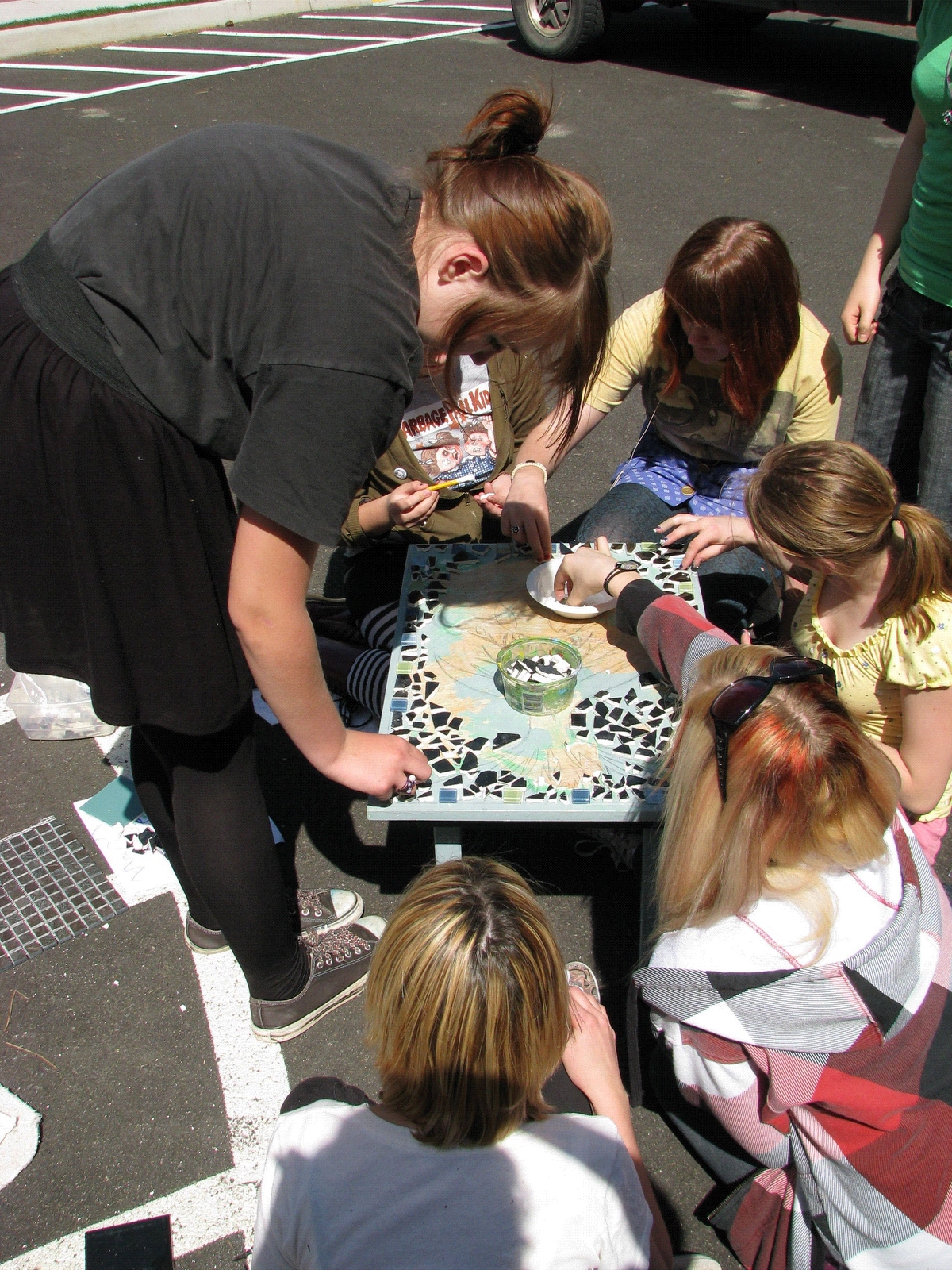
We had arrived on a Friday which was a day for exploration. There were any number of classes going on from baking bread, repairing bikes, making mosaics, working in and exploring the garden and the streams, creating ceramics, engaging in drama, videotaping, and the Rise up for Nicaragua –sewing quilt. Again the social component was connected with the academic explorations in which the children were engaged. When a child read on the internet about “The Great American Bake Sale” to end childhood hunger in America, she brought the idea to her community meeting. As a result, one of the exploration activities was to learn to bake bread. The school has a huge oven in the garden where some thirty loaves could be made at one time. (It was tasty) The loaves were then donated to the poor and homeless in the community. The school also has its own greenhouse where the children are raising vegetables to give to the poor.
THE SCHOOL GARDEN

THE GREENHOUSE


THE OVEN


THE STREAM

One of the parents was working at the oven in the garden and I had a chance to chat with her. Of course, I asked why she sent her child to this school. At first, she mentioned the focus on individuality, creativity and community and then thought about the freedom from so much trivia she had seen in the two earlier schools that her child had attended – the obsession with gum chewing, wearing tank shirts, etc. Then after a few moments, she said, I guess it really comes down to the fact that this school respects children.
That mutual respect perhaps characterizes the school the best. There was so much more that I witnessed that I might share in a later blog posting. The school has a video on YouTube where you can see more. You can find it at: http://www.youtube.com/watch?v=kNS3GlHvVYM
Of course, the question that many of you probably want to ask is the question about children’s achievement and test scores in this kind of environment. Well, the school is high achieving. It reminds me of something that John Dewey always said – that one does not necessarily hit the goal by directly aiming at it. One of the sad consequences of the current reform and its obsession with a standardized test score is the elimination of everything that makes learning and life worthwhile – the arts, music, dance, drama, physical development, etc. It is one of those unintended consequences of the policies we construct. But as Dewey always reminded us, when our curriculum is embedded in meaningful activities, when it has a function other than achieving a test score, children not only ironically achieve but also learn to love to learn. After all, as Dewey would say, education is life not just a preparation for life.
The next issue of the Journal of Educational Controversy will focus on the theme, “The Education and Schools our Children Deserve,” and we will be featuring articles, ideas, and video from other League schools. Susan Donnelly, the head of the Whatcom Day Academy, the school we partner with in the League, will co-edit the issue. Our hope is to provide a vision of what our schools can be.
The next issue of the Journal of Educational Controversy will focus on the theme, “The Education and Schools our Children Deserve,” and we will be featuring articles, ideas, and video from other League schools. Susan Donnelly, the head of the Whatcom Day Academy, the school we partner with in the League, will co-edit the issue. Our hope is to provide a vision of what our schools can be.
Monday, April 12, 2010
Whose History Should We Teach?
We reported in several postings below some of the conservative pressures on the curriculum decisions made by the Texas Board of Education on its proposed social studies curriculum. As a journal devoted to the discussion of the controversies in education, we ought to become clearer about the nature of the controversy that is surrounding the recent decision that Texas made. Certainly, introducing the conservative tradition in American political and social life is a legitimate topic in any history textbook. In his article below, Eric Foner from The Nation discusses some of the deeper issues underlying the Texas decision.
Twisting History in Texas
Comment
By Eric Foner
This article appeared in the April 5, 2010 edition of The Nation.
“Reprinted with permission from the April 5, 2010 issue of The Nation magazine. Portions of each week’s Nation magazine can be accessed at http://www.thenation.com/.”
The changes to the social studies curriculum recently approved by the conservative-dominated Texas Board of Education have attracted attention mainly because of how they may affect textbooks used in other states. Since Texas certifies texts centrally rather than by individual school districts, publishers have a strong incentive to alter their books to conform to its standards so as to reach the huge Texas market. Where was Lee Harvey Oswald, after all, when he shot John F. Kennedy? In the Texas School Book Depository--a tall Dallas building filled with textbooks.
Most comment on the content of the new standards has focused on the mandate that high school students learn about leading conservative figures and institutions of the 1980s and '90s, specifically Phyllis Schlafly, the Moral Majority, the Heritage Foundation, the Contract With America and the NRA. In fact, there is nothing wrong with teaching about modern conservatism, a key force in recent American history. My own textbook has a chapter called "The Triumph of Conservatism" and discusses most of the individuals and groups mentioned above.
More interesting is what the new standards tell us about conservatives' overall vision of American history and society and how they hope to instill that vision in the young. The standards run from kindergarten through high school, and certain themes obsessively recur. Judging from the updated social studies curriculum, conservatives want students to come away from a Texas education with a favorable impression of: women who adhere to traditional gender roles, the Confederacy, some parts of the Constitution, capitalism, the military and religion. They do not think students should learn about women who demanded greater equality; other parts of the Constitution; slavery, Reconstruction and the unequal treatment of nonwhites generally; environmentalists; labor unions; federal economic regulation; or foreigners.
Here are a few examples. The board has removed mention of the Declaration of the Seneca Falls Convention, the letters of John and Abigail Adams and suffrage advocate Carrie Chapman Catt. As examples of "good citizenship" for third graders, it deleted Harriet Tubman and included Clara Barton, founder of the Red Cross, and Helen Keller (the board seems to have slipped up here--Keller was a committed socialist). The role of religion--but not the separation of church and state--receives emphasis throughout. For example, religious revivals are now listed as one of the twelve major "events and eras" from colonial days to 1877.
The changes seek to reduce or elide discussion of slavery, mentioned mainly for its "impact" on different regions and the coming of the Civil War. A reference to the Atlantic slave trade is dropped in favor of "Triangular trade." Jefferson Davis's inaugural address as president of the Confederacy will now be studied alongside Abraham Lincoln's speeches.
In grade one, Veterans Day replaces Martin Luther King Jr. Day in the list of holidays students should be familiar with. (Later, "building a military" has been added as one of two results of the Revolution--the other being the creation of the United States--an odd inclusion, given the founders' fear of a standing army.) The Double-V Campaign during World War II (blacks' demand that victory over the Axis powers be accompanied by victory over segregation at home) has been omitted from the high school curriculum. Japanese-American internment is now juxtaposed with "the regulation of some foreign nationals," ignoring the fact that while a few Germans and Italians were imprisoned as enemy aliens, the vast majority of people of Japanese ancestry who were interned were US citizens.
Students in several grades will be required to understand the "benefits" (but none of the drawbacks) of capitalism. The economic system, however, dares not speak its name--it is referred to throughout as "free enterprise." Labor unions are conspicuous by their absence. Mankind's impact on the environment is apparently entirely benign--the curriculum mentions dams for flood control and the benefits of transportation infrastructure but none of the problems arising from the exploitation of nature. Lest anyone think that Americans should not fall below a rudimentary standard of living, the kindergarten curriculum deletes food, shelter and clothing from its list of "basic human needs."
Americans, the board seems to suggest, do not need to take much notice of the rest of the world, or of noncitizens in this country. Kindergartners no longer have to learn about "people" who have contributed to American life, only about "patriots and good citizens." High school students must evaluate the pros and cons of US participation in "international organizations and treaties." In an original twist, third grade geography students no longer have to be able to identify on a map the Amazon, the Himalayas or (as if it were in another country) Washington, DC.
Clearly, the Texas Board of Education seeks to inculcate children with a history that celebrates the achievements of our past while ignoring its shortcomings, and that largely ignores those who have struggled to make this a fairer, more equal society. I have lectured on a number of occasions to Texas precollege teachers and have found them as competent, dedicated and open-minded as the best teachers anywhere. But if they are required to adhere to the revised curriculum, the students of our second most populous state will emerge ill prepared for life in Texas, America and the world in the twenty-first century.
About Eric Foner
Eric Foner, a member of The Nation's editorial board and DeWitt Clinton Professor of History at Columbia University, is the author of Give Me Liberty, an American history textbook.
Twisting History in Texas
Comment
By Eric Foner
This article appeared in the April 5, 2010 edition of The Nation.
“Reprinted with permission from the April 5, 2010 issue of The Nation magazine. Portions of each week’s Nation magazine can be accessed at http://www.thenation.com/.”
The changes to the social studies curriculum recently approved by the conservative-dominated Texas Board of Education have attracted attention mainly because of how they may affect textbooks used in other states. Since Texas certifies texts centrally rather than by individual school districts, publishers have a strong incentive to alter their books to conform to its standards so as to reach the huge Texas market. Where was Lee Harvey Oswald, after all, when he shot John F. Kennedy? In the Texas School Book Depository--a tall Dallas building filled with textbooks.
Most comment on the content of the new standards has focused on the mandate that high school students learn about leading conservative figures and institutions of the 1980s and '90s, specifically Phyllis Schlafly, the Moral Majority, the Heritage Foundation, the Contract With America and the NRA. In fact, there is nothing wrong with teaching about modern conservatism, a key force in recent American history. My own textbook has a chapter called "The Triumph of Conservatism" and discusses most of the individuals and groups mentioned above.
More interesting is what the new standards tell us about conservatives' overall vision of American history and society and how they hope to instill that vision in the young. The standards run from kindergarten through high school, and certain themes obsessively recur. Judging from the updated social studies curriculum, conservatives want students to come away from a Texas education with a favorable impression of: women who adhere to traditional gender roles, the Confederacy, some parts of the Constitution, capitalism, the military and religion. They do not think students should learn about women who demanded greater equality; other parts of the Constitution; slavery, Reconstruction and the unequal treatment of nonwhites generally; environmentalists; labor unions; federal economic regulation; or foreigners.
Here are a few examples. The board has removed mention of the Declaration of the Seneca Falls Convention, the letters of John and Abigail Adams and suffrage advocate Carrie Chapman Catt. As examples of "good citizenship" for third graders, it deleted Harriet Tubman and included Clara Barton, founder of the Red Cross, and Helen Keller (the board seems to have slipped up here--Keller was a committed socialist). The role of religion--but not the separation of church and state--receives emphasis throughout. For example, religious revivals are now listed as one of the twelve major "events and eras" from colonial days to 1877.
The changes seek to reduce or elide discussion of slavery, mentioned mainly for its "impact" on different regions and the coming of the Civil War. A reference to the Atlantic slave trade is dropped in favor of "Triangular trade." Jefferson Davis's inaugural address as president of the Confederacy will now be studied alongside Abraham Lincoln's speeches.
In grade one, Veterans Day replaces Martin Luther King Jr. Day in the list of holidays students should be familiar with. (Later, "building a military" has been added as one of two results of the Revolution--the other being the creation of the United States--an odd inclusion, given the founders' fear of a standing army.) The Double-V Campaign during World War II (blacks' demand that victory over the Axis powers be accompanied by victory over segregation at home) has been omitted from the high school curriculum. Japanese-American internment is now juxtaposed with "the regulation of some foreign nationals," ignoring the fact that while a few Germans and Italians were imprisoned as enemy aliens, the vast majority of people of Japanese ancestry who were interned were US citizens.
Students in several grades will be required to understand the "benefits" (but none of the drawbacks) of capitalism. The economic system, however, dares not speak its name--it is referred to throughout as "free enterprise." Labor unions are conspicuous by their absence. Mankind's impact on the environment is apparently entirely benign--the curriculum mentions dams for flood control and the benefits of transportation infrastructure but none of the problems arising from the exploitation of nature. Lest anyone think that Americans should not fall below a rudimentary standard of living, the kindergarten curriculum deletes food, shelter and clothing from its list of "basic human needs."
Americans, the board seems to suggest, do not need to take much notice of the rest of the world, or of noncitizens in this country. Kindergartners no longer have to learn about "people" who have contributed to American life, only about "patriots and good citizens." High school students must evaluate the pros and cons of US participation in "international organizations and treaties." In an original twist, third grade geography students no longer have to be able to identify on a map the Amazon, the Himalayas or (as if it were in another country) Washington, DC.
Clearly, the Texas Board of Education seeks to inculcate children with a history that celebrates the achievements of our past while ignoring its shortcomings, and that largely ignores those who have struggled to make this a fairer, more equal society. I have lectured on a number of occasions to Texas precollege teachers and have found them as competent, dedicated and open-minded as the best teachers anywhere. But if they are required to adhere to the revised curriculum, the students of our second most populous state will emerge ill prepared for life in Texas, America and the world in the twenty-first century.
About Eric Foner
Eric Foner, a member of The Nation's editorial board and DeWitt Clinton Professor of History at Columbia University, is the author of Give Me Liberty, an American history textbook.
Wednesday, April 7, 2010
April salon to reflect journal's theme
The 12th Annual Educational Law and Social Justice Forum this year will present an evening salon of music, art, poetry and conversation on the topic Art, Social Imagination, and Democratic Education, the theme of our current issue of the journal. Authors whose work is published in the issue will join the audience at the salon. We hope that both the salon and the journal will engage the community in a conversation around the public purposes of our schools and the role of the arts in promoting both a meaningful education and a vital democratic society. It will be both experiential with live music and art and interactive. The audience is invited to join the conversation with the authors and share their own works of art as well as their own justice poems about resistance and empowerment, about finding one's own spirit in freedom and community and about the nature and development of social imagination for democratic living.
The Woodring 12th Annual Educational Law and Social Justice ForumPresents
An Evening Salon with Music, Art, Poetry and ConversationOn the Topic:
Art, Social Imagination and Democratic Education
Wednesday, April 28, 2010
5:30pm Reception
6-8pm Salon
Solarium in Old Main – 5th Floor
Western Washington University
Sponsored by the Center for Education, Equity and Diversity and the Journal of Educational ControversyWoodring College of Education
Western Washington University
Program:
5:30-6:00
Reception with music and refreshments
Welcoming interlude
Bellacorda String Quartet
Selections from Mozart Quartet in C Major “The Dissonant”
-------------------------------------------------------------------------------------------------
6:00 Musical Introduction to Salon
Quartet No. 1 in d minor (Mvts III & IV) Randall Thompson (1889-1984)
Vivace ma non troppo
Allegro appasionata
Bellacorda Quartet:
Christine Wilkinson, Violin
Rosalie Romano, Violin
Michael Neville. Viola
Noel Evans, Violoncello
Selections from Mozart Quartet in C Major “The Dissonant”
-------------------------------------------------------------------------------------------------
6:00 Musical Introduction to Salon
Quartet No. 1 in d minor (Mvts III & IV) Randall Thompson (1889-1984)
Vivace ma non troppo
Allegro appasionata
Bellacorda Quartet:
Christine Wilkinson, Violin
Rosalie Romano, Violin
Michael Neville. Viola
Noel Evans, Violoncello
Art Slide Show and Discussion of Children’s Drawings – Susan Donnelly, Whatcom Day Academy
Conversation on Social Imagination, Art and Education with Authors and Facilitators and the Audience:
• Facilitators: Lorraine Kasprisin, Editor, Journal of Educational Controversy and Kristen French, Director of the Center for Education, Equity and Diversity
• Authors: Daniel Larner, Susan Donnelly, Rosalie Romano, Anne Blanchard, Matt Miller
• Video clip of Maxine Greene will be shown. This issue of the journal was dedicated to Maxine Greene.
Audience will be invited to bring and share their own justice poems as well as works of art.
Free and open to the public.
Wednesday, March 17, 2010
Texas Conservatives Win Curriculum Change
Texas Conservatives Win Curriculum Change
By JAMES C. McKINLEY Jr.
New York Times
Published: March 12, 2010
AUSTIN, Tex. — After three days of turbulent meetings, the Texas Board of Education on Friday approved a social studies curriculum that will put a conservative stamp on history and economics textbooks, stressing the superiority of American capitalism, questioning the Founding Fathers’ commitment to a purely secular government and presenting Republican political philosophies in a more positive light.
To read the entire article, go to: New York Times
**********************************************************
The 2011 summer issue of the Journal of Educational Controversy will engage readers in a conversation on "The Education Our Children Deserve." The Times article reports that "there were no historians, sociologists or economists consulted at the meetings" of the board. It is time for public intellectuals, scholars, and teachers to join parents, community leaders and the general public in a conversation about the public purposes of our schools in a democratic society. We encourage a wide-range of voices to enter the dialogue and to submit manuscripts.
Go to our "call for submissions" for more information.
By JAMES C. McKINLEY Jr.
New York Times
Published: March 12, 2010
AUSTIN, Tex. — After three days of turbulent meetings, the Texas Board of Education on Friday approved a social studies curriculum that will put a conservative stamp on history and economics textbooks, stressing the superiority of American capitalism, questioning the Founding Fathers’ commitment to a purely secular government and presenting Republican political philosophies in a more positive light.
To read the entire article, go to: New York Times
**********************************************************
The 2011 summer issue of the Journal of Educational Controversy will engage readers in a conversation on "The Education Our Children Deserve." The Times article reports that "there were no historians, sociologists or economists consulted at the meetings" of the board. It is time for public intellectuals, scholars, and teachers to join parents, community leaders and the general public in a conversation about the public purposes of our schools in a democratic society. We encourage a wide-range of voices to enter the dialogue and to submit manuscripts.
Go to our "call for submissions" for more information.
Monday, February 1, 2010
Maxine Greene Tribute Now Online

The Journal of Educational Controversy is pleased to announce that the winter 2010 issue on “Art, Social Imagination and Democratic Education” is now online. This issue is dedicated to the life and work of Maxine Greene.
We would like to draw the readers’ attention to an innovation that we introduced in this issue. In place of one of the printed articles, we are providing the reader a slide show of a child’s artistic drawings, with the author’s voice describing to the readers the significance of what they are viewing in the child’s work. The author traces the motifs found consistently in the child’s drawing over the course of several years so the reader/viewer can gain insight into the child’s imaginative communities, values, and dreams.
We invite readers to contribute formal refereed responses to our Rejoinder Section or more spontaneous responses on our journal’s blog.
Next Issue: The Role of Professionals in the Public Square
Future Issues:
The Education our Children Deserve
The Modern University in Turbulent Times
The School to Prison Pipeline
The Effect of Cultural Diversity on the Schools across the Globe: A Comparative Look
Tuesday, December 15, 2009
“American Indians in Children’s Literature” Blog
I have been following a very informative blog that would be helpful for teachers who are trying to understand the rich cultural lives of an increasingly diverse student population in our schools. Called, “American Indians in Children’s Literature,” it helps teachers to grow in their understanding, appreciation and discernment of Native American literature. It also corrects so many of our misconceptions. Actually it goes beyond just books and says its mission is to provide "critical perspectives of indigenous peoples in children's books, the school curriculum, popular culture, and society-at-large." As always, we try to bring our readers multiple perspectives on issues.
If you are aware of other resources that would expand our understanding of the cultural diversity of our students, please let us know in your comments to this blog and we will share them.
If you are aware of other resources that would expand our understanding of the cultural diversity of our students, please let us know in your comments to this blog and we will share them.
Monday, November 23, 2009
Education Policy Blog: Creating a Democratic Learning Community
Education Policy Blog: Creating a Democratic Learning Community
Check out the link above from the Education Policy Blog for more on Sam Chaltain's new book that we discuss in the post below.
Check out the link above from the Education Policy Blog for more on Sam Chaltain's new book that we discuss in the post below.
Friday, November 20, 2009
American Schools: The Art of Creating a Democratic Learning Community

Many of our readers will remember Sam Chaltain’s article, “Ways of Seeing (and of Being Seen): Visibility in Schools,” that we published in our winter 2008 issue of the journal on the theme, “Schooling as if Democracy Matters.” Sam is the National Director for the Forum for Education & Democracy. In his article, he describes the current state of invisibility so many students experience in our schools and lays the groundwork for rethinking the role of school leadership. “The central challenge in any organizational culture," writes Chaltain, "is to help people become more aware of the inner place from which they operate." Chaltain has now developed his ideas further in a new book, American Schools: The Art of Creating a Democratic Learning Community, published by Rowman & Littlefield Education and featuring a foreword from Justice Sandra Day O'Connor. If you are interested in reviewing this book for a future issue of our journal, please contact CEP-eJournal@wwu.edu We are thinking about experimenting with a new video review format. If you have the expertise and would like to try this new format, let us know.
Below are some of the advance reviews of the book:
"Our country's ongoing commitment to democratic principles can only be actualized if democracy lives in our public schools. This book reveals how schools can help students and teachers see and hear one another, create a strong community, and develop the sensibilities and skills for democratic life. It provides a framework for democratic leadership that is accessible, actionable, and grounded in good pedagogy."—Linda Darling-Hammond, Charles E. Ducommun Professor of Education, Stanford University
"Sam Chaltain expects schools to do more than merely give their students knowledge of the world. By helping them to make themselves known to the world, he believes that they will be able to meet the democratic goal of taking responsibility for it. This book offers ideas and practical examples."—Ted Sizer, founder, Coalition of Essential Schools and former Dean of Harvard Graduate School of Education
"A powerful concept provides the organizing theme of this refreshing book: our nation's school leaders must strike the right balance between freedom and structure in order to create healthy, high-functioning learning environments. But there is a pervasive, more subtle one that slips along with the turning of the pages: the curriculum provides knowledge and skills relevant to daily functioning, but the persona of the teacher powerfully shapes the becoming of each unique being."—John Goodlad, president, Institute for Educational Inquiry
"Sam Chaltain has written a provocative, daring book, one that tangles with how best to create community and tolerance within the walls of a school. Chaltain is on to something - that an understanding of freedom is essential to creating active, engaged citizens, and that supporting individual freedoms need not negate an orderly, structured environment. I urge you to read American Schools."—Alex Kotlowitz, author of There Are No Children Here
"I want to thank Sam Chaltain for writing this book. I wish I had the guidance of his ideas when my colleagues and I created our own network of public schools. Sam explains through personal stories and case studies how the visible can become visible, how the disengaged can become engaged, and how structure and freedom can complete a well-rounded education. Sam shows education leaders how student achievements can be enhanced, how teachers can be supported to use their talents and interests to learn from one another, and how the larger community of parents and citizens can be mobilized to become part of the ongoing creation of powerful schools. What separates this book from others on school leadership is its clear set of doable practice focused relentlessly on the public purpose of schools. Sam is a much talented writer; lyrical in his descriptions, humorous in his candor, and greatly respectful of educators who try each day to be true to their larger calling."—Carl Glickman, professor at the University of Georgia
Tuesday, August 11, 2009
Obama’s School Choice: Shouldn’t the education that Malia and Sasha receive be available to all?
Our colleague David Marshak has just published this provocative piece for the August 3rd issue of Education Week and has permitted us to reproduce it on our blog. David is professor emeritus at Seattle University and our colleague here at Western Washington University. In his article, he describes the Sidwell Friends School that President Obama's children attend and asks why all children don't have this kind of education available to them. In asking this question, David exposes the wrongheaded direction that the public school is taking today. All children may not be able to attend this kind of elite private school, but all children ought to attend a public school system that is guided by the enlightened philosophy that shapes this school's vision. In reading David's description of the school, I saw many similarities with our partner school, the Whatcom Day Academy, that I talk about in a post below where we describe the creation of the new Educational Institute for Democratic Renewal that houses the Journal of Educational Controversy. To read about the philosophy of our partner school, the reader can go to the link on our Institute's website. Also check out our YouTube video below and hear teacher, Vale Hartley, describe her classroom at the 2008 Educational Law and Social Justice Forum.
ESSAY BY DAVID MARSHAK
Education Week
Published Online: August 3, 2009
COMMENTARY
Obama’s School Choice
Shouldn’t the education that Malia and Sasha receive be available to all?
By David Marshak
U.S. Secretary of Education Arne Duncan wants to intensify the industrial, modernist character of American public schools. He wants a longer school day, a longer school week, and a longer school year. He wants national subject standards, which will inevitably lead to one national test. And he wants to institute merit pay, which is a euphemism for paying teachers to produce higher test scores. And this sort of merit pay, combined with national academic standards and one national test, will inevitably result in even more public schools becoming test-prep factories. Thus, more and more of the same.
Every one of these putative remedies grows from a belief that intensification of the command-and-control, modernist, factory model of production is what schools need to improve their performance.
Arne Duncan seems to have no understanding that the most effective organizations in our society, both for-profit corporations and nonprofits, have evolved beyond command-and-control cultures. The author and business professor Peter M. Senge describes these new entities as “learning organizations,” which are built on the foundation of systems thinking, personal mastery, mental models, shared vision, and team learning.Senge explains why Duncan’s desire to intensify the factory model of schooling is destined for failure. “Today’s problems come from yesterday’s ‘solutions,’ ” he says. Factory-model schools, though always flawed by racism and classism, worked reasonably well when America was primarily an industrial society. But given our evolution into a more postindustrial culture, the industrial elements of schooling—mass production, rigid time and curricular structures, simplistic age-grading, and depersonalization and alienation—have become the problem, not the solution.
A postindustrial society requires postindustrial, post-modern schools. We could find a good example of this kind of education by following President Barack Obama’s two daughters to school one morning. Since their move to Washington, Malia and Sasha Obama have attended the Sidwell Friends School. It is both private and expensive, but these are not its essential characteristics. Sidwell Friends is more profoundly defined both by the values that it rejects—and by those that it embodies.
Sidwell rejects the modernist, industrial paradigm of schooling that makes school like an assembly line engaged in mass production, that claims all children should learn the same stuff at the same time. It also rejects the modernist claim that children’s individuality and inner knowing are irrelevant to education.
Sidwell embraces a post-modernist paradigm of schooling defined by the following elements:
• Sidwell is a prekindergarten through 12th grade school, with 1,097 students. This is about 84 children in each grade, a small enough number so that no child is lost in the crowd. If Sidwell had a free-standing high school, it would have all of 336 students.
• Sidwell offers “a rich and rigorous interdisciplinary curriculum designed to stimulate creative inquiry, intellectual achievement, and independent thinking in a world increasingly without borders.” It does not limit its curriculum to the antiquated 19th-century subjects, as does every set of state curriculum standards—or the new national standards that Arne Duncan is pitching.
• Sidwell encourages its students “to give expression to their artistic abilities.” It does not cut the arts out of the curriculum to focus only on math and reading, as so many schools have done in our testing-obsessed era, but understands that the arts need to be an integral element in every child’s education.
• Sidwell Friends School is a community that values “the power of individual and collective reflection.” It values not only knowledge that is outside the child or teenager, but also what children and adolescents know within themselves. Sidwell encourages reflection and inner knowing, neither of which are acknowledged in any state’s academic standards.
• Sidwell promotes “an understanding of how diversity enriches us,” recruits a diverse student body (39 percent of its students are persons of color), and offers a global and multicultural curriculum.
• In its curriculum and communal life, Sidwell emphasizes “stewardship of the natural world” and engages its students both in learning the science of ecology and in developing the ethics that are at the core of the concept of stewardship: that every individual has a personal responsibility for ecological health and sustainability.
• Sidwell also promotes service, and its curriculum and communal life engage its students in understanding “why service to others enhances life.”
• Sidwell explicitly acknowledges multiple forms of accessing knowledge and truth: “through scientific investigation, through creative expression, through conversation, … through service within the school community and beyond.” All state standards are far more simple-minded.
• Sidwell recognizes that schooling is about both individual learning and learning how to work together well with others. “Work on individual skills and knowledge is balanced with group learning, in which each person’s unique insights contribute to a collective understanding.”
• Sidwell is a school that focuses on personalization of learning and on educating the whole person. “Above all,” its literature declares, “we seek to be a school that nurtures a genuine love of learning and teaches students ‘to let their lives speak.’ ” Sidwell’s central ambition is “to recognize and nurture each person’s unique gifts.”
Yes, Sidwell Friends is an expensive private school; the tuition is about $29,000 a year. And it has one teacher on staff for every seven students—plus small classes and expensive facilities.
But Sidwell’s commitment to implementing a post-modern paradigm of schooling based on the personalization of learning, a global and multicultural curriculum, an emphasis on ecology and environmental stewardship, service to others, multiple forms of knowledge, and personal responsibility and excellence has little to do with money. It’s driven primarily by the value of educating the whole person, and any school in America could enact a program founded on that same value.
If Barack and Michelle Obama have abandoned industrial-paradigm, modernist schooling and have chosen to send Malia and Sasha to a post-modern school focused on the personalization of learning in the context of a caring, responsible school community, isn’t it time for every family in the nation to have the same opportunity?
And if President Obama sends his own kids to such a school, why are he and Arne Duncan advocating policies that would intensify the most defective features of industrial schooling, rather than trying to transform schools to make them more like Sidwell Friends?
David Marshak is a lecturer in the Fairhaven College of Interdisciplinary Studies and the Woodring College of Education at Western Washington University, in Bellingham, Wash., and is a professor emeritus at Seattle University.
First published in Education Week on August 3, 2009.
Subscribe to:
Posts (Atom)