As many of our readers already know, the Educational Institute for Democratic Renewal at the Woodring College of Education at Western Washington University, that houses the Journal of Educational Controversy, also partners with a creative, innovative and progressive school, the Whatcom Day Academy, to promote a democratic vision on what schools can be. Our work together is also associated with the League of Democratic Schools, a project initiated by educator, John Goodlad. On our institute’s page, readers can read about the philosophy of the school and view some of the videos featuring actual practices in the school along with a slide show of student art in which Susan Donnelly, the head of the school, guides the viewer into seeing more deeply into the artistic creations and evolution of young children’s drawings. On that page, the viewer can also view a section of a public forum that the Institute sponsored, in which teacher, Vale Hartley, describes her use of Socratic questioning with her young students along with short video clips that illustrate her technique. Readers can also read Vale’s article in our journal’s issue on Schooling as if Democracy Matters and Susan’s articles in our issue on Art, Social Imagination and Democratic Education.
One of the goals of both the Institute and the Whatcom Day Academy is to provide leadership to the community. I am so pleased to announce that Susan Donnelly in conjunction with Professor Matthew Miller of Western Washington University has received a $30000 grant that will enable them to both develop new ideas for childhood literacy practices but also to share their ideas with the community.
Congratulations to Susan and Matt. We hope to share more about this in future blogs.
But our readers will not have to wait too long to learn more about Susan’s school. Susan Donnelly is the co-editor for the upcoming summer issue of the Journal of Educational Controversy. In addition to our printed articles, readers can anticipate a lot of video footage highlighting innovative practices in schools. The theme for the issue is, “The Education and Schools Our Children Deserve.” For a look at another school in the League, see our post below on Schools that Make a Difference: A Look at the League of Democratic Schools.
Showing posts with label innovative schools. Show all posts
Showing posts with label innovative schools. Show all posts
Sunday, March 13, 2011

Tuesday, March 1, 2011
A Look at some Unique Schools around the World
Editor: I once had a colleague who likened his life as a teacher to a person whom one meets at a fork in the road who provides guidance as we find our own way in the world and choose the direction our life will take. How little we as teachers really know about the extent of our influence on a life. Today, we welcome a guest blogger, Nathan Sutton, to share one such experience. Nathan has worked on our journal’s staff since September and is about to enter his internship this spring to become a high school teacher. In his post, Nathan describes his decision to teach abroad for his internship and describes a unique kind of school that we thought our readers would find interesting. Hopefully, when Nate returns from abroad, he will write a post on this blog or an article for our journal on what he learned from this experience.
Schooling for a United World
by
Nathan Sutton
My introduction to the mission of United World Colleges happened in Kathmandu in the summer of 2007. There I met a British man who had spent much of his adult life as a Zen Buddhist monk, but was, at the time, on sabbatical from a ‘college’ in Norway. He and his wife were taking time to volunteer in rural Nepalese villages. He had a calm air about him and an amiable personality. We shared a dinner and conversation about the world and our place in it. The man left my presence and I haven’t seen him since; indeed I never discovered his name.
The meeting with the monk-turned-teacher and its remarkable influence has remained with me now for nearly four years and I have been an avid follower of the United World College (UWC) and its mission. Today I find myself at the terminus of the Master in Teaching program at Woodring College, Western Washington University. The more I explore the philosophies, pedagogy and practices of various schools the more I am confident of my alignment with the philosophies of UWC and remain hopeful of my future with the organization.
I grew up on a small hobby farm in southern Minnesota. There was very little in the way of outside culture and no ethnic or racial diversity to speak of in the agricultural region of my upbringing. Yet my father somehow managed to find interesting people to bring to our dinner table – European bicyclists in need of shelter from a storm, a Mongolian Tai Chi instructor, or an actor from San Francisco. I always marveled at their stories and wondered how they made it to our home in our small corner of the world. After a family trip to Sweden to mark my parents’ twentieth wedding anniversary, I had a revelation and decided I liked being abroad. I was a teenager now and could better appreciate the concept of culture. For this trip that meant drinking wine for the first time, riding on the back of a bicycle powered by a beautiful Swedish girl and dancing at a beachside disco until sunrise; it was visiting the country home of my ancestors. Now I was the one inside of a home in someone else’s corner of the world. I was hooked on exploring culture – and I never looked back.
Various travels since then have offered me more in-depth looks at culture – sights I never imagined I would see, tastes I never knew existed, languages I never dreamed my tongue would shape. But the most important aspect of these travels was the people I met along the way. It was the relationships which fostered and (often) fizzled, stories shared and the universal gift of laughter bestowed which made the trips meaningful. People keep me inclined to explore around corners, curious about the vibrancy of humanity, and engaged in living with those around me, regardless of location. I want all of these feelings to continue and see United World College as an ideal occupation for encouraging and cultivating my passions.
The origin of United World College began with Kurt Hahn, an educator and founder of various organizations including the first UWC, the Duke of Edinburgh's Award, Outward Bound and more. Mr. Hahn believed in a holistic education of youth, where young people can discover more about themselves, others and the world around them than they ever thought possible. In order to do so, youth should be set with high standards in personal health and fitness, activity and adventure, community commitment and responsibility, and abundant academic exploration. In 1962, in Southern Wales, the first UWC opened.
Now there are 13 schools around the world, on five continents. According to their website, “almost 40,000 students from over 180 countries have studied at UWC schools and colleges and there are over 130 national committees.” The national committees help to recruit youth and process applications for international schools. Students at UWC hail from Afghanistan and Finland, China and South Africa, Palestine and Bosnia, Malaysia and Brazil, Iraq and Canada, along with scores of other countries. There is a constant and concerted effort by UWC to recruit youth from all walks of life and all regions of the world in order to maximize exposure to varying cultures and languages, art and conversation, customs and ideas.
The current thirteen UWC campuses around the world will be joined by other colleges currently in various stages of development. Each has a focus, but is bound to the following UWC values:
International and intercultural understanding
Celebration of difference
Personal responsibility and integrity
Mutual responsibility and respect
Compassion and service
Respect for the environment
A sense of idealism
Personal challenge
Action and personal example
(Obtained from the organization’s website at uwc.org)
With these principles in mind, the UWC students and staff seek to explore the complexities of the world and its inhabitants. They seek to embrace individuality, independence and exploration while learning skills in partnership, conflict resolution, and an utmost respect for diversity. All of these concepts need not be mutually exclusive or conflicting – UWC recognizes this and passes it on to future leaders.
In a world such as ours, with increasing interactions among various peoples, economic and political turmoil, and ever-growing populations, the mission of UWC and its legacy seem all the more salient. I endeavor to be an effective and informed citizen of the world and to work with others with comparable ambitions. The youth served at UWC are from many nations and come from many different backgrounds. I want to meet these students, teach in their classrooms and, above all, learn from them and their colorful experiences.
"I regard it as the foremost task of education to insure the survival of these qualities: an enterprising curiosity, an undefeatable spirit, tenacity in pursuit, readiness for sensible self denial, and above all, compassion."
– Kurt Hahn
Friday, April 30, 2010
Schools that Make a Difference: A Look at the League of Democratic Schools

Several years ago, the Woodring College of Education at Western Washington University partnered with a local school, the Whatcom Day Academy, to be part of the League of Democratic Schools started by John Goodlad. Our partner school is now featured on the website of the Educational Institute for Democratic Renewal at Woodring, the institute that also houses the Journal of Educational Controversy. While the journal provides a format for a national and international exchange of ideas on important and controversial issues in education, our partnership allows us to put some of these ideas in practice and share them with others across the globe.
Recently, at a regional meeting of the League in Bend, Oregon, I was able to experience another school in the League, the Westside Village Magnet School. It is a wonderful example of a democratic progressive school and provides a model of what our schools can achieve. The first thing you notice when you first arrive at the school is the sense of activity all around you. The children are everywhere, and there is a sense of joy that permeates the building. Without the usual bells and teacher talk, the children just seem to know where they should be, something that they have internalized though the culture that the school has created.
A young boy walks up to me and introduces himself as Paul and shakes my hand as he welcomes me to the school. There is a sign in the library of the rights and responsibilities of the students, but it isn’t just the usual mission statements that one finds in schools. It is internalized in the students. We had arrived around noon and students were walking all around cleaning the school. We learned later that the multi-age school is broken into families that represent every level. For ten minutes each day, each family has an assigned set of chores that each student is responsible for. Other times groups are organized around interests.
CHILDREN DOING CHORES

We arrived too late to see the morning community meetings, but we were told that each day starts with different community meetings that are conducted by the children. Each age group has a chance to conduct the meeting and the students raise the issues that concern them.

There is also a peer mediation council made up of students where conflicts can be worked out. On this particular day, a video crew of volunteers from the community was videotaping the mediation process to show to other schools in the community who had requested more information about it. The children would role play a conflict (they played out an incident in the girl’s restroom today) and then take the conflict to the peer mediation council. The student mediators learn to use active listening, search for feelings as well as facts, paraphrase responses, and ask clarifying questions. The mediators then frame the situation, write up the issues and begin to discuss solutions. All discuss win/win solutions and continue to brainstorm until the conflicting students find a solution that they can both agree on. Both the role playing conflict and the mediation process were videotaped to show other schools how it works.
The school is organized around themes. The theme this year was on global issues. Each hub of multi-age student groups – broken into k-1, 2-3, 4-6, 7-8 or something like this – approach the themes at their own developmental level and in an interdisciplinary way. I visited a room where children were making masks. The criteria for the technical making of masks were posted on the wall along with two other sets of criteria – a Research Mask Criteria and a Mask Museum Display Card Criteria.
The artwork was easily connected with their research projects (the school is very inquiry-based) and the following criteria were used to guide the students with the creation of their masks on two dimensions other than just the technical criteria.
Research Mask Criteria:
1. Create a mask that represents the culture, living beings or environment impacted or affected by the issue.
2. Focus on a critical component /issue/solution from your research.
3. Personify your mask.
4. Exaggerate at least one feature.
5. Create Balance and unity.
6. Sketch your design first.
7. Follow Deb’s mask-making technique.
8. Adorn mask to enhance the message.
The third set of criteria that was posted on the wall dealt with a museum display of their work. Notice that many of their state standards that as a public school the school has to incorporate in its curriculum are easily integrated into this interdisciplinary approach.
Mask Museum Display Card Criteria:
1. Create a museum display card
2. Use a thought-provoking quote to inspire
3. Write a complete paragraph using a topic sentence that explains specific information from your research to support your opinions and conclusions.
4. Capture the reader’s interest.
5. Use descriptive language that includes adjectives, vivid verbs and adverbs.
6. Include a title.
7. Follow the writing process.
Many of the children had been studying the artwork of the Oregon artist, Betty LaDuke. The school places great emphasis on the arts and the creative process. As I wandered around the room watching the children draw and paint, I couldn’t resist asking them some questions. They very competently described their use of colors and patterns that they found in LaDuke’s paintings. The task was to create a painting that incorporated Betty LaDuke’s painting criteria. The assignment asked them to capture the essence of their research topic. They were also asked to share the people the topic mostly impacts, show how a change we might make would make a difference for our earth, capture the essence of the culture, include a theme, include a focal point, use vibrant, strong colors and repeated patterns, line and color (all reminiscent of LaDuke’s paintings), include people in the painting, and use Betty LaDuke’s folk art style. They were later to title it and mount it.
Drawings and paintings were all over the school and classroom walls -- most with a cultural and social theme. In fact, the social consciousness that the students exhibited was seamlessly intertwined with the academics and extracurricular activities.


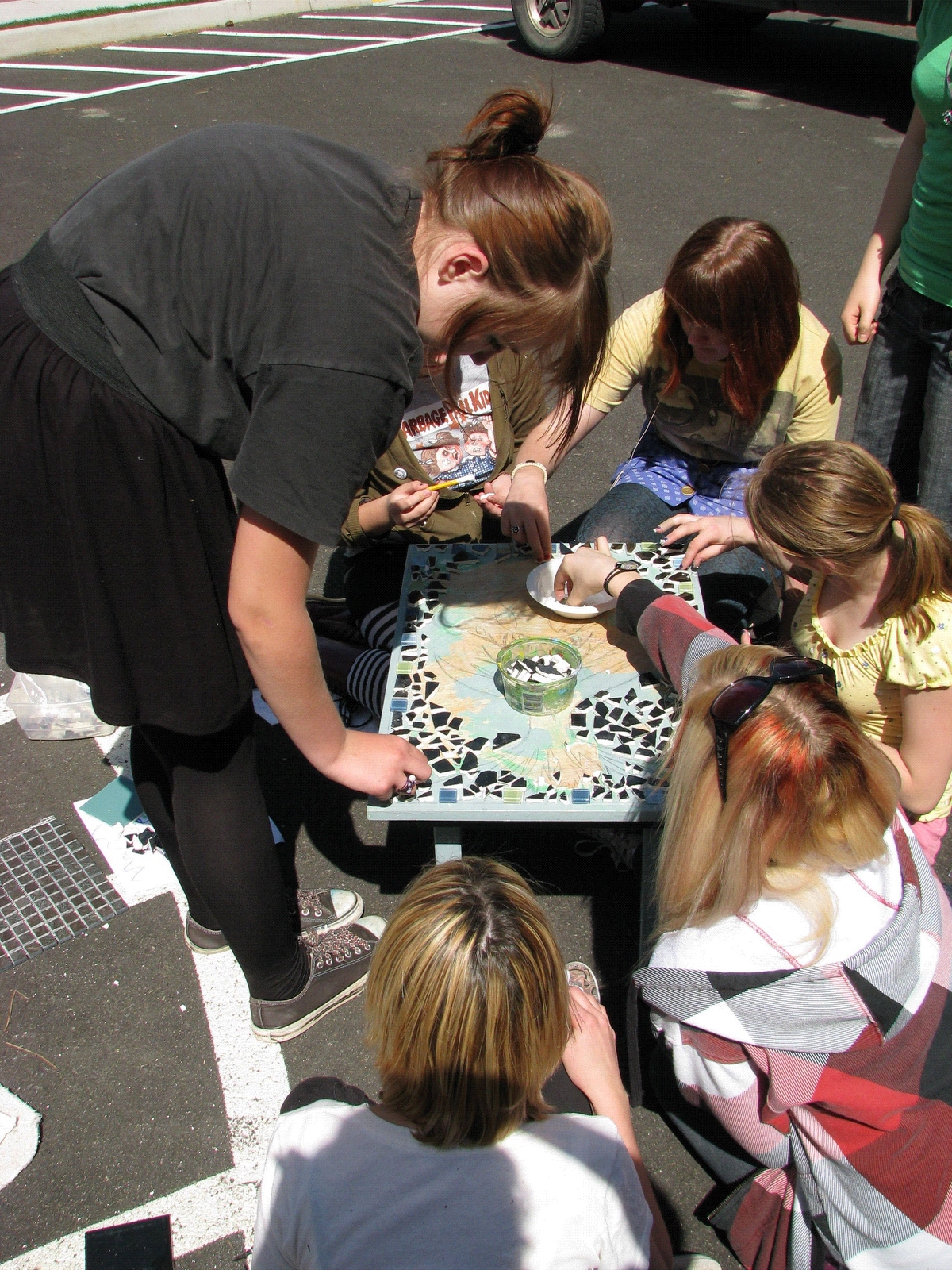
We had arrived on a Friday which was a day for exploration. There were any number of classes going on from baking bread, repairing bikes, making mosaics, working in and exploring the garden and the streams, creating ceramics, engaging in drama, videotaping, and the Rise up for Nicaragua –sewing quilt. Again the social component was connected with the academic explorations in which the children were engaged. When a child read on the internet about “The Great American Bake Sale” to end childhood hunger in America, she brought the idea to her community meeting. As a result, one of the exploration activities was to learn to bake bread. The school has a huge oven in the garden where some thirty loaves could be made at one time. (It was tasty) The loaves were then donated to the poor and homeless in the community. The school also has its own greenhouse where the children are raising vegetables to give to the poor.
THE SCHOOL GARDEN

THE GREENHOUSE


THE OVEN


THE STREAM

One of the parents was working at the oven in the garden and I had a chance to chat with her. Of course, I asked why she sent her child to this school. At first, she mentioned the focus on individuality, creativity and community and then thought about the freedom from so much trivia she had seen in the two earlier schools that her child had attended – the obsession with gum chewing, wearing tank shirts, etc. Then after a few moments, she said, I guess it really comes down to the fact that this school respects children.
That mutual respect perhaps characterizes the school the best. There was so much more that I witnessed that I might share in a later blog posting. The school has a video on YouTube where you can see more. You can find it at: http://www.youtube.com/watch?v=kNS3GlHvVYM
Of course, the question that many of you probably want to ask is the question about children’s achievement and test scores in this kind of environment. Well, the school is high achieving. It reminds me of something that John Dewey always said – that one does not necessarily hit the goal by directly aiming at it. One of the sad consequences of the current reform and its obsession with a standardized test score is the elimination of everything that makes learning and life worthwhile – the arts, music, dance, drama, physical development, etc. It is one of those unintended consequences of the policies we construct. But as Dewey always reminded us, when our curriculum is embedded in meaningful activities, when it has a function other than achieving a test score, children not only ironically achieve but also learn to love to learn. After all, as Dewey would say, education is life not just a preparation for life.
The next issue of the Journal of Educational Controversy will focus on the theme, “The Education and Schools our Children Deserve,” and we will be featuring articles, ideas, and video from other League schools. Susan Donnelly, the head of the Whatcom Day Academy, the school we partner with in the League, will co-edit the issue. Our hope is to provide a vision of what our schools can be.
The next issue of the Journal of Educational Controversy will focus on the theme, “The Education and Schools our Children Deserve,” and we will be featuring articles, ideas, and video from other League schools. Susan Donnelly, the head of the Whatcom Day Academy, the school we partner with in the League, will co-edit the issue. Our hope is to provide a vision of what our schools can be.
Subscribe to:
Posts (Atom)