by Lee Wei Lian
(This article is first published in The Malaysian Insider)
What do Prime Minister Datuk Seri Najib Razak, Malaysia’s founding father Tunku Abdul Rahman, Malaysia’s second richest man T. Ananda Krishnan and YTL chairman Tan Sri Francis Yeoh have in common?
The answer: all four studied at once famous schools that are now glaringly absent from the list of 20 high performance schools recently announced by the government.
Victoria Institution (Ananda, Yeoh), St John’s Institution (Najib), Penang Free School (Tunku Abdul Rahman) and others like Malacca High School and St Michael’s Institution are all storied schools that have been allowed to fall behind until they are no longer counted as among the elite educational institutions in the country.
Just imagine if Eton College in the UK or Raffles Institution in Singapore was not recognised as one of the top schools in their respective countries.
That is the equivalent of what has befallen what were once the most respected schools in Malaysia. Today, they do not even rate a mention on a list of the top 20 high performance schools.
It is a crying shame as these schools produced many leaders that were influential in the development of Malaysia and to a lesser extent even in Singapore.
But what happened to these academic icons? Was it merely a case of these venerable institutions being surpassed by more ambitious upstarts? Was it merely oversight that they were left off the list? Or was it a result of deliberate attempts over the years to sideline these institutions because they were founded by the British and/or missionaries?
Or was it sheer mismanagement on the part of the government that these once most prestigious names in Malayan/Malaysian education were allowed to fade along with the general perception of the quality of education in the country? Did, like so much else that is wrong with Malaysia, politics get in the way of academic stewardship?
Just consider the contributions these schools have made to society and business. Besides Tunku, the Penang Free School also nurtured the likes of Tan Sri P. Ramlee, actor and director extraordinaire, Danny Quah, a prominent economist and head of the department of economics at the London School of Economics who also sits on the National Economic Advisory Council which is formulating Malaysia’s new economic model, and Jomo Kwame Sundaram, Assistant Secretary-General for Economic Development in the United Nations’ Department of Economic and Social Affairs.
Apart from the prime minister, St John’s groomed one of Asia’s top bankers, CIMB CEO Datuk Seri Nazir Razak, one of the world’s top central bankers Tan Sri Dr Zeti Akhtar Aziz and the former vice-chancellor of the National University of Singapore, B.R. Sreenivasan.
Methodist Boy’s School produced the chairman of the Genting group, Tan Sri Lim Kok Thay, the chairman of the OCBC Bank and former CEO of Singapore Airlines, Dr Cheong Choong Kong, the vice chancellor of UKM, Professor Tan Sri Dr Sharifah Hapsah Syed Hasan Shahabudin, Tan Sri Tay Ah Lek, managing director of Public Bank, and Singapore’s former Minister of Education Ong Bang Poon.
Besides Ananda and Yeoh, Victoria Institution also educated the one of the world’s richest men, the Sultan of Brunei, Sultan Hassanal Bolkiah, former Singapore Deputy Prime Minister S. Rajaratnam, as well as some of Malaysia’s most legendary sportsmen, footballer Mokhtar Dahari and all four Sidek brothers.
Even if there was no list of top 20 “high performance schools” there would be little disagreement that these schools are now just a shadow of their former selves and can no longer command the respect they once did.
What does it then say about a government that allowed such historic and educational gems, some that date back nearly 200 years, to slip down the ranks in less than 50?
A closer look at the list also reveals something of the government’s apparently negligent attitude towards heritage conservation. Seri Bintang Utara made it to the list as a high performance school despite having to survive the demolition of its premises in Jalan Bukit Bintang, Kuala Lumpur where the “ginormous” Pavilion mall now stands and what appears to be attempts to wipe out its identity as it was formerly known as the Bukit Bintang Girls School, or more popularly BBGS.
To this day, while I like and enjoy the high quality of the Pavilion mall, I still feel a wave of disgust every time I set foot in it that seemingly nothing of BBGS, Kuala Lumpur’s oldest and one of its most prestigious schools, was preserved in the construction of the mall and that the government did not see fit to mandate any preservation either.
And all this is more than an academic shame as these schools are reminders of a time when students of all races grew up in school together and were taught to discard their racial lenses and be Johannians and Victorians, a truly depressing contrast to the current situation where Malays grow up in national schools, Chinese in Chinese schools and Indians in Tamil schools.
Can the Najib administration reverse the decline of these once prestigious schools? Anything can be achieved if there is sufficient will so the bigger question is, do they even want to?
* Lee Wei Lian attended the Bukit Bintang Boys School in Petaling Jaya. Nisi Dominus Frustra.
Addendum: The list of Malaysia’s 20 high performance schools are: Sekolah Tun Fatimah (Johor Baru), Sekolah Dato’ Abdul Razak (Seremban), Malay College Kuala Kangsar, Sekolah Seri Puteri (Cyberjaya), Sekolah Menengah Sultan Abdul Halim (Jitra), Kolej Tunku Kurshiah (Seremban), Kolej Islam Sultan Alam Shah (Klang), Sekolah Menengah Sains (SMS) Tuanku Syed Putra (Perlis), Sekolah Sultan Alam Shah (Putrajaya) and SMS Muzaffar Syah (Malacca), Sekolah Menengah Kebangsaan (SMK) (P) Sri Aman(Petaling Jaya), SMK Aminuddin Baki (Kuala Lumpur), SMK Sultanah Asma (Alor Star) and SMK (P) St George (Penang), Sekolah Kebangsaan (SK) Seri Bintang Utara (KL), SK Taman Tun Dr Ismail 1 (KL), SK Bukit Damansara (KL), SK Zainab (2) (Kota Baru), SK Convent Kota (Taiping), SK Bandar Baru Uda 2 (Johor Baru).
Showing posts with label national schools. Show all posts
Showing posts with label national schools. Show all posts
Wednesday, February 3, 2010

Monday, May 12, 2008
Two Interesting Letters on National Schools
Saw these two letters in Mkini today. I'll reproduce them below for your perusal. Both are referring to the trend for national schools to become more and more mono-racial. Both letters raise relevant points.
First letter can be found here.
Tahun Satu sekolah ini tiada pelajar Cina
Alias Mohd Yusof | Feb 5, 08 3:13pm
Semasa hadir pada sesi taklimat untuk kemasukan anak saya ke tahun satu di Sekolah Kebangsaan Taman Sri Pulai, Daerah Kulai, Johor baru-baru ini, setiap ibubapa telah diedarkan senarai nama murid tahun satu.
Saya perhatikan, dari sejumlah lebih kurang 300 nama murid tahun satu itu, tidak ada seorang pun dari kalangan murid keturunan Cina. Ini sungguh menghairankan saya, walaupun bagi setengah orang fenomena ini mungkin tidak begitu penting. Malah tidak ada siapa pun yang saya lihat mempersoalkan perkara ini.
Kepada saya, ia suatu yang amat merisaukan dan mengganggu fikiran saya. Perkara tidak ada murid keturunan Cina yang masuk ke sekolah ini pada tahun 2008 ini membuatkan saya tertanya-tanya. Mungkin ia tidak menjadi pelik kalau penduduk yang tinggal di kawasan sekolah ini tidak ada kaum Cina.
Yang jelasnya lebih 20 peratus penduduk di kawasan ini adalah dari kalangan kaum Cina. Kenapa agaknya kaum Cina tidak berminat untuk masuk ke sekolah kebangsaan?
Kalau nak dikatakan sekolah jenis kebangsaan Cina lebih baik prestasinya berbanding sekolah kebangsaan sebagai alasan mereka tidak berminat hendak menghantar anak ke sekolah kebangsaan, telahpun diketahui umum Sekolah Kebangsaan Taman Sri Pulai ini adalah sekolah yang terbaik dari segi pencapaian akademiknya di Daerah Kulai ini.
Kalau sekolah kebangsaan yang terbaik pun mereka tidak berselera hendak menghantar anak-anak mereka, apalagi dengan sekolah kebangsaan yang lain-lain itu.
Padahal sekolah jenis kebangsaan Cina yang paling dekat dengan Taman Sri Pulai ini terletak tidak kurang dari enam kilometer jauhnya, tapi mereka masih sanggup hantar anak-anak ke sana berbanding sekolah kebangsaan yang hanya terletak di depan rumah mereka sahaja.
Tidakkah kita sedar kesan dari pengasingan sekolah mengikut kaum ini sangat besar kepada keutuhan perpaduan masyarakat majmuk negara kita ini. Perpaduan seharusnya dipupuk dari peringkat kanak-kanak lagi. Melentur buluh biarlah dari rebung, saya tidak nampak semangat perpaduan dapat dipupuk melalui ucapan dan slogan sahaja.
Perpaduan harus dihayati dalam kehidupan sebenar, pada semua peringkat dan mesti bermula dari peringkat kanak-kanak lagi. Mungkin kepada orang politik, apa yang mereka maksudkan perpaduan itu bila
tidak ada pergaduhan antara kaum dan ada persefahaman dalam pembahagian tender projek kerajaan antara parti-parti komponen.
Oleh itu saya tidak hairan kalau orang politik tidak risau langsung dengan isu tidak ada murid Cina di Sekolah Kebangsaan Taman Sri Pulai ini, kerana memang tidak ada berlaku pergaduhan kaum pun di situ.
Kalau orang politik benar-benar faham maksud perpaduan, tentulah kes yang saya timbulkan di sini (tidak adanya murid Cina di tahun satu di Sekolah Kebangsaan Taman Sri Pulai) sudah menjadi isu yang sangat besar dan penting kepada mereka.
Kalau sekali pun kaum Cina terpaksa menghantar anak-anak mereka ke sekolah jenis kebangsaan Cina kerana hendakkan anak-anak mereka dapat belajar tulisan dan bahasa Cina ataupun atas-atas sebab lain, takkanlah tidak ada jalan penyelesaiannya selain daripada mengasingkan sekolah anak-anak mereka.
Nampaknya mereka sanggup mengorbankan perkara yang lebih penting iaitu perpaduan yang sebenar daripada mencari penyelesaian masalah yang rasanya tidaklah begitu sukar untuk diatasi.
Seperti yang biasa saya sebutkan, kita boleh memberi perlindungan dan memulihara harimau untuk mengelakkan dari pupus tapi janganlah sehingga sampai binatang ganas ini boleh mengancam haiwan ternakan dan nyawa manusia sendiri.
Realitinya, haiwan ternakan kita itulah yang lebih penting untuk menentukan survival kehidupan manusia. Bahasa dan tulisan ibunda kita memang patut dipertahan dan dipelihara tetapi janganlah sampai kita mengorbankan perkara yang lebih penting iaitu perpaduan tulen. Kerana perpaduan tulenlah yang lebih utama dalam menentukan survival bangsa kita.
Saya rasa masih ada jalan untuk anak-anak kita belajar bahasa dan tulisan ibunda mereka di satu sekolah yang sama, itupun kalau kita betul-betul mahu melihat perpaduan yang tulen di kalangan rakyat berbilang kaum.
The second letter can be found here.
Sekolah kebangsaan milik semua kaum
David Kumaran | Feb 27, 08 4:57pm
Berdasarkan surat dari Alias Mohd Yusof, saya pasti beliau adalah seorang yang benar-benar memahami maksud perpadaun dan benar-benar mahukan perpaduan antara kaum di negara kita, kekal dan dieratkan lagi.
Soalan yang beliau bangkitkan sangat logik, iaitu, mengapakah ahli-ahli politik tidak peduli apabila statistik sekolah menunjukkan tiada seoarang pun murid darjah 1 yang terdiri dari kaum Cina pada sessi 2008 di Sekolah Kebangsaan Taman Sri Pulai, Daerah Kulai, Johor.
Bukan sahaja di sekolah tersebut, malah di mana-mana sekolah kebangsaan pun, bilangan kaum bukan Melayu yang masuk ke darjah 1 semakin berkurangan.
Saya sendiri pun pernah berjumpa sekolah-sekolah sedemikian. Jadi, apakah punca yang menyebabkan ibubapa bukan Melayu tidak menghantar anak mereka ke sekolah kebangsaan.
Saya mempunyai tiga orang anak yang belajar di sekolah kebangsaan. Sejak anak pertama saya mula pergi ke sekolah (sekarang dia di Tingkatan 2), saya memerhatikan banyak perubahan yang berlaku dalam masa tujuh tahun yang lepas. Contohnya, semasa anak saya itu di darjah 4, dia dipaksa oleh seorang guru supaya memakai tudung (bukannya skaf) untuk pertandingan 'oral speaking'.
Yang peliknya, syarat ini tidak diletakkan pada masa pemilihan murid atau semasa latihan. Hanya beberapa hari sebelum pertandingan bermula, barulah syarat ini dikenakan ke atas murid bukan Melayu.
Satu lagi contoh, anak ketiga saya dan murid bukan Islam di darjah 2 tahun ini, diletakkan dalam satu kelas bersama murid beragama Islam semasa mata pelajaran agama Islam. Ia sudah lama berlaku tanpa pengetahuan saya atau ibubapa murid bukan Islam yang lain.
Saya hanya dapat tahu perkara ini apabila saya pergi melawat anak saya pada suatu hari. Apabila saya membawa hal ini kepada guru besar, alasannya ialah guru kelas moral cuti bersalin dan tiada guru gantian walaupun sudah dipohon kepada Jabatan Pendidikan. Tetapi saya tidak setuju dan akhirnya pihak sekolah bersetuju untuk memindahkan semua murid bukan Islam ke kelas lain ketika kelas Islam.
Dan baru-baru ini pula (berlaku tahun ini), kedua-dua anak saya memberitahu saya bahawa dua guru Melayu meminta kesemua murid Islam dalam kelas supaya bangun dan membaca doa sebelum memulakan pelajaran Sains atau BM (walaupun murid bukan-Islam tidak perlu membaca doa tersebut). Kedua-dua anak saya tadi belajar di sekolah yang berlainan.
Hal-hal sebegini tidak berlaku pada masa dahulu dan hanya sejak beberapa tahun kebelakangan ini, banyak unsur keagamaan dibawa masuk ke sekolah tanpa mengambilkira sensitiviti murid bukan Islam. Jadi, apakah ibubapa bukan Melayu akan buat? Terpaksalah mereka hantar anak-anak mereka ke sekolah jenis kebangsaan Cina atau Tamil.
Pada pendapat saya, unsur-unsur keagamaan tidak harus dibawa masuk ke sekolah kebangsaan kerana ia adalah sekolah milik semua kaum tanpa mengira agama atau bangsa. Kelas agama Islam boleh dibenarkan tetapi tindakan menempatkan murid bukan Islam dalam kelas yang sama, adalah sesuatu yang menyinggung perasaan kaum lain. Memaksa murid bukan Islam supaya memakai tudung pulak, lagi tidak harus dibenarkan sama sekali di mana-man sekolah pun.
What do you guys think?
First letter can be found here.
Tahun Satu sekolah ini tiada pelajar Cina
Alias Mohd Yusof | Feb 5, 08 3:13pm
Semasa hadir pada sesi taklimat untuk kemasukan anak saya ke tahun satu di Sekolah Kebangsaan Taman Sri Pulai, Daerah Kulai, Johor baru-baru ini, setiap ibubapa telah diedarkan senarai nama murid tahun satu.
Saya perhatikan, dari sejumlah lebih kurang 300 nama murid tahun satu itu, tidak ada seorang pun dari kalangan murid keturunan Cina. Ini sungguh menghairankan saya, walaupun bagi setengah orang fenomena ini mungkin tidak begitu penting. Malah tidak ada siapa pun yang saya lihat mempersoalkan perkara ini.
Kepada saya, ia suatu yang amat merisaukan dan mengganggu fikiran saya. Perkara tidak ada murid keturunan Cina yang masuk ke sekolah ini pada tahun 2008 ini membuatkan saya tertanya-tanya. Mungkin ia tidak menjadi pelik kalau penduduk yang tinggal di kawasan sekolah ini tidak ada kaum Cina.
Yang jelasnya lebih 20 peratus penduduk di kawasan ini adalah dari kalangan kaum Cina. Kenapa agaknya kaum Cina tidak berminat untuk masuk ke sekolah kebangsaan?
Kalau nak dikatakan sekolah jenis kebangsaan Cina lebih baik prestasinya berbanding sekolah kebangsaan sebagai alasan mereka tidak berminat hendak menghantar anak ke sekolah kebangsaan, telahpun diketahui umum Sekolah Kebangsaan Taman Sri Pulai ini adalah sekolah yang terbaik dari segi pencapaian akademiknya di Daerah Kulai ini.
Kalau sekolah kebangsaan yang terbaik pun mereka tidak berselera hendak menghantar anak-anak mereka, apalagi dengan sekolah kebangsaan yang lain-lain itu.
Padahal sekolah jenis kebangsaan Cina yang paling dekat dengan Taman Sri Pulai ini terletak tidak kurang dari enam kilometer jauhnya, tapi mereka masih sanggup hantar anak-anak ke sana berbanding sekolah kebangsaan yang hanya terletak di depan rumah mereka sahaja.
Tidakkah kita sedar kesan dari pengasingan sekolah mengikut kaum ini sangat besar kepada keutuhan perpaduan masyarakat majmuk negara kita ini. Perpaduan seharusnya dipupuk dari peringkat kanak-kanak lagi. Melentur buluh biarlah dari rebung, saya tidak nampak semangat perpaduan dapat dipupuk melalui ucapan dan slogan sahaja.
Perpaduan harus dihayati dalam kehidupan sebenar, pada semua peringkat dan mesti bermula dari peringkat kanak-kanak lagi. Mungkin kepada orang politik, apa yang mereka maksudkan perpaduan itu bila
tidak ada pergaduhan antara kaum dan ada persefahaman dalam pembahagian tender projek kerajaan antara parti-parti komponen.
Oleh itu saya tidak hairan kalau orang politik tidak risau langsung dengan isu tidak ada murid Cina di Sekolah Kebangsaan Taman Sri Pulai ini, kerana memang tidak ada berlaku pergaduhan kaum pun di situ.
Kalau orang politik benar-benar faham maksud perpaduan, tentulah kes yang saya timbulkan di sini (tidak adanya murid Cina di tahun satu di Sekolah Kebangsaan Taman Sri Pulai) sudah menjadi isu yang sangat besar dan penting kepada mereka.
Kalau sekali pun kaum Cina terpaksa menghantar anak-anak mereka ke sekolah jenis kebangsaan Cina kerana hendakkan anak-anak mereka dapat belajar tulisan dan bahasa Cina ataupun atas-atas sebab lain, takkanlah tidak ada jalan penyelesaiannya selain daripada mengasingkan sekolah anak-anak mereka.
Nampaknya mereka sanggup mengorbankan perkara yang lebih penting iaitu perpaduan yang sebenar daripada mencari penyelesaian masalah yang rasanya tidaklah begitu sukar untuk diatasi.
Seperti yang biasa saya sebutkan, kita boleh memberi perlindungan dan memulihara harimau untuk mengelakkan dari pupus tapi janganlah sehingga sampai binatang ganas ini boleh mengancam haiwan ternakan dan nyawa manusia sendiri.
Realitinya, haiwan ternakan kita itulah yang lebih penting untuk menentukan survival kehidupan manusia. Bahasa dan tulisan ibunda kita memang patut dipertahan dan dipelihara tetapi janganlah sampai kita mengorbankan perkara yang lebih penting iaitu perpaduan tulen. Kerana perpaduan tulenlah yang lebih utama dalam menentukan survival bangsa kita.
Saya rasa masih ada jalan untuk anak-anak kita belajar bahasa dan tulisan ibunda mereka di satu sekolah yang sama, itupun kalau kita betul-betul mahu melihat perpaduan yang tulen di kalangan rakyat berbilang kaum.
The second letter can be found here.
Sekolah kebangsaan milik semua kaum
David Kumaran | Feb 27, 08 4:57pm
Berdasarkan surat dari Alias Mohd Yusof, saya pasti beliau adalah seorang yang benar-benar memahami maksud perpadaun dan benar-benar mahukan perpaduan antara kaum di negara kita, kekal dan dieratkan lagi.
Soalan yang beliau bangkitkan sangat logik, iaitu, mengapakah ahli-ahli politik tidak peduli apabila statistik sekolah menunjukkan tiada seoarang pun murid darjah 1 yang terdiri dari kaum Cina pada sessi 2008 di Sekolah Kebangsaan Taman Sri Pulai, Daerah Kulai, Johor.
Bukan sahaja di sekolah tersebut, malah di mana-mana sekolah kebangsaan pun, bilangan kaum bukan Melayu yang masuk ke darjah 1 semakin berkurangan.
Saya sendiri pun pernah berjumpa sekolah-sekolah sedemikian. Jadi, apakah punca yang menyebabkan ibubapa bukan Melayu tidak menghantar anak mereka ke sekolah kebangsaan.
Saya mempunyai tiga orang anak yang belajar di sekolah kebangsaan. Sejak anak pertama saya mula pergi ke sekolah (sekarang dia di Tingkatan 2), saya memerhatikan banyak perubahan yang berlaku dalam masa tujuh tahun yang lepas. Contohnya, semasa anak saya itu di darjah 4, dia dipaksa oleh seorang guru supaya memakai tudung (bukannya skaf) untuk pertandingan 'oral speaking'.
Yang peliknya, syarat ini tidak diletakkan pada masa pemilihan murid atau semasa latihan. Hanya beberapa hari sebelum pertandingan bermula, barulah syarat ini dikenakan ke atas murid bukan Melayu.
Satu lagi contoh, anak ketiga saya dan murid bukan Islam di darjah 2 tahun ini, diletakkan dalam satu kelas bersama murid beragama Islam semasa mata pelajaran agama Islam. Ia sudah lama berlaku tanpa pengetahuan saya atau ibubapa murid bukan Islam yang lain.
Saya hanya dapat tahu perkara ini apabila saya pergi melawat anak saya pada suatu hari. Apabila saya membawa hal ini kepada guru besar, alasannya ialah guru kelas moral cuti bersalin dan tiada guru gantian walaupun sudah dipohon kepada Jabatan Pendidikan. Tetapi saya tidak setuju dan akhirnya pihak sekolah bersetuju untuk memindahkan semua murid bukan Islam ke kelas lain ketika kelas Islam.
Dan baru-baru ini pula (berlaku tahun ini), kedua-dua anak saya memberitahu saya bahawa dua guru Melayu meminta kesemua murid Islam dalam kelas supaya bangun dan membaca doa sebelum memulakan pelajaran Sains atau BM (walaupun murid bukan-Islam tidak perlu membaca doa tersebut). Kedua-dua anak saya tadi belajar di sekolah yang berlainan.
Hal-hal sebegini tidak berlaku pada masa dahulu dan hanya sejak beberapa tahun kebelakangan ini, banyak unsur keagamaan dibawa masuk ke sekolah tanpa mengambilkira sensitiviti murid bukan Islam. Jadi, apakah ibubapa bukan Melayu akan buat? Terpaksalah mereka hantar anak-anak mereka ke sekolah jenis kebangsaan Cina atau Tamil.
Pada pendapat saya, unsur-unsur keagamaan tidak harus dibawa masuk ke sekolah kebangsaan kerana ia adalah sekolah milik semua kaum tanpa mengira agama atau bangsa. Kelas agama Islam boleh dibenarkan tetapi tindakan menempatkan murid bukan Islam dalam kelas yang sama, adalah sesuatu yang menyinggung perasaan kaum lain. Memaksa murid bukan Islam supaya memakai tudung pulak, lagi tidak harus dibenarkan sama sekali di mana-man sekolah pun.
What do you guys think?
Wednesday, January 30, 2008
Lulu's Concerned About Our Schools
The following post is taken in its entirety from Lulu's blog. I don't have to add much else really. But we know that it's nothing new. Those interested in reading up other examples of the deteriorating state of our national schools - check out my post here.
I do think however, that the recent developments are absolutely shocking and certainly runs in the face of the objective of making our national schools the school of choice for all Malaysians as per the much-hyped National Education Blueprint.
This school, and trust Lulu, it's not the only one, "disqualified" kids who were wearing shorts from winning with flimsy excuses such as failing to get the ribbons at the designated spots and that the numbers pinned on the shirts were torn.
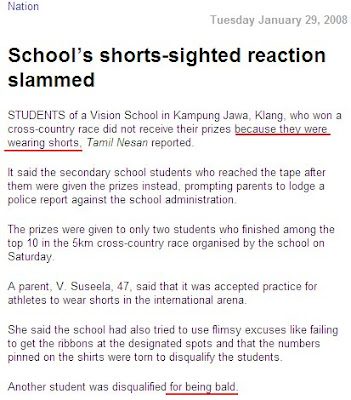 This school pula, insisted that the children shave off their moustaches and beards and used harsh words when they tried to explain. The reason behind their un-shavenness was that they had taken a Thaipusam vow, and at least one of their parents had written in to the school informing them of their vow and the date when they would shave it off.
 And we have here a case of kids who do not attend religious class [and you know la, in schools, which religion is allowed to hold "religious class"] who were asked to wash the toilet. Nothing bad/evil in washing school toilets, Lulu has had a fair share, but making it non-muhibbah? that's not right...
 KJ John, who has a regular column in Malaysiakini also had problems with the zealots in his son's school.
He writes,
Join the Parent-Teacher Association (PTA/PIBG). You cannot afford to let zealots narrow your children's mind and perspective of life.
I do think however, that the recent developments are absolutely shocking and certainly runs in the face of the objective of making our national schools the school of choice for all Malaysians as per the much-hyped National Education Blueprint.
This school, and trust Lulu, it's not the only one, "disqualified" kids who were wearing shorts from winning with flimsy excuses such as failing to get the ribbons at the designated spots and that the numbers pinned on the shirts were torn.
This school pula, insisted that the children shave off their moustaches and beards and used harsh words when they tried to explain. The reason behind their un-shavenness was that they had taken a Thaipusam vow, and at least one of their parents had written in to the school informing them of their vow and the date when they would shave it off.And we have here a case of kids who do not attend religious class [and you know la, in schools, which religion is allowed to hold "religious class"] who were asked to wash the toilet. Nothing bad/evil in washing school toilets, Lulu has had a fair share, but making it non-muhibbah? that's not right...KJ John, who has a regular column in Malaysiakini also had problems with the zealots in his son's school.He writes,
"The second case was when a new Ustaz in my son’s primary school insisted that all Primary 6 prefects wear long pants; not one teacher stood up to ask why or challenged this arbitrary decision. Therefore, when I went in to write a complaint, the non-Malay deputy principal was truly appreciative of my “public protest” as he could use “my parent complaint” to raise and address this issue with the principal regarding the “new policy” which was not discussed by the teachers, but merely implemented by the new Ustaz.If you are a parent, Lulu hopes that you are sensitive and aware of what's happening in your children's school. Also, some children may choose to abide and suffer in silence. Take an active role in your children's school. Also, remember that right for your school Christian, Buddhist and Hindu activities are given in the Federal Constitution. Challenge your school principal if he does not allow it. When/If you are not sure if they are right or wrong, use your schooldays as the benchmark.
The third instance was when I was on a PIBG committee at my son’s school when we heard that the principal had issued a verbal directive to all non-Muslim clubs and societies to “refrain from undertaking their religious activities within the school compound.”
At the next PIBG committee meeting, I enquired of the principal where and why there was such a policy. She replied that it was a directive from the PPD or the Pegawai Pendidikan Daerah. I asked for a copy of the written directive, as I knew the implications of such a directive. The principal confirmed that it was an unwritten one. I advised her against following such “non-policies” and requested for her to rescind the policy before the annual PIGB meeting.
She did not and the matter was raised at the next PIBG meeting and was resolved when another senior ex-government servant and a Malay parent argued that it was against the Federal Constitution."
Join the Parent-Teacher Association (PTA/PIBG). You cannot afford to let zealots narrow your children's mind and perspective of life.
Tuesday, December 4, 2007
De-Cristianising Mission Schools? (II)
Here are some follow up reports on the blog post with regards to calls by Members of Parliament to remove all traces of non-Muslim symbolises and influence our national schools.
Parliamentary Opposition leader, Sdr Lim Kit Siang has received reports of such actions in the following schools, and is awaiting reports of more. He has also called for the Minister of Education, Datuk Seri Hishammuddin Hussein to respond as to whether such actions are encouraged by the Ministry, tacitly or otherwise.
Parliamentary Opposition leader, Sdr Lim Kit Siang has received reports of such actions in the following schools, and is awaiting reports of more. He has also called for the Minister of Education, Datuk Seri Hishammuddin Hussein to respond as to whether such actions are encouraged by the Ministry, tacitly or otherwise.
- St. David High School, Bukit Baru, Melaka, the cross had been replaced by a crown.
- Convent Girls School in Muar, Cross was replaced with a cresent moon on badge.
- Methodist Boys Secondary School, Kuala Lumpur
Tuan Syed Hood bin Syed Edros [Parit Sulong]: …Tuan Yang di-Pertua, saya ingin menyentuh satu perkara tentang Kementerian Pelajaran iaitu sekolah-sekolah mubaligh seperti Convent, La Salle, Methodist dan sebagainya. Saya difahamkan Lembaga Pengarah di sekolah-sekolah iniAs some readers have suggested in the comments, the MPs should possibly call for the Government to stop sending scholars to foreign schools, particular those like Oxford and Cambridge as practically all of their colleges have a chapel within its compounds.
sebahagiannya ditadbir dari gereja-gereja di luar negara seperti di Vatican City. Saya juga difahamkan permohonan untuk membina surau di sebahagian sekolah-sekolah ini terpaksa mendapat kebenaran daripada Lembaga Pengarah yang mana Lembaga Pengarah ini sebahagiannya ditadbir oleh gereja.
Jadi amat memalukanlah, bagi diri saya, tentang pentadbiran sekolah-sekolah ini yang masih lagi dikawal oleh pihak gereja. Begitu juga saya difahamkan tentang iklim sekolah-sekolah tersebut, banyak ibu bapa Islam menghantar anak-anak mereka ke sana, mereka kompelin sebab ada kalanya sekolah dimulakan dengan lagu-lagu gereja. Ini saya tidak tahu benar atau tidak, tetapi ia apa yang saya dapat daripada ibu bapa sendiri tetapi yang jelas di sekolah-sekolah ini terpampang simbol-simbol agama. Saya rasa kecewa di dalam negara Islam, Malaysia ini, kalau saya pergi ke sekolah convent, ada terpampang patung St. Mary di depandepan sekolah convent...
Datuk Haji Mohamad bin Haji Aziz [Sri Gading]: [Bangun]
Tuan Syed Hood bin Syed Edros [Parit Sulong]: Silakan Yang Berhormat bagi Sri Gading.
Timbalan Yang di-Pertua [Datuk Dr. Yusof bin Yacob]: Ya, Yang Berhormat bagi Sri Gading.
Datuk Haji Mohamad bin Haji Aziz [Sri Gading]: Bagi saya sudah tidak terkejut, Yang Berhormat bagi Parit Sulong, cerita ini... [Disampuk] Bukan soal biasa. Soalnya kenapa boleh berlaku seperti ini? Satu. Hari Raya yang lepas, saya diberitahu oleh seorang bapa, waktu Aidilfitri disambut, sekolah jenis-jenis ini tidak ditutup. Terima kasih.
Tuan Syed Hood bin Syed Edros [Parit Sulong]: Bukan sahaja patung, tetapi Ahli-ahli Yang Berhormat pergilah, tengoklah salib Kristian diletakkan di depan-depan sekolah. Saya tidak faham Kementerian Pelajaran, adakah pegawai-pegawai tidak nampak atau memang dasar kita
membenarkan perkara ini. Walau bagaimanapun, saya sebagai orang yang bertanggungjawab kepada diri saya, agama, bangsa dan tanah air ini, saya menyatakan pendirian saya bahawa patung-patung ini hendaklah dirobohkan, salib-salib ini hendaklah dimusnahkan dan pengaruhpengaruh gereja di sekolah-sekolah ini hendaklah dihentikan. Begitu juga dana yang dikumpulkan di sekolah-sekolah ini. Adakah kita mendapat laporan? Kalau boleh kementerian mendedahkan dana sekolah-sekolah ini. Saya
difahamkan ada sekolah-sekolah ini juga ditaja oleh pihak-pihak gereja. Dana-dananya datang daripada gereja-gereja dan adakah pihak kementerian pantau sumber-sumbernya? Adakah audit-audit dilaksanakan?
Monday, December 3, 2007
De-Cristianising Mission Schools?
Here's just some excerpts from a blog post by a self-confessed drama queen currently studying at one of our local "mission" schools i.e., a "Sekolah Kebangsaan Convent" over recent comments by a few honourable Members of Parliament on such schools. The rather over-the-top post has been circulated widely over the Internet and has received the attention of our Parliamentary Opposition leader, Sdr Lim Kit Siang. ;-)
Apparently in the Parliament, some exceedingly brilliant gentleman, the representative of Parit Sulong (where?) have nothing to do with his time and nothing to do in his community that he had to point out that mission schools in Malaysia, such as Convent, La Salle and Methodist have crosses and statues representing the Christian faith in them. These crosses and statues must be demolished.Sdr Lim Kit Siang followed up in Parliament yesterdy by raising several supplementary questions to another genius, Datuk Noh Omar, the Deputy Education Minister, and as per usual, no satisfactory response obtained.
Also he pointed out that these schools have strong Christian influences and apparently sing "church songs" during school assembly.(FYI: Those are hymns, not songs). And shock and horror!!- apparently Malay-Muslim parents send their children to these school as well!! What is the world coming to?!!
Then his sidekick, an even more incredible genius of a man, the representative from Sri Gading (bitch, again - from where?) have to butt in and mentioned that apparently "a father have alerted him that these missionary schools are not close during Raya". Raya is Eid Mubarak; as in the main festival celebrated by Muslims. Bear in mind, Malaysia is an Islamic nation.
Not close during Raya? Right....
Ok listen up geniuses, I am a Malay woman. A Muslim-Malay woman and my parents sent me to be educated in SRK. Convent Klang and then, oh nooo they didn't stop there. They then sent me to my high school: SMK. Convent Klang. That's right bitch, I'm a Convent girl. A Muslim-Malay woman educated the Convent way.
When I went there, there was never a moment where we were made to sing...what did you called it again...right "church songs" during assembly. We did read prayers but it was the Islamic prayer that we read weekly at the assembly while the other students who weren't Muslims stood in silence of respect to it. Did they other students have parents alerting the Parliament members about how the have to stand in silence when the Muslims were saying their prayers? No. Perhaps its a little thing called religious sensitivity or maybe because they were shit scared of idiots like you who are in the Parliament talking about Islamic supremacy.
Also calling into the demolishing of the crosses and Christianity artifacts. Where I went to school, we no longer have a church in it. The church have been converted into the hall and where the altar where the people used to pray, a stage have built over it. There were no crosses at all though on the walls where they used to hang, one can see the outline of Jesus Christ. When the school was repainted, all that gone missing. So what is there to demolish? We do have a giant cross in front of the school but it never bothered us. It is a part of the British/Malaya heritage, it is a part of Malaysian history. Demolish that? Demolish a part of our country's history just because you are an uneducated prick that have no religious tolerance?
[...]
Religion is a set of beliefs. You choose what to believe. Just because you think your religion is better than other peoples' does not give you the right to condemn and push your religion onto them.
Last time I checked, we promote this country to the outside world as a country where people of different races live harmoniously and without conflict. Last time I checked, we are a country that is proud of our religious diversity and sensitivity. Last time I checked, this country wasn't run by a bunch of idiots with the Taliban-mentality.
The loyalty of mission schools was questioned, with the baseless allegation that they refuse to observe Aidilfitri public holiday and close the schools. There was even the preposterous accusation that the mission schools were administered by churches outside the country, including the Vatican.Will you be willing to bet your bottom dollar that we haven't heard the last of this issue and the highly intelligent Members of Parliament will continue to raise this issue to stir religious fanaticism leading one day, to the renaming of all national missionary schools from SK Convent Klang to SK Tan Sri Zakaria Mat Deros?
I asked Noh Omar whether he is aware that the extremist demands by the two BN MPs have created a furore, particularly on the Internet, and why the Education Ministry was condoning such extremism by its silence when such statement should be denounced without equivocation.
I also reminded the Deputy Education Minister that it is wrong and mischievous to assume that Muslims studying in mission schools are potential apostates, when mission schools had made great contributions in nation-building and produced many Malay leaders, including Deputy Prime Minister, Datuk Seri Najib Razak, the Education Minister himself, the Perak Raja Muda Raja Nazrain Shah and the Sultan of Selangor who had been products of mission schools.
There was no satisfactory reply from Noh Omar.
Friday, August 31, 2007
What Went Wrong In Our Schools?
If you had read my other blog, you'd have know that I'm kinda tied up with a writing project for my "work", so I didn't really have time to post a "Merdeka" message. In addition, I've been receiving requests for comments on the latest Higher Education Action Plan launched by Dato' Mustapa Mohammad and the Prime Minister recently. In particular, whether the hype over autonomy for our local universities as well as the highly commended "Apex University" concept are justified. Well, I have my reservations but as I've not read the report in detail except for the media reports (you'd probably need to give me at least a week), I won't say too much as yet.
Anyway, I thought it'll be good for everyone to read an article by R Nadeswaran of The Sun on "What Went Wrong in Our Schools?" published earlier this week, which I'll take the liberty to republish here for all to read.
Anyway, I thought it'll be good for everyone to read an article by R Nadeswaran of The Sun on "What Went Wrong in Our Schools?" published earlier this week, which I'll take the liberty to republish here for all to read.
At the sound of the engine, my late father, who was returning home from work, stood at attention. Others who were cycling got off their bikes and did not move until the Austin A40 went past.Happy Merdeka to you too! ;)
I watched this drama unfold almost every other day - circa 1956.
I remember these scenes vividly as it gave me early impressions and would have a great impact on me decades later. Innocently, I asked my mother what it was all about. She said: "Ithu Vellakaran vatcha sattam." (This is the law of the white man).
When the estate manager was on the move, everything else came to a standstill. The mandore would chide even children if they did not give the manager his due respect.
I was considered lucky because my dad was an estate conductor or kerani as they used to call him, but for the other workers, they were at the mercy of the management and its systems.
Being the son of the kerani, I was forbidden to go to the "labour lines" as they used to call the one-room wooden houses that housed Indian immigrants brought here to tap rubber.
That was my first glimpse of apartheid a'la Malaya, and fortunately, I was never to see such class polarisation and discrimination, when the family moved out of Ebor Estate in Batu Tiga, to Klang.
In town, the initial adaptation was difficult because the boys in the neighbourhood spoke English and I had spent two years in the estate Tamil school.
But those I befriended had no inhibitions. We studied together; walked to school together and played together. No one, let alone my friends who came from the Special Malay Class to join me in Standard Four classified me as kaum pendatang.
I learnt to sing Negara Ku with others, with Mrs Nora Eu on the piano. We did not have to raise flags or write slogans to show our patriotism.
We were all Malayans and we never saw any barriers - racial or religious - in our interaction.
While I was representing the school in the oratory contests and debates which were open to only non-Malays during the Bulan Bahasa Kebangsaan, the Indian Muslims and Pakistanis, in order to take part, proudly gave their full names including son of or daughter of - not bin or binti.
Today, the same people have conveniently dropped those words and assimilated themselves with the majority. I have no problems with that. Good for them that they have learnt how to work around the system.
We had two Abdul Halims in class and in order to avoid confusion, we called one Halim Kichap - referring to skin tone - and he had no qualms about that.
We learnt about the Prophet Muhammad (peace be upon him), Francis Drake, Christopher Columbus, Gandhi, Mohamed Ali Jinnah and the like.
We were taught that a Javanese Hindu named Parameswara founded Malacca, but we are now told that someone is trying to re-write history by obliterating his name from textbooks.
My Standard Six teacher, B. M. Das, used the cane sparingly and those who had contemplated complaining to their parents were politely told that "if your father comes to school to complain, you can sit at the back of the class and watch me teach".
There were only 13 "A" graders in the trial exams before the government exams proper.
"If there are more than 13 who pass with an A, I'll eat your shoes," he ventured. Our class produced 33 and it goes to show how teachers used to motivate the pupils. Das never ate our shoes and we never asked him to!
In secondary school, we had inter-class games, inter-house games and inter-school games. We all got involved. When the class was playing, everyone was on the field - cheering the team on.
Besides, everyone was encouraged to join the literary and debating society or other extra-mural activities, as they were called. But then, there were no computer labs or clubs.
We never identified ourselves by race and the only "segregation" came when we had to attend "Pupil's Own Language" classes in the afternoon. Everyone ate from each other's tah pau from home, and nothing was taboo.
In Form Two, our literature teacher P.K. Singh made us read a book a week, and then write a synopsis and identify 10 new words that we had learnt. It was this that helped our generation excel in the language.
Cikgu Idris, who taught us Bahasa Kebangsaan, told us that letters should end with Wassalam, an Arabic form of greeting which has now taken religious connotations.
We had the like of Lee Mun Yew and D. R. Daniel as headmasters of two schools - Klang High School and Anglo Chinese School respectively - which had a strong rivalry be it on the playing field or the debating halls.
They were there when the inter-school matches were played, and of course, like all school sports days, the main event was the inter-school relay.
Fifty years on and as a parent of a school-going child, I wonder how these great school days just disappeared and how well-versed they are with some famous names and places. Thanks to the Internet, some children know that the American Independence Day falls on July 4 or that Captain Tasman sailed to Australia with a boatload of convicts and that at one time, the sun never set on the Great British Empire.
What went wrong? Why are children now embroiled in colour, creed and religion at such a young age?
We are blaming the schools for all the ills that afflict society. Can it be changed? Can we go back to the times when we gained so much knowledge within six hours? Can we re-live the times when you had to fight tooth and nail to find a place in the school football team?
I don't have the answers, but as the nation turns 50 tomorrow, our policymakers should put on their thinking caps for a solution.
Happy Merdeka!
Tuesday, June 12, 2007
Marginalising Vernacular Schools
As reported by Malaysiakini here, the Chinese education movement Dong Jiao Zong (DJZ) or United School Committees Association, produced a report "in response to a call for feedback on the blueprint by the education ministry early this year."
I'd like to state upfront that the following views are those of my own, and not necessarily that of the political party which I'm affiliated to. There are points raised in the report which I'm in full agreement with, while there are others, which I thought were unreasonable.
First, the points which I'm in general agreement with:
1. More funds for vernacular schools
2. Greater Transparency & Accountability
3. A call for more dialogue with the Ministry of Education
As the Minister himself represented earlier, he has admitted in an exclusive interview with Nanyang Siangpau that “people should not regard the various types of schools in the country as a hurdle to be cleared. After all, this is not a zero-sum game because multi-culturalism is an added advantage and a strength for the country.”
Hence, we hope that he makes good his promise to receive feedback in good faith from all channels, including those via blogs.
On the point of disagreement with DJZ report, I find that the DJZ President, Yap Sin Tian's concern over the fact that Chinese and Tamil languages have been added as subjects in Malay- medium schools.
The availability of mother tongue education is only one of the factors affecting the parents decision to enrol students into national or vernacular schools. Two other overwhelming factors are the actual quality of education delivered as well as the perceived religiousification of the national schools.
If both streams of education seek to compete to provide better quality education in a 'secular' environment for non-Muslims, then the ultimate beneficiaries will be our future young Malaysians. Hence healthy competition should definitely not be obstructed. ;)
I'd like to state upfront that the following views are those of my own, and not necessarily that of the political party which I'm affiliated to. There are points raised in the report which I'm in full agreement with, while there are others, which I thought were unreasonable.
First, the points which I'm in general agreement with:
1. More funds for vernacular schools
DJZ president Yap Sin Tian said the blueprint “continues to ignore vernacular schools”As expressed extensively in my artictle "National vs Vernacular Schools", the BN government has persisted in ignoring the needs of vernacular schools in the country.
From 1970-2006, DJZ estimated that the country saw an increase of 2,900 national schools. A total of 193 vernacular schools - 58 Chinese schools and 134 Tamil - were closed for various reasons.
DJZ insisted that there is demand for 134 Chinese schools nationwide. Currently, there are 1,810 vernacular schools, 205 of which are run without government aid. DJZ alleged that the government has spent more money on national schools and has marginalised vernacular schools.
...despite the consistent claim by the government that it will build more vernacular schools in accordance to the needs of the people, the number of Chinese primary schools have declined from 1,333 in 1957 to 1,288 today while enrolment has more than doubled from 310,000 to 636,000. At the same time, the number of Tamil primary schools has been reduced from 526 in 2001 to 523 in 2006 despite a 12.7% increase in enrolment from 88,810 in 2001 to 100,142 in 2006.The perception of being marginalised cannot be help when The government's disbursement of RM1.4 million to 248 Chinese primary schools, or a meagre RM6,000 per school as hyped by Deputy Education Minister Datuk Hon Choon Kim in the vernacular press, pales in comparison to the RM709 million allocated to building 15 new Mara Junior Science Colleges (MRSMs), and more for upgrades and repairs of existing MRSMs.
2. Greater Transparency & Accountability
DJZ also wants greater transparency in the disbursement of funds... [including] listing subsidies for all schools.By listing the relevant expenses and disbursements to all schools, both the interested parties as well as the rakyat can decide for themselves if the government has been equitable in their distribution.
3. A call for more dialogue with the Ministry of Education
...the United Chinese School Teachers Association (Jiao Zong) president Ong Chiew Chuen said that "the ministry should initiate open dialogues with associations."It is actually quite unfortunate that the National Education Blueprint 2006-2010 launched by the Datuk Seri Hishammuddin Hussein, had not taken into account the views of the various communities and associations representing the education sector, which falls under the purview of the Ministry.
As the Minister himself represented earlier, he has admitted in an exclusive interview with Nanyang Siangpau that “people should not regard the various types of schools in the country as a hurdle to be cleared. After all, this is not a zero-sum game because multi-culturalism is an added advantage and a strength for the country.”
Hence, we hope that he makes good his promise to receive feedback in good faith from all channels, including those via blogs.
On the point of disagreement with DJZ report, I find that the DJZ President, Yap Sin Tian's concern over the fact that Chinese and Tamil languages have been added as subjects in Malay- medium schools.
“It’s as though there is a move by the government to prioritise Malay-medium schools and phase out vernacular schools,” he said.Selecting a school for one's children is a matter of choice and certainly, "competition" in terms of offering options and improving the quality of education between different streams is a move which should be encouraged. I've written on my views which are supportive of offering mother tongue languages in national schools. Instead is the much delayed implementation of the programme, despite it being a key objective of the new Blueprint should be subject to criticism.
The availability of mother tongue education is only one of the factors affecting the parents decision to enrol students into national or vernacular schools. Two other overwhelming factors are the actual quality of education delivered as well as the perceived religiousification of the national schools.
If both streams of education seek to compete to provide better quality education in a 'secular' environment for non-Muslims, then the ultimate beneficiaries will be our future young Malaysians. Hence healthy competition should definitely not be obstructed. ;)
Thursday, April 5, 2007
More on Young Malaysians Roundtable
Yes, Raja Nazrin certainly made an important speech, and the Young Malaysians Roundtable which attracted some 150 participants is a success in itself, judging even sole from the coverage it has received in all media over the past few days. Thanks to Kian Ming, who's certainly more on the ball, when he highlighted the media reports of the event.
I am thankful to the Centre for Public Policy Studies, in particular, Tricia Yeoh for inviting me to speak at one of the 3 sessions, with regards to the Governments Education Policy and its effectiveness in forging national development and unity. Wearing my "Education-in-Malaysia blogger" hat, I was given a short 10-15 minutes to raise my views in a panel which also comprised of Dr Oh Ei Sun and my favourite UM academic, Dr Azmi Sharom.
Given the short time frame (or I could have gone on-and-on for hours), I had to pick a single issue to talk about to make it meaningful. I ended up picking the issue of vernacular education for it appears to have the biggest relevance to national unity in this country. I have separately dealt with these issues at depth here on this blog, e.g., here, here and here. Kian Ming too, has his views blogged here and here.
As mentioned during the conference, I picked what I regarded as the most divisive issue to be tackled head-on because, if we can't openly deal with these issues and find the relevant resolution to them, then all talk of promoting national unity will only be about sweeping the cracks under the carpet.
Thanks to the New Straits Times, I was given a fair bit of prominence (given the limited space) in a report on Wednesday. Although understandly, it focused on my comment that parents are choosing vernacular schools due to declining quality of national schools, and not other issues raised, it's a good start ;).
There was a comment from the floor, coming from a confident young lady probably in her early 20s, who objected to my views. She stated outright that she believed that vernacular education should be abolished outright. She argued that the education received up to 12 years old plays a key role in ensuring the ability of young Malaysians to mix amongst various races in their teenage and subsequent years. In addition, there's no reason for various types of education options given that we are a single country. There should just be a single type of education.
My reply to her (and unfortunately, given that I was with the panel, I had "the last word", which didn't give her the option to reply ;)) was 2 fold:
However, certainly, I implore the Government to stop marginalising the vernacular education community through clearly unfair policies. It is important for the Government to start believing in its own rhetoric of a multi-cultural society being Malaysia's strength, for preferential and unequal policies will only lead to the very outcome which it is seeking to avoid, national disunity.
I am thankful to the Centre for Public Policy Studies, in particular, Tricia Yeoh for inviting me to speak at one of the 3 sessions, with regards to the Governments Education Policy and its effectiveness in forging national development and unity. Wearing my "Education-in-Malaysia blogger" hat, I was given a short 10-15 minutes to raise my views in a panel which also comprised of Dr Oh Ei Sun and my favourite UM academic, Dr Azmi Sharom.
Given the short time frame (or I could have gone on-and-on for hours), I had to pick a single issue to talk about to make it meaningful. I ended up picking the issue of vernacular education for it appears to have the biggest relevance to national unity in this country. I have separately dealt with these issues at depth here on this blog, e.g., here, here and here. Kian Ming too, has his views blogged here and here.
As mentioned during the conference, I picked what I regarded as the most divisive issue to be tackled head-on because, if we can't openly deal with these issues and find the relevant resolution to them, then all talk of promoting national unity will only be about sweeping the cracks under the carpet.
Thanks to the New Straits Times, I was given a fair bit of prominence (given the limited space) in a report on Wednesday. Although understandly, it focused on my comment that parents are choosing vernacular schools due to declining quality of national schools, and not other issues raised, it's a good start ;).
There was a comment from the floor, coming from a confident young lady probably in her early 20s, who objected to my views. She stated outright that she believed that vernacular education should be abolished outright. She argued that the education received up to 12 years old plays a key role in ensuring the ability of young Malaysians to mix amongst various races in their teenage and subsequent years. In addition, there's no reason for various types of education options given that we are a single country. There should just be a single type of education.
My reply to her (and unfortunately, given that I was with the panel, I had "the last word", which didn't give her the option to reply ;)) was 2 fold:
- Just as there are weaknesses in the national schools, there are also weaknesses in vernacular schools. Regular readers would know my despair at the competence of the English language in vernacular schools. However, given the weaknesses, we should address these weaknesses head-on, instead of abolishing vernacular education altogether.
I reiterated my stand that that vernacular education represents a part of our multi-racial and multi-lingual society which should be regarded as an asset and to quote the Education Minister's rhetoric, "the very fabric of our society". The focus of our government should be on integration and not assimilation. - Even without taking the above reason into consideration, we must also address the issue of choice and options for Malaysian parents. Parents are choosing vernacular schools over national schools (even those previously from national schools) for a reason. Parents want the option of mother-tongue education not provided in national schools, and more so, they want better quality education for their children which, by clear consensus, is generally available at many vernacular schools.
By eliminating vernacular schools, one will be taking away the alternative for Malaysian parents (irrespective of race). It should be noted that some 10% of Chinese school enrolment, or some 60,000 students are non-Chinese. Where would they then send their children for quality education? Most Malaysians certainly cannot afford an education in private schools such as Cempaka Secondary School, where the she had the privilege of completing her studies.
However, certainly, I implore the Government to stop marginalising the vernacular education community through clearly unfair policies. It is important for the Government to start believing in its own rhetoric of a multi-cultural society being Malaysia's strength, for preferential and unequal policies will only lead to the very outcome which it is seeking to avoid, national disunity.
Monday, April 2, 2007
Don't blame parents for national unity woes
Tony has covered many of these points before in his previous posts but I thought I'd post his most recent Malaysiakini letter here for posterity's sake.
Don’t blame parents for national unity woes
Tony Pua
Mar 30, 07 3:38pm
It was reported that the National Unity and Integration Department director-general Azman Azmin said the “parents’ tendency to send their children to vernacular schools instead of national schools” was the “most probable” cause for the issues relating to national unity.
By pin-pointing vernacular schools as the main cause of the lack of national unity is akin to the recently withdrawn ethnic relations guidebook for our university students which placed the misguided blame on “Indian youths” as the main cause for the Kampung Medan riots in 2001. The National Unity and Integration Department has failed to take into consideration the larger context and hence the underlying cause of national disunity in Malaysia.
If vernacular schools are even at fault for the lack of national unity, then surely the government's policy of promoting ethnic-centric Mara Junior Science Colleges (MRSMs) and Matriculation Colleges will be equally at fault for the problems. If vernacular schools result in the lack of racial interaction, then surely, by placing the top bumiputera students in ethnically centric schools is only perpetuating the problems.
Azman has failed to take into consideration the fact that we live in a multi-cultural country. Even Education Minister Hishammuddin Hussein has argued that “multi-culturalism is an added advantage and a strength for the country.” By treating vernacular schools as obstacles to national unity is akin to the fallacious argument that national unity can only be achieved through cultural assimilation.
On the other hand, the lack of national unity in Malaysia is bred by the persistent unfair and discriminatory practices which marginalises Malaysians of non-Malay descent. For example, the government's disbursement of RM1.4 million to 248 Chinese primary schools - or a meagre RM6,000 per school - as hyped by Deputy Education Minister Hon Choon Kim in the vernacular press, pales in comparison to the RM709 million allocated to building 15 new MRSMs, and more for upgrades and repairs of existing MRSMs.
In addition, despite the consistent claim by the government that it will build more vernacular schools in accordance to the needs of the people, the number of Chinese primary schools have declined from 1,333 in 1957 to 1,288 today, while enrolment has more than doubled from 310,000 to 636,000.
At the same time, the number of Tamil primary schools has been reduced from 526 in 2001 to 523 in 2006 despite a 12.7% increase in enrolment from 88,810 in 2001 to 100,142 in 2006. It is hence not surprising that the non-Malay community in Malaysia feels threatened and discriminated against.
The continued discriminatory policies in education also fails to take into account other policies which discriminates against non-bumiputeras, contributing significantly to the lack of racial integration and national unity.
Hence, the emphasis of mother-tongue education in vernacular schools should not colour our judgement of their national unity contributions. Instead, its contribution to society should be judged by the quality of students, their patriotism to the country and in turn, their future contributions back to Malaysian society.
It is critical for the government to have faith in its own rhetoric, that not only does vernacular education contribute to the richness of the Malaysian education system, it weaves the very fabric of our diverse multi-cultural identity.
On a separate point, parents can definitely not be blamed for choosing schools based on academic standards and quality. If vernacular schools are at fault for the lack of national unity, then surely, our national school system will be equally at fault for providing weak and poor quality education. Malaysian parents are wise to choose the type of education for their children to they will maximise their potentials to ensure international marketability in their future careers.
Azman should immediately retract his statement which blamed the existence of vernacular schools as well as the millions of parents who send their children to these schools as the main cause for the lack of national unity in Malaysia. On the other hand, the continued neglect of the vernacular education system may ironically sow the seeds of national disunity, the very outcome which our government has been seeking to avoid.
The writer is economic advisor to secretary-general, Democratic Action Party.
Don’t blame parents for national unity woes
Tony Pua
Mar 30, 07 3:38pm
It was reported that the National Unity and Integration Department director-general Azman Azmin said the “parents’ tendency to send their children to vernacular schools instead of national schools” was the “most probable” cause for the issues relating to national unity.
By pin-pointing vernacular schools as the main cause of the lack of national unity is akin to the recently withdrawn ethnic relations guidebook for our university students which placed the misguided blame on “Indian youths” as the main cause for the Kampung Medan riots in 2001. The National Unity and Integration Department has failed to take into consideration the larger context and hence the underlying cause of national disunity in Malaysia.
If vernacular schools are even at fault for the lack of national unity, then surely the government's policy of promoting ethnic-centric Mara Junior Science Colleges (MRSMs) and Matriculation Colleges will be equally at fault for the problems. If vernacular schools result in the lack of racial interaction, then surely, by placing the top bumiputera students in ethnically centric schools is only perpetuating the problems.
Azman has failed to take into consideration the fact that we live in a multi-cultural country. Even Education Minister Hishammuddin Hussein has argued that “multi-culturalism is an added advantage and a strength for the country.” By treating vernacular schools as obstacles to national unity is akin to the fallacious argument that national unity can only be achieved through cultural assimilation.
On the other hand, the lack of national unity in Malaysia is bred by the persistent unfair and discriminatory practices which marginalises Malaysians of non-Malay descent. For example, the government's disbursement of RM1.4 million to 248 Chinese primary schools - or a meagre RM6,000 per school - as hyped by Deputy Education Minister Hon Choon Kim in the vernacular press, pales in comparison to the RM709 million allocated to building 15 new MRSMs, and more for upgrades and repairs of existing MRSMs.
In addition, despite the consistent claim by the government that it will build more vernacular schools in accordance to the needs of the people, the number of Chinese primary schools have declined from 1,333 in 1957 to 1,288 today, while enrolment has more than doubled from 310,000 to 636,000.
At the same time, the number of Tamil primary schools has been reduced from 526 in 2001 to 523 in 2006 despite a 12.7% increase in enrolment from 88,810 in 2001 to 100,142 in 2006. It is hence not surprising that the non-Malay community in Malaysia feels threatened and discriminated against.
The continued discriminatory policies in education also fails to take into account other policies which discriminates against non-bumiputeras, contributing significantly to the lack of racial integration and national unity.
Hence, the emphasis of mother-tongue education in vernacular schools should not colour our judgement of their national unity contributions. Instead, its contribution to society should be judged by the quality of students, their patriotism to the country and in turn, their future contributions back to Malaysian society.
It is critical for the government to have faith in its own rhetoric, that not only does vernacular education contribute to the richness of the Malaysian education system, it weaves the very fabric of our diverse multi-cultural identity.
On a separate point, parents can definitely not be blamed for choosing schools based on academic standards and quality. If vernacular schools are at fault for the lack of national unity, then surely, our national school system will be equally at fault for providing weak and poor quality education. Malaysian parents are wise to choose the type of education for their children to they will maximise their potentials to ensure international marketability in their future careers.
Azman should immediately retract his statement which blamed the existence of vernacular schools as well as the millions of parents who send their children to these schools as the main cause for the lack of national unity in Malaysia. On the other hand, the continued neglect of the vernacular education system may ironically sow the seeds of national disunity, the very outcome which our government has been seeking to avoid.
The writer is economic advisor to secretary-general, Democratic Action Party.
Saturday, March 24, 2007
National vs Vernacular Schools
Hey, I have my first article published in The Sun yesterday, entitled "Schools Debate Not a Zero Sum Game". It was originally rejected by another local daily. I've written various posts on national versus vernacular schools before, particularly from the perspective of where I should send my daugther for school in the coming years. However, this article attempts a balanced look at the important question of how the Government should be treating vernacular schools.
The recently launched National Education Blueprint 2006 by Education Minister Datuk Seri Hishammuddin Hussein focuses purely on “strengthening the national schools”, with vernacular schools representing just a statistic in Malaysia's education landscape. Vernacular schools are often neglected or treated with suspicion due to their ethnically Chinese or Tamil nature. There are widespread fears that the strengthening or even the presence of vernacular schools in Malaysia is antithetical to achieving national unity.
Chinese and Tamil educationists on the other hand, fear the strengthening of national schools will erode the future character and viability of vernacular schools. For many of them, every facet of the existing vernacular education must be protected at all cost. Otherwise, they fear detractors will pounce on any signs of weakness to destroy vernacular education in this country.
As a result, parties on both sides of the equation treat the issue of national versus vernacular schools as a zero sum game -- one party's gain is the other's loss. However, such views are certainly flawed and works against the interest of a multi-racial and multi-cultural country like Malaysia. They are bred through mistrust and hardened by years of negative experiences.
Even the Education Minister has admitted in an exclusive interview with Nanyang Siangpau that “people should not regard the various types of schools in the country as a hurdle to be cleared. After all, this is not a zero-sum game because multi-culturalism is an added advantage and a strength for the country.” In fact, treating vernacular schools as obstacles to national unity is akin to the fallacious argument that national unity can only be achieved through cultural assimilation.
Hence, the only way to break this self-perpetuating cycle of combativeness and mutual distrust is, well, to build trust. It is important for the government and its officials to gain the confidence of the guardians of vernacular education. They must fully believe in its rhetoric that “multiculturalism is an added advantage and a strength for this country”, and take concrete steps to demonstrate its sincerity to the people.
To a large extent, the Chinese and Tamil educationists cannot be blamed for their fear of marginalisation. The government's disbursement of RM1.4 million to 248 Chinese primary schools, or a meagre RM6,000 per school as hyped by Deputy Education Minister Datuk Hon Choon Kim in the vernacular press, pales in comparison to the RM709 million allocated to building 15 new Mara Junior Science Colleges (MRSMs), and more for upgrades and repairs of existing MRSMs.
In addition, despite the consistent claim by the government that it will build more vernacular schools in accordance to the needs of the people, the number of Chinese primary schools have declined from 1,333 in 1957 to 1,288 today while enrolment has more than doubled from 310,000 to 636,000. At the same time, the number of Tamil primary schools has been reduced from 526 in 2001 to 523 in 2006 despite a 12.7% increase in enrolment from 88,810 in 2001 to 100,142 in 2006.
Vernacular school educationists are also, understandably, unconvinced by the “national unity” argument because the government has taken steps to build and expand MRSM secondary schools which are almost exclusive domains of ethnic Malays. Pre-university matriculation colleges which limit the intake of non-bumiputeras to 10% are also set up as an alternative to national two-year STPM programmes.
At the same time, it is important for vernacular schools to play up its Malaysian character to improve its perception amongst government officials and Malaysians in general. Instead of taking an overly defensive stance of protecting “mother tongue education”, it should perhaps focus greater on its nation building contributions and Malaysian character.
For instance, it should share its expertise in helping national schools get their stuttering mother tongue language programmes off the ground. This is an education policy which has been delayed by some two years already. By introducing such programmes in national schools, it will ensure that students will be able to preserve their cultural identity in multi-cultural environment. Strengthening national schools should hence not be seen as a threat to the survival of vernacular schools, but instead be treated as complementary to the very cause pursued by the latter.
Overall, the Chinese vernacular schools have for example, provided consistently high teaching and academic standards which has led to better educated Malaysians. It is for this reason, that many parents of all ethnic groups are increasingly attracted to these schools despite their typically overcrowded and under-equipped nature. Recently, at a Malay wedding, I was surprised to find out from a Malay parent who sends her daughter to a Chinese primary school in Ampang that the school had approximately 20% non-Chinese students in its most recent intake. Surely, there can be no better endorsement of vernacular education than its multi-racial character, which contributes immensely to our nation building process.
The emphasis of mother-tongue education in vernacular schools should not colour our judgement of their national unity contributions. Instead, its contribution to society should be judged by the quality of students, their patriotism to the country and in turn, their future contributions back to Malaysian society.
Hence, it is critical for the government to have faith in its own rhetoric, that not only does vernacular education contribute to the richness of the Malaysian education system, it weaves the very fabric of our diverse multi-cultural identity. The government must take the first step to win back the trust of the vernacular education community by giving priority to their development via coherent and well-funded programmes, instead of handing out piecemeal breadcrumbs. As a matter of fact, continued neglect of the vernacular education system may ironically sow the seeds of national disunity, the very outcome which our government has been seeking to avoid.
The recently launched National Education Blueprint 2006 by Education Minister Datuk Seri Hishammuddin Hussein focuses purely on “strengthening the national schools”, with vernacular schools representing just a statistic in Malaysia's education landscape. Vernacular schools are often neglected or treated with suspicion due to their ethnically Chinese or Tamil nature. There are widespread fears that the strengthening or even the presence of vernacular schools in Malaysia is antithetical to achieving national unity.
Chinese and Tamil educationists on the other hand, fear the strengthening of national schools will erode the future character and viability of vernacular schools. For many of them, every facet of the existing vernacular education must be protected at all cost. Otherwise, they fear detractors will pounce on any signs of weakness to destroy vernacular education in this country.
As a result, parties on both sides of the equation treat the issue of national versus vernacular schools as a zero sum game -- one party's gain is the other's loss. However, such views are certainly flawed and works against the interest of a multi-racial and multi-cultural country like Malaysia. They are bred through mistrust and hardened by years of negative experiences.
Even the Education Minister has admitted in an exclusive interview with Nanyang Siangpau that “people should not regard the various types of schools in the country as a hurdle to be cleared. After all, this is not a zero-sum game because multi-culturalism is an added advantage and a strength for the country.” In fact, treating vernacular schools as obstacles to national unity is akin to the fallacious argument that national unity can only be achieved through cultural assimilation.
Hence, the only way to break this self-perpetuating cycle of combativeness and mutual distrust is, well, to build trust. It is important for the government and its officials to gain the confidence of the guardians of vernacular education. They must fully believe in its rhetoric that “multiculturalism is an added advantage and a strength for this country”, and take concrete steps to demonstrate its sincerity to the people.
To a large extent, the Chinese and Tamil educationists cannot be blamed for their fear of marginalisation. The government's disbursement of RM1.4 million to 248 Chinese primary schools, or a meagre RM6,000 per school as hyped by Deputy Education Minister Datuk Hon Choon Kim in the vernacular press, pales in comparison to the RM709 million allocated to building 15 new Mara Junior Science Colleges (MRSMs), and more for upgrades and repairs of existing MRSMs.
In addition, despite the consistent claim by the government that it will build more vernacular schools in accordance to the needs of the people, the number of Chinese primary schools have declined from 1,333 in 1957 to 1,288 today while enrolment has more than doubled from 310,000 to 636,000. At the same time, the number of Tamil primary schools has been reduced from 526 in 2001 to 523 in 2006 despite a 12.7% increase in enrolment from 88,810 in 2001 to 100,142 in 2006.
Vernacular school educationists are also, understandably, unconvinced by the “national unity” argument because the government has taken steps to build and expand MRSM secondary schools which are almost exclusive domains of ethnic Malays. Pre-university matriculation colleges which limit the intake of non-bumiputeras to 10% are also set up as an alternative to national two-year STPM programmes.
At the same time, it is important for vernacular schools to play up its Malaysian character to improve its perception amongst government officials and Malaysians in general. Instead of taking an overly defensive stance of protecting “mother tongue education”, it should perhaps focus greater on its nation building contributions and Malaysian character.
For instance, it should share its expertise in helping national schools get their stuttering mother tongue language programmes off the ground. This is an education policy which has been delayed by some two years already. By introducing such programmes in national schools, it will ensure that students will be able to preserve their cultural identity in multi-cultural environment. Strengthening national schools should hence not be seen as a threat to the survival of vernacular schools, but instead be treated as complementary to the very cause pursued by the latter.
Overall, the Chinese vernacular schools have for example, provided consistently high teaching and academic standards which has led to better educated Malaysians. It is for this reason, that many parents of all ethnic groups are increasingly attracted to these schools despite their typically overcrowded and under-equipped nature. Recently, at a Malay wedding, I was surprised to find out from a Malay parent who sends her daughter to a Chinese primary school in Ampang that the school had approximately 20% non-Chinese students in its most recent intake. Surely, there can be no better endorsement of vernacular education than its multi-racial character, which contributes immensely to our nation building process.
The emphasis of mother-tongue education in vernacular schools should not colour our judgement of their national unity contributions. Instead, its contribution to society should be judged by the quality of students, their patriotism to the country and in turn, their future contributions back to Malaysian society.
Hence, it is critical for the government to have faith in its own rhetoric, that not only does vernacular education contribute to the richness of the Malaysian education system, it weaves the very fabric of our diverse multi-cultural identity. The government must take the first step to win back the trust of the vernacular education community by giving priority to their development via coherent and well-funded programmes, instead of handing out piecemeal breadcrumbs. As a matter of fact, continued neglect of the vernacular education system may ironically sow the seeds of national disunity, the very outcome which our government has been seeking to avoid.
Subscribe to:
Posts (Atom)