Showing posts with label Growing Up in Ireland. Show all posts

Sunday, October 31, 2010

Smoking and drinking while pregnant

Smoking and drinking while pregnant is generally acknowledged to be a bad for the child's health depending, of course, on the extent of it. So how common is it and what are some of the predictors?
Using Growing Up in Ireland data I graph the mothers response to a question which asked about this. About 60% never drank and less than 40% said occasionally. For smoking about 75% never smoked though about 13% smoked daily.
These questions were asked 9 years after the child was born and are probably under-estimates. One is less likely, I think, to overstate one's drinking or smoking.
If one does some simple multivariate (ordered probit) analysis it is striking that there are some very different patterns:
Older mothers are more likely to have consumed alcohol than younger mothers while pregnant but young mothers are more likely to smoke than the older ones. Income also has opposite effects being positively associated with drinking and negatively associated with smoking. The same is true for mothers education. Likewise medical card holders are more (less) likely to smoke (drink). So there seems to be a clear class divide. These effects are simultaneous, remember.
The one factor I found which had a consistent effect (& there are many other possible factors which I didn't look at) was a question that asked the respondent "Would you describe yourself as religious/spiritual?". Those that answered in the higher categories ("very much so" or "extremely") were significantly less likely to have smoked or drank alcohol while pregnant.
It is interesting to speculate whether this has something to do with an association between religiousity and discount rates. It seems there may be positive externalities from religion/spirituality.

Wednesday, October 27, 2010

Some Irish boys are better at maths than girls

Differences between the sexes in educational attainment are of interest to many people. In Ireland, as elsewhere, males are being left behind by females in key exams and university entrance. So where does it all start and is it the same for everyone?
Using the Growing up in Ireland data I look at differences in maths score: I estimate quantile regressions controlling for a bunch of chararacteristics (SES, birthweight, maternal smoking, income and more). These show the effect of being male on the maths score at different points of the conditional distribution : so high quantiles are not "high test scores" but "high test scores conditional on the covariates one has included". I interpret this as proxying unobserved ability, this could be cognitive ability but not necessarily. The outcome is scaled to have a mean of 100 and a std deviation of 15.
The results are striking. Boys do better on average so a linear regression gives a coefficient of about 1.2. By comparison, being right-handed or having been breastfed is worth an extra 1.4 points. But at lower quantiles the effects are smaller and are not statistically significant. At higher quantiles the effect is around 4 points.
So I interpret this as saying that at low levels of unobserved ability it doesn't matter if the child is a boy or girl. But for "smarter" children being a boy is an advantage i.e. being male and being "smart" are complements.

Tuesday, October 26, 2010

Handedness and ability at maths: evidence from Ireland

There is a great deal of interest both popularly and amongst scholars about whether cognitive ability is predicted by handedness. The literature contains many findings which cannot be simply summarized and there are many many myths. Evidence for Ireland has been non-existent, as far as I am aware, until now with the release of the Growing Up in Ireland data.
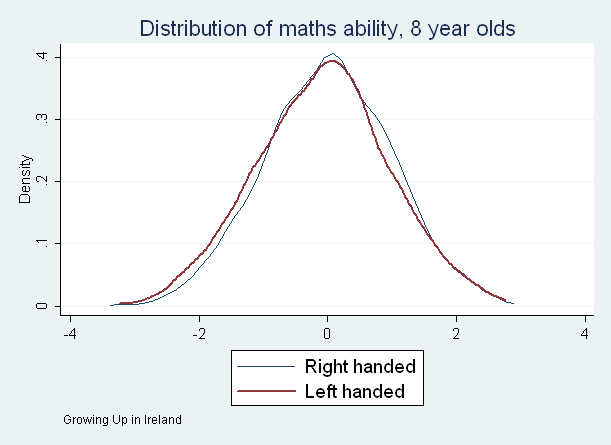
So what can we say? Below I plot the density of attainment at a maths test that the 8 year olds in GUI sat.
Sadly, if you are a ciotóg, you can see the distribution is shifted to the left - but not by much. The good news is that when you look at the distribution of reading ability, there is no difference at all.
In numerical terms, left-handers are about 8% of a standard deviation lower. By comparison girls are about 11.5% of one standard deviation lower.

Sunday, October 3, 2010

Are some Irish mothers "too posh to push"?

The use of C-section to deliver babies has tended to go up over time and has generated some concern. It is, after all, a significant operation and can have negative consequences. For example mothers are less likely to breastfeed after a C-section.

It is sometimes argued that mothers elect to have C-sections as they are “too posh to push”. Leaving aside the question of whether this is a good or bad thing: is it actually true? Using the Growing Up in Ireland data I estimate some simple probit models predicting the probability of elective and emergency c-sections. Household income (equivalised & in log form) is positively associated with having a C-section. But the coefficient for emergency c-section is almost twice as big as that of elective. This doesn’t fit in with a simple story of affluent mothers choosing to have c-section. I have no idea why income would have such an effect on emergency C-sections.

Mother’s education, interestingly, seems to have no effect (& remember education is generally seen as a better measure of socio-economic status than income) nor does a measure of social class (not shown here) nor does whether the mother smoke or drank during pregnancy. Factors that do predict a c-section include the mother’s BMI and her age (for the elective case) and the baby’s birth-weight (for the emergency case). Clearly many other factors may influence these outcomes & not all of which are in this data.

So while there is clearly a connection between how well-off a mother is and whether she delivers via a C-section its not at all clear that it is a simple case of "money talks".


(1)

(2)


elective

emergency

log income

0.0168*

0.0292***


(2.41)

(3.96)


mother's educ

-0.00209

0.00246


(0.73)

(0.81)


birthweight

-0.0101

-0.0322***


(1.77)

(5.20)


born on time

0.0693***

-0.0590***


(8.73)

(6.58)


" early

0.193***

-0.00267


(7.86)

(0.23)


" very early

0.126*

0.214***


(2.44)

(4.26)


partner

0.0186

-0.0114


(1.82)

(0.96)


girl

-0.00154

-0.0202**


(0.24)

(2.95)


Mothers BMI

0.00346***

0.00427***


(5.32)

(6.22)


" smoke

-0.00852

-0.00414


(1.62)

(0.78)


" drink

-0.0121

-0.00234


(1.93)

(0.35)


Age

0.00565***

-0.000325


(8.71)

(0.48)

N

7020

7020

pseudo R2

0.065

0.055

Marginal effects; Absolute t statistics in parentheses

* p<0.05,**p<.01,***p<.001


Tuesday, August 24, 2010

Social class and educational attainment of Irish children

It is well known that children from high SES backgrounds do much better in school and this explains, at least proximately, the very sharp SES gradient with regard to university entrance. Or, to put it in English, working class kids get, on average, much worse Leaving Certs and this is why they are much less likely to get to uni' and certainly less likely to get into the more remunerative professional programs. The recent hullaboloo about "Free fees" , on the occasion of my paper on the subject, more or less ignored this inconvenient truth.
But when in the lifecycle does disadvantage set in? Clearly it doesn't just happen at 18. The Growing up in Ireland data allows us to take a snapshot of this gradient when children in Ireland are about 9 years of age.

This graphs the mean maths score by household social class and one can clearly see a pronounced association. Social class is based on the highest class of the two parents - if there are two around. Even at age 8 or 9 coming from a professional/managerial household makes a big difference. Alternatively one could look at the education of the primary carer (usually the mother):

Its still the same old story: if your parents have low education then you are at a considerable disadvantage. Doing some simple multivariate modelling, both factors have an independent effect, as does income and other variables. Girls do worse for example though as is well known the reverse seems to be the case when it comes to doing the Leaving Cert.
To get an idea of the magnitudes involved, the mean and standard deviation of the maths test (which is the Drumcondra test) are respectively-0.64 & 0.92 respectively. When one does the regressions one finds that a child of a graduate mother can expect a score that is about .5 higher than a child of a mother with only minimum education (so about 55% of a std dev). For social class the gradient is flatter: the average difference between the top and bottom social classes is about .26. By comparison, the "penalty" to being a girl is 0.1.
Whether the childrens subsequent education exacerbates or reduces this pattern we cannot say. But Jim Heckman, for example, has argued strongly in favour of dynamic complementarities i.e. that learning begets learning which implies that, if anything, early inequalities get worse over time.
So one lesson from all this is I think, that early intervention is necessary if we are serious about addressing socio-economic inequalities in education. Alls we need to do is get serious about it.